Contractor Payment Terms That Get You Paid (Plus a Clause to Copy)
Deposits, milestones, due dates and late fees, set before the job starts. See how terms change the cash you float on a $12,000 remodel, then copy the clause.
Good contractor payment terms say four things: how much you get before you start, how much you get at each milestone, when each invoice is due, and what happens if it's late. For residential work that usually means a deposit within your state's limit, progress payments tied to finished work, and a short due date like 7 days.
The rule: never let your money on the job get far ahead of the customer's money.
On a $12,000 remodel with $4,000 of materials bought in week one, a 10% deposit plus a 30% payment when demo is done means you float $2,800 for about a week. Paid at completion on net 30, you float $4,000 for about eight weeks.
Payment terms are where your cash flow gets decided. You set them before the job, on the estimate and the contract, not on the final invoice when it's too late to change them.
This guide is for trade contractors billing homeowners for residential work, with a short section for subs working under a general contractor. All amounts are in US dollars and the example is hypothetical.
Deposit and cancellation rules vary by state, so we link the official sources and tell you where to check. This isn't legal advice; have your contract reviewed for your state.
1. What are contractor payment terms?
Contractor payment terms are the part of your estimate and contract that set when and how the customer pays: the deposit, the payment schedule, the due date on each invoice, the payment methods you accept, and any late fee. The customer agrees to them before work starts, and every invoice after that follows them.
On the job, that's six lines in the contract:
- Deposit: how much, due when.
- Payment schedule: what you get paid at each milestone.
- Due date: due on receipt, 7 days, net 30.
- Change orders: approved in writing, billed with the next payment.
- Payment methods: card, bank transfer, check.
- Late payment: what happens after the due date, if your state allows a fee.
2. How much deposit can a contractor ask for?
Whatever your state allows, and no more than you need to start the job. Some states cap it, some don't.
- California: a home improvement down payment can't be more than $1,000 or 10% of the contract price, whichever is less. Other payments must be listed in the contract and based on work completed or materials delivered, per the Contractors State License Board.
- Maryland: a home improvement contractor can't take more than one-third of the contract price as a deposit, and can't take any payment until the contract is signed, per the Maryland Home Improvement Commission. Beyond the deposit, the schedule is up to you and the homeowner.
- Everywhere else: check your state's contractor board before you write a percentage into your estimates. Rules change and some cities add their own.
One federal rule catches contractors who sell at the kitchen table. Under the FTC's Cooling-Off Rule (16 CFR Part 429), a customer who signs at home for $25 or more can cancel until midnight of the third business day after the sale, and you have 10 business days to refund their payments.
Bona fide emergencies the customer documents, and repair or maintenance visits the customer asked for, are excluded; extra work you sell on that visit isn't. Either way, don't order non-returnable equipment the afternoon you sign.
3. What's a fair payment schedule for a residential job?
A small deposit, then payments tied to milestones the customer can see, then a final payment at the walk-through. Each payment should cover work that's done or materials that are on site.
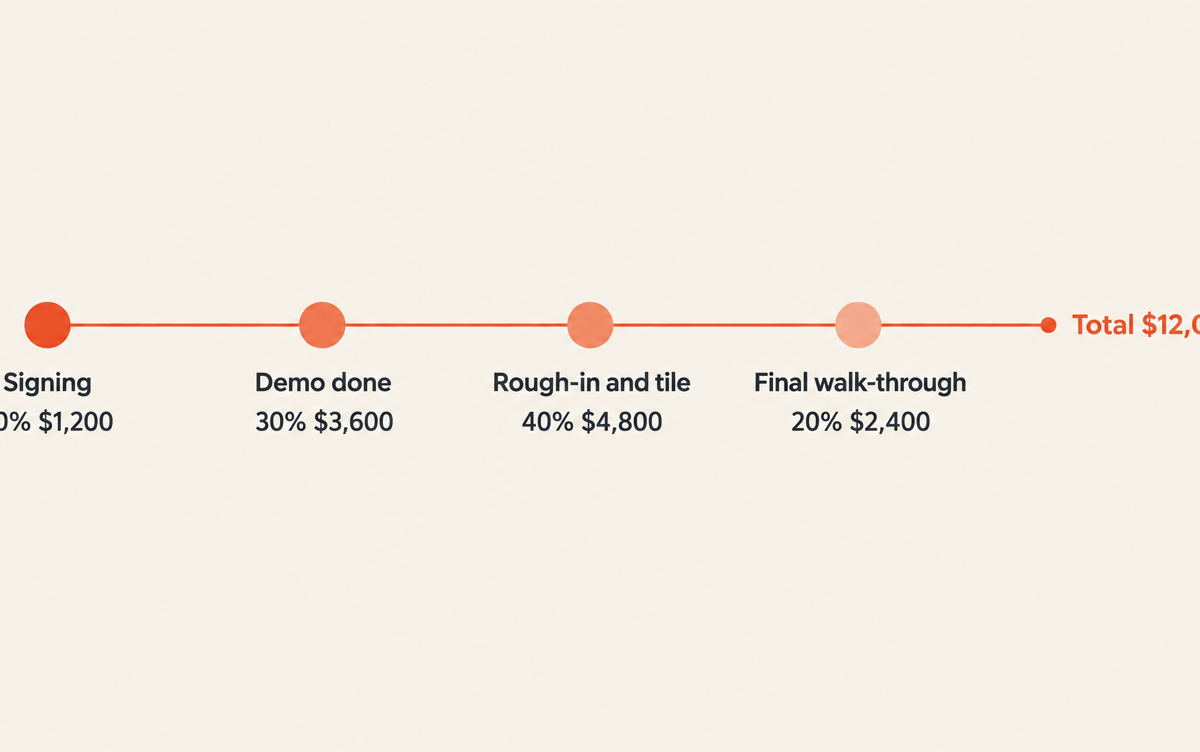
For a hypothetical $12,000 bathroom remodel that takes four weeks:
| Milestone | Share | Amount | Week |
|---|---|---|---|
| Contract signed (deposit) | 10% | $1,200 | 0 |
| Demo done, materials delivered | 30% | $3,600 | 1 |
| Rough-in and tile done | 40% | $4,800 | 3 |
| Final walk-through | 20% | $2,400 | 4 |
| Total | 100% | $12,000 |
Small jobs don't need a schedule. A $400 repair is one invoice, due on receipt. Once you're buying materials or the job runs more than a week, milestones protect you.
Milestones beat dates. "When tile is done" can't be argued with. "Week three" can, the minute the inspector is late.
4. Worked example: how much cash you float on a $12,000 job
Same hypothetical remodel: $12,000 contract, four weeks, $4,000 of materials bought in week one. The question is how much of your own money is in the job before the customer's money shows up.
| Payment terms | Paid before materials | You float | For about |
|---|---|---|---|
| Paid at completion, net 30 | $0 | $4,000 | 8 weeks |
| 10% deposit, then the schedule above | $1,200 | $2,800 | 1 week |
| California: $1,000 deposit, then progress payments | $1,000 | $3,000 | 1 week |
| Maryland: deposit up to one-third | $4,000 | $0 | 0 weeks |
The math: $4,000 of materials minus whatever the customer paid before you bought them. On net 30, the money arrives four weeks of work plus 30 days later, so call it eight weeks.
In California, 10% of $12,000 is $1,200, which is over the $1,000 cap. So the deposit is $1,000, and the week-one payment has to match work done or materials delivered.
Run that job three times a year on completion terms and you've fronted $12,000 of materials for your customers. Interest-free.
5. Due on receipt, net 30 or 2/10 net 30: which due date should you use?
Due on receipt or 7 days for homeowners. Net 15 or net 30 for property managers and commercial customers who pay on a cycle. Write the actual date on the invoice, not just the term.
- Due on receipt: pay when you get it. Best for small jobs and final payments.
- Net 7, net 15, net 30: payment due 7, 15 or 30 days after the invoice date.
- 2/10 net 30: 2% off if paid within 10 days, otherwise the full amount in 30. On a $2,400 final payment, that's $48 off, so $2,352 if they pay fast.
An early-payment discount only makes sense if getting paid three weeks sooner is worth more to you than $48. Do that math for your shop before you offer it.
6. Can you charge a late fee, and what if they still don't pay?
Yes, if the late fee is in the contract the customer signed and your state allows the rate. A fee you add after the fact starts an argument, not a payment.
Write it as a rate: 1.5% per month on a $2,400 balance is $36 a month. Check your state's limit before you use that number.
Then follow up on a schedule. A friendly text with the payment link the day after it's due, a call at one week, a written notice at two weeks.
After that, your options are a lien, small claims or collections, and lien rights come with state deadlines that can start early in the job. The full follow-up schedule is in our guide to invoicing as a contractor.
7. Payment terms when you work for a general contractor
Read two clauses before you sign: retainage and pay-when-paid. Both decide when you see your money, and neither is in your control after you sign.
- Retainage: a percentage of each payment the GC holds back until the project is finished. Find out the percentage and exactly what triggers its release.
- Pay-when-paid or pay-if-paid: the GC pays you after the owner pays them. "If" versions can mean you don't get paid at all if the owner doesn't. How these clauses hold up depends on your state.
Price the wait. If you'll get 90% now and the rest months later, that's working capital you're lending.
8. A payment terms clause you can adapt
Copy this into your estimate or contract, swap in your numbers, and have it checked against your state's rules.
Payment terms. Contract price: $12,000.
Deposit: $1,200 due at signing, or the maximum your state allows, whichever is less. No work or material orders before the deposit is received.
Progress payments: $3,600 when demolition is complete and materials are delivered; $4,800 when rough-in and tile are complete; $2,400 at the final walk-through.
Each payment is due within 7 days of the invoice date.
Change orders are priced and approved in writing before the work starts and are billed with the next payment.
Accepted payment methods: card, bank transfer or check.
Late payments: [late fee at a rate your state allows] on balances more than 7 days past due.
Put the same terms on the estimate, the contract and every invoice. When all three say the same thing, nobody can claim they didn't know.
In WinPal you can invoice from your phone and let clients pay online, which takes "I'll mail a check" off the table. See what a plan costs on the pricing page.
Common questions about contractor payment terms
What are typical payment terms for contractors?
For residential work: a deposit within your state's limit at signing, progress payments at milestones the customer can see, and a final payment at the walk-through, each due on receipt or within about 7 days. Commercial customers and property managers often pay net 15 or net 30. Put the terms on the estimate first.
Can a contractor ask for 50% upfront?
It depends on your state. California caps home improvement down payments at $1,000 or 10%, whichever is less, and Maryland caps deposits at one-third of the contract price. Where there's no cap, 50% upfront still makes customers nervous. A smaller deposit plus a payment when materials arrive covers you just as well.
How long does a customer have to pay a contractor?
As long as your payment terms say. If the invoice says due on receipt, it's due now; net 30 means 30 days from the invoice date. Write the actual due date on every invoice. If there are no written terms, you're negotiating after the fact, which is the worst time.
What does net 30 mean on a contractor invoice?
Net 30 means the full balance is due 30 days after the invoice date. It's common with commercial customers and property managers who pay on a monthly cycle. For homeowners it mostly just delays your money. Write the actual date, like "due November 9", because nobody counts days.
Should you take a deposit before ordering equipment?
Yes. When you're ordering expensive equipment before the job, get the deposit before you order, within your state's limit, and wait out any cancellation window first. Our guide to pricing HVAC jobs shows $3,600 of equipment on a $7,090 install.
What to do before your next estimate goes out
Write your payment terms once: deposit, milestones, due date, change orders, methods, late fee. Check them against your state's rules. Then paste them into every estimate, so the invoice is never the first time the customer sees them.
Want estimates and invoices that carry the same terms, sent from your phone? Get started with WinPal.