How to Price Electrical Jobs: Residential Work From Wage to Flat Rate
From a $30 wage to a $1,225 flat rate: one 50 amp garage circuit priced line by line, plus the bid checklist that keeps a full panel from eating your margin.
To price electrical jobs, count every hour the job takes (drive and inspection included), multiply by what an hour really costs you with overhead, and divide by one minus your margin. Then add materials at cost plus a markup, and the permit as a pass-through. For work you do every week, round that number into a flat rate and write the exclusions down.
Electrical job price = hours × (loaded wage + overhead) ÷ (1 − margin) + materials × (1 + markup) + permit.
A 50 amp circuit and outlet in a garage: 5 hours × $70 ÷ 0.75 = $467 for labor, $506 of materials × 1.25 = $633, plus a $125 permit. $1,225.
That's the method for residential electrical work. The hard part isn't the formula. It's the hours you forget to count and the panel you didn't look at before you quoted.
This guide is for the electrician with one or two trucks doing residential service and small remodel work. All amounts are in US dollars and the example is hypothetical.
Wage, burden and material prices come from published sources linked as we go. Overhead, small parts and the permit fee are assumptions you'll swap for your own numbers.
1. What goes into the price of an electrical job?
Five things: your hours, what each hour costs you, the overhead each hour has to carry, materials, and the profit you decide to keep. Permits ride on top. It's the same math we use to price a water heater swap, with a breaker panel instead of a gas line.
Where electricians lose money is rarely the wire. It's the hour they spent driving back for the inspection, and the job where the panel had no open spaces.
2. How much should an electrician charge per hour?
Start from your wage, add about 30% for taxes and insurance, add your overhead per billable hour, then divide by one minus your margin. With the numbers below, that's $70 an hour of cost and about $93 an hour billed.
The BLS median wage for electricians was $30.38 an hour in May 2025. Across private industry, benefits are 30.0% of total compensation (BLS, June 2026). Use that as your burden for payroll taxes, insurance and the rest.
$30.38 plus 30% is $39.49. Call it $40 an hour loaded.
Now the part people skip: not every hour is billable. ServiceTitan calls 30% billable a good efficiency rate for service techs and 50% extremely efficient. A solo electrician who also quotes, drives and buys parts lands somewhere in there.
We'll assume 1,000 billable hours a year, about 48% of a 2,080-hour year. Put $30,000 of overhead (truck, insurance, license, tools, phone, software) over those hours and every billable hour carries $30 of overhead. That's an assumption; a newer truck pushes it up.
$40 loaded plus $30 overhead is $70 an hour of cost before any profit. Want your own number instead of ours? Run it through the contractor hourly rate calculator.
3. Hourly, flat rate or per opening: which pricing method fits?
Flat rate for service work you've done many times. Hourly (time and materials) for troubleshooting and anything you can't see yet. Per opening for new work and remodels where you can count the boxes.
- Flat rate. Outlets, fixtures, dedicated circuits, EV chargers, panel swaps. The customer gets a firm number and you keep the upside when you're fast. You carry the risk when it runs long, so the exclusions matter.
- Hourly. Diagnosing a dead circuit, tracing a tripping breaker, old houses with surprises in the walls. The customer carries the risk, so expect more questions before the yes.
- Per opening. A set price per box (outlet, switch, light) on a remodel or addition, plus panel and service work priced separately. Work out the per-opening number from the same hourly cost, not from what the other guy charges.
Published residential rates give you a sanity check, not your price. Housecall Pro lists $60 to $90 an hour for journeymen and $90 to $100 and up for masters.
4. How much should you mark up electrical materials?
Pick a markup you can defend and use it every time. We use 25% in the example. Charge more on cheap small parts, because a $3 connector at 25% doesn't pay for the trip to get it.
Watch the markup and margin trap. A 20% markup on $1,250 of cost gets you $1,500, which is a 16.7% margin, not 20%.
A real 20% margin is $1,250 ÷ 0.80 = $1,562.50. If you think in margin but price in markup, you're short on every job.
The profit margin calculator converts one to the other if you don't want to do it in your head. And don't stack both: a 25% margin on top of a 25% markup on a $166 breaker makes your price look strange for no reason the customer can see.
5. Worked example: pricing a 50 amp EV circuit in a garage
The job (hypothetical): add a 240V, 50 amp circuit with a surface-mounted NEMA 14-50 outlet in an attached garage, about 35 feet of cable from the panel. The panel has two open spaces and the service has room for the load.
Code note before you price it: since the 2020 NEC, 210.8(A) covers 125 to 250 volt receptacles in dwelling garages, per Leviton's summary of the 2020 changes. Where that code is adopted, this outlet needs GFCI protection, so the example uses a GFCI breaker. Check what your jurisdiction has adopted.
First, the hours:
| Time | Basis | Hours |
|---|---|---|
| On site: mount outlet, run and secure cable, install breaker, terminate, test, label | assumption | 3.5 |
| Drive, both ways | assumption | 0.75 |
| Return trip for the inspection | assumption | 0.75 |
| Billed hours | 5.0 |
Then the price:
| Line | Basis | Amount |
|---|---|---|
| Labor and overhead | 5.0 hr × ($40 + $30) | $350 |
| At 25% margin | $350 ÷ 0.75 | $467 |
| Cable | Southwire 50 ft 6/3 NM-B, $294.99 at Ace | $294.99 |
| GFCI breaker | Square D HOM250GFI, $166.35 at SupplyHouse | $166.35 |
| Outlet | Leviton 55050 surface NEMA 14-50, $20.11 at SupplyHouse | $20.11 |
| Small parts | connector, straps, anchors, label; assumption | $25 |
| Materials with 25% markup | $506.45 × 1.25 | $633 |
| Permit | pass-through; assumption | $125 |
| Price | $1,225 |
Material prices are retail list prices checked on October 9, 2026. Your supply-house account price will be different, so use yours.
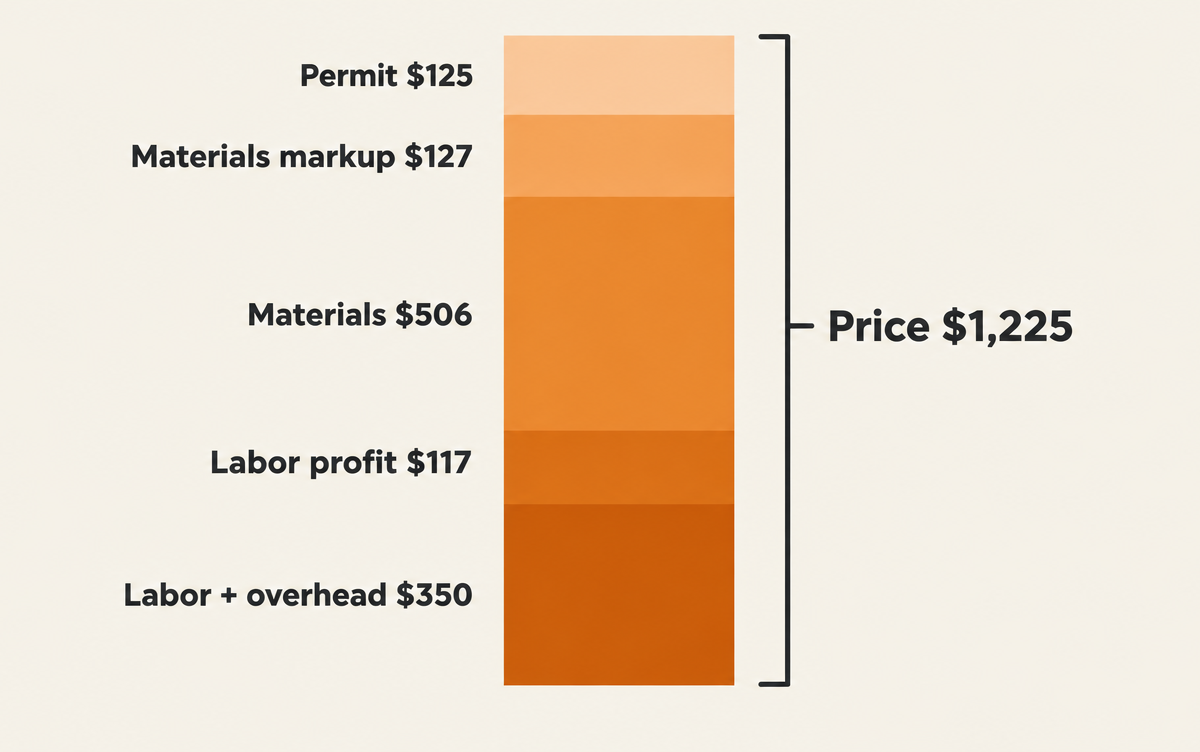
Your profit is $117 on the labor side ($467 minus $350) and $127 on materials ($633 minus $506). That's $244 on a $1,225 job, just under 20% overall.
Is that in the market? Housecall Pro lists $570 to $1,000 to install a dedicated circuit.
You're above that, and the reason is in the materials: $295 of 6-gauge copper and a $166 GFCI breaker. A 20 amp kitchen circuit is a different job.
The hourly equivalent, for when a customer asks: $467 over 5 hours is about $93 an hour for labor, overhead and profit together.
6. How do you turn that into a flat rate?
Round it, say what's included, say what isn't, and reuse it as a line item every time the job comes up.
Our $1,225 becomes: "50 amp garage circuit with NEMA 14-50 outlet, up to 35 ft from the panel: $1,225. Includes GFCI breaker, cable, outlet, permit and inspection. Excludes panel or service upgrades, runs over 35 ft, drywall patching and the charger itself."
Runs past 35 feet need an adder. The cable alone is $5.90 a foot at the Ace price, or about $7.37 marked up, before your extra time.
Why the exclusions matter: if the job runs half an hour long on time and materials, you bill about $47 more. On a flat rate with no exclusion, that same half hour costs you $35 of profit. The surprises that aren't yours belong on the estimate, not in your margin.
7. How to bid electrical jobs so the panel doesn't eat your margin
Look at the panel before you price, put the likely surprises on the bid as separate lines, list the permit, and put an expiry date on it.
- Photos of the panel. The label, the open spaces, the main breaker size. Ask the customer to send them if you can't go out first.
- Check the load. A big new load on an older service needs a load calculation (NEC Article 220) before you promise a price. If the service can't take it, that's a different quote.
- Walk the route. Finished ceiling, unfinished attic, exterior run, concrete? Each one changes the hours.
- Price the "if we find" items. "No open spaces in panel: tandem or subpanel, quoted on site." "Aluminum branch wiring found: quoted separately." Now the surprise is a line the customer already saw.
- Permit and inspection as lines. FieldPulse puts permits and inspections at $75 to $500 or more. Check your city's fee schedule and count the return trip.
- Expiry date. Copper and breaker prices move. Thirty days is plenty.
Not sure your last bid covered all of this? It's the same checklist whether you're a handyman pricing a $400 punch list or wiring a garage.
Common questions about pricing electrical work
How do you price residential electrical work?
Multiply your billable hours by your loaded wage plus overhead per hour, divide by one minus your margin, then add materials at cost with a markup and the permit as a pass-through. For repeat jobs, round it into a flat rate with written exclusions. The worked example above shows a 50 amp circuit priced this way.
How much should I charge for electrical work per hour?
Work it out from your costs. A $30.38 median wage plus 30% burden is about $40, plus $30 of overhead per billable hour is $70, and a 25% margin makes it about $93. Housecall Pro lists $60 to $90 for journeymen and $90 to $100 and up for masters.
How do you bid an electrical job?
Get photos of the panel, check the load, walk the cable route, then price hours, materials and permit with the formula above. Put the likely surprises on the bid as priced options, list what's excluded, and add an expiry date. Send it as line items the customer can read.
What profit margin should an electrician use?
Pick a margin and apply it the same way every time. The example uses 25% on labor and a 25% markup on materials, which came out just under 20% profit on the whole ticket. Remember a 20% markup is only a 16.7% margin.
Should electricians charge a service call fee?
Yes for diagnostic and small service calls, because the drive costs you the same whether the fix takes five minutes or an hour. Housecall Pro puts residential service call fees at $100 to $200, usually billed separately from the hourly rate. Waive or credit it if they book the repair.
What to do on your next electrical estimate
Count the hours including the drive and the inspection trip. Multiply by your loaded cost plus overhead, divide by 0.75. Materials at cost times 1.25, permit as a line.
Then round it, write the exclusions and send it. When the job's done, here's how to invoice it so you get paid.
Sent a bid last week and not sure it was priced right? Upload it to the estimate checker and find out.