How to Price Painting Jobs Without Guessing the Hours
Measure the walls, count the gallons, split the hours, add overhead and margin. A 12x12 bedroom priced line by line, with a $/sq ft check at the end.

To price a painting job, measure the wall area, work out the gallons, split the labor into cut-in and rolling hours, add overhead, then set the price with margin math. That gives you a number you can defend instead of a guess that sounds about right.
Painting job price = (labor + materials + overhead) ÷ (1 − target margin).
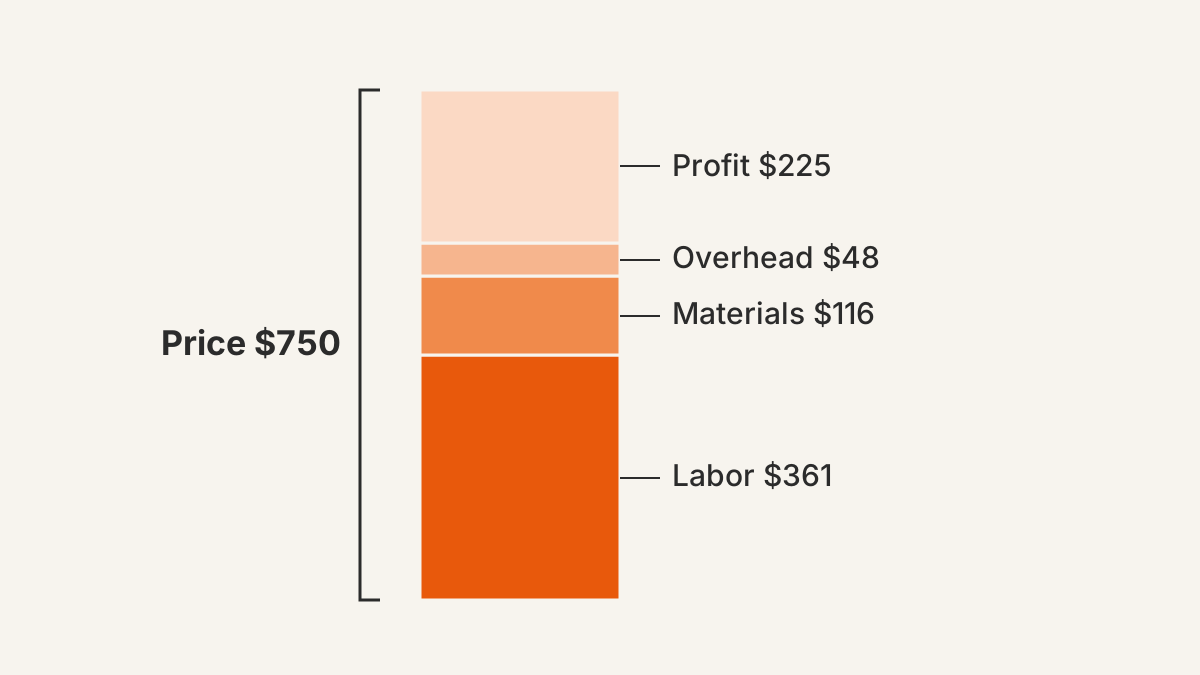
A 12x12 bedroom, walls only, two coats: $525 in costs ÷ 0.70 = $750 at a 30% margin.
Most pricing guides hand you a per-square-foot range and wish you luck. Ranges are useful for a sanity check at the end. They are useless at the start, because they don't know your speed, your paint or your truck.
This guide builds one room from the tape measure up. All dollar amounts are in US dollars. The example is hypothetical: the coverage and production figures come from published sources (linked as we go), the rates and material prices are assumptions you should replace with your own.
1. What's the formula for pricing a painting job?
Price equals your costs divided by one minus the margin you want to keep. Costs are labor, materials and a share of overhead, added up for that one job. Everything after this section is about finding those three numbers for a specific room, then doing the division.
Two things to notice before we start. First, labor is the big one. Home Depot Pro puts labor at roughly 80% of a painting job's cost, and HomeAdvisor says 75 to 95%.
If your hours are wrong, nothing else matters.
Second, "divided by one minus margin" is not the same as "times 1.3". We'll show why in a minute, because it's the most common way painters short themselves by a few hundred dollars a month. It's the same trap we walked through in the handyman pricing guide, and it works the same way for paint.
2. How do I measure a room for a painting estimate?
Perimeter times wall height, minus doors and windows. That wall area drives both your gallons and your hours, so get it from a tape measure, not from the customer's guess.
Our example room: 12 ft by 12 ft with 8 ft ceilings. One door, one window.
| Measurement | Math | Result |
|---|---|---|
| Perimeter | 12 + 12 + 12 + 12 | 48 ft |
| Gross wall area | 48 ft × 8 ft | 384 sq ft |
| Door (3 ft × 6 ft 8 in) | subtract | 20 sq ft |
| Window (3 ft × 4 ft) | subtract | 12 sq ft |
| Net wall area | 384 − 20 − 12 | 352 sq ft |
One habit that pays off: also count the linear feet you'll cut in by hand. Ceiling line (48 ft), baseboard line (48 ft), door frame (about 16 ft) and window frame (about 14 ft) come to roughly 126 linear feet per coat. Cutting in is slow, and it's the part most people forget to price.
3. How much paint do I need?
Net wall area times coats, divided by the coverage printed on the can, rounded up. Don't use "a gallon does 400 square feet" as gospel. Check your product.
Sherwin-Williams' data sheet for Emerald Interior lists 350 to 400 sq ft per gallon per coat. Benjamin Moore's sheet for Regal Select says 400 to 450. Both recommend two coats for full color and performance on most jobs.
For our room: 352 sq ft × 2 coats = 704 sq ft of coverage. At 350 to 400 sq ft per gallon, that's 1.8 to 2.0 gallons.
Buy two gallons and expect to run close to the line if the can says 350. Leftover goes to the customer for touch-ups, which they'll thank you for.
Primer changes the math. You need it on bare drywall, patched areas sanded to bare substrate, stains, glossy surfaces and big color changes, per Benjamin Moore's contractor guidance.
Previously painted walls in good condition, similar color: no primer. That's our example.
Materials for the room, using retail pricing (Behr Premium Plus at $37.98 a gallon on Sep 21, 2026; your contractor account will do better):
- Paint: 2 gallons × $38 = $76
- Sundries (tape, plastic, roller covers, spackle): $40, an assumption
- Materials: $116
4. How many hours will the job take?
Split it. Cut-in by the linear foot, rolling by the square foot, then prep and cleanup as their own lines. Guessing "about a day" is how the day becomes a day and a half you don't get paid for.
There's no free industry-standard production table.
What exists are published contractor figures: Home Depot Pro uses 150 sq ft per hour for rolling walls. Prosperity Painting's calculator, built from timing their own crews, uses 40 linear feet per hour for a careful hand-cut line and about 280 sq ft per hour for a second rolled coat. Painters Academy quotes 120 sq ft per hour for brush and roll.
Treat these as starting points and time yourself on the next three jobs. Your number beats theirs.
| Task | Basis | Hours |
|---|---|---|
| Move furniture, protect floor, patch and sand | assumption | 1.5 |
| Cut in, coat 1 | 126 lnft at about 60 lnft/hr, a practiced hand | 2.1 |
| Roll, coat 1 | 352 sq ft at 150 sq ft/hr | 2.3 |
| Cut in, coat 2 | faster over fresh paint | 1.6 |
| Roll, coat 2 | 352 sq ft at 280 sq ft/hr | 1.3 |
| Cleanup, put the room back, walkthrough | assumption | 0.5 |
| Total | 9.3, call it 9.5 |
Sanity check: HomeGuide puts an average room at 6 to 10 hours including prep and cleanup. We're near the top because we priced a careful cut line and two full coats.
If your number lands at 14, look for a task you double counted. If it lands at 5, you forgot the prep.
One more thing: Sherwin-Williams lists a four-hour recoat wait for that product. Two coats means one long day or two visits. Price the drive if it's two.
5. What hourly rate should I use for labor?
Your loaded cost: what you pay yourself per hour plus taxes and insurance. Not the number a competitor charges. Not the number you'd like to charge.
The margin gets added later, on purpose, so you can see it.
The BLS median wage for painters was $23.75 an hour in May 2025. A solo operator who pays himself $30 an hour and adds about 25% for self-employment tax and insurance is at roughly $38 loaded.
We'll use $38. Yours may be higher, and that's fine, as long as it's your real cost.
Labor: 9.5 hours × $38 = $361.
6. What about overhead and profit?
Overhead is the stuff that doesn't show up on any one job: truck, insurance, phone, software, ladders, the hours you spend quoting. Benjamin Moore and Jobber both suggest about 10% of job costs as a simple starting point. The better method once you have a year of numbers: total overhead divided by billable hours, added to your hourly rate.
Overhead for our room at 10%: ($361 + $116) × 0.10 = $48. Total cost: $361 + $116 + $48 = $525.
Now profit, and the part that trips people up. If you want to keep 30% of the price as profit, you divide by 0.70, you don't multiply by 1.30.
- Divide: $525 ÷ 0.70 = $750. Profit $225. That's a 30% margin.
- Multiply: $525 × 1.30 = $682.50. Profit $157.50. That's a 23% margin, even though you called it 30%.
Same job, $67.50 difference. Over a year of rooms, that's a used truck. Pick the margin you want and use the divide formula every time.
7. Worked example: pricing a 12x12 bedroom, walls only
Everything above in one place. Two coats, previously painted, similar color, no primer, no ceiling, no trim.
| Line | Basis | Amount |
|---|---|---|
| Labor | 9.5 hr × $38 loaded | $361 |
| Materials | 2 gal paint + sundries | $116 |
| Overhead | 10% of labor and materials | $48 |
| Total cost | $525 | |
| Price at 30% margin | $525 ÷ 0.70 | $750 |
| Profit | $750 − $525 | $225 |
Add a ceiling, trim, a dark-to-light color change or a second room and each becomes its own line with its own hours. Don't fold them into "and a little extra." That's how extras become free.
8. Is my price in line with what painters charge?
Convert it to dollars per square foot and compare with published ranges. If you're far outside, check your hours before you touch your margin.
$750 ÷ 352 sq ft of wall = $2.13 per sq ft of wall. HomeGuide's published range for interior painting is $1 to $3 per square foot, and their walls-only figure for a 12x12 room is $380 to $1,400.
We're in the middle. Good.
Watch the trap here: some sources quote per square foot of floor, not wall. HomeAdvisor's $2 to $6 per square foot is applied to home size in its cost table (a 1,000 sq ft home runs $2,000 to $6,000), so that's floor area; its walls-only figure is about $2.75 per square foot. Our room is 144 sq ft of floor, so $750 works out to $5.21 per floor square foot, which also lands inside their range.
Same job, two numbers, both "right." Always say which one you mean on the estimate.
9. Should I price per square foot, per hour or per room?
All three should reconcile to the same formula. The difference is what you show the customer and how much risk you carry.
- Per room or per job (flat): best for defined scope like our bedroom. Customer sees one number, you keep the upside if you're fast.
- Per square foot: best for whole-house repaints and quick quotes. Build the rate from your own costs the way we just did, then apply it.
- Hourly: best for open-ended repair work where you can't see the whole scope. Customer carries the risk, so expect more questions.
Whichever you pick, the estimate itself should still show line items: prep, walls two coats, materials, extras. When a customer asks to add the ceiling, it's a line, not an argument.
Common questions about pricing painting jobs
How do I quote a painting job?
Measure the walls, count the gallons from the can's coverage, split the hours into cut-in and rolling plus prep, add overhead, then divide costs by one minus your margin. Write the result as line items with what's included and what's not, and put an expiry date on it.
How do painters typically price jobs?
Most use a flat price per job for defined scope, built from a per-square-foot rate or a labor-hours estimate. Hourly pricing is common for repair-heavy work. Published interior ranges run about $1 to $3 per square foot of wall (HomeGuide) or $2 to $6 per square foot of home size (HomeAdvisor), which is why you should say which one you mean.
How much would a painter charge to paint a 12x12 room?
HomeGuide lists $380 to $1,400 for walls only and $770 to $2,900 with trim and ceiling. Our worked example lands at $750 for walls, two coats, at a 30% margin. Your number depends on your speed, your rate and what's included.
How do you price a painting job by the square foot?
Build the rate from a job you've already costed: price divided by wall area. Our example gives $2.13 per square foot of wall. Then apply it to the next room and adjust for ceilings, trim, color changes and repairs, which all add hours.
Do I charge for two coats?
Yes, and say so on the estimate. Two coats is what the paint manufacturers specify for full coverage, and the second coat is real hours and real gallons. If a customer wants one coat, price one coat and write "one coat" next to it so the callback isn't on you.
What to do on your next painting estimate
Measure, count gallons, split the hours, add 10% overhead, divide by 0.70. Then look at the dollars per square foot and see if it feels like the market. If it does, send it as line items, not one lump.
The same method works for any trade. We walked through it for a $400 handyman job, a 200 sq ft landscaping install and a water heater swap.
Not sure the last estimate you sent was priced right? Upload it to the estimate checker and see where it lands.