How to Price Handyman Jobs Without Selling Yourself Short
Work out your costs, choose a pricing method and build an estimate that pays for the whole job. Includes a worked $400 example.

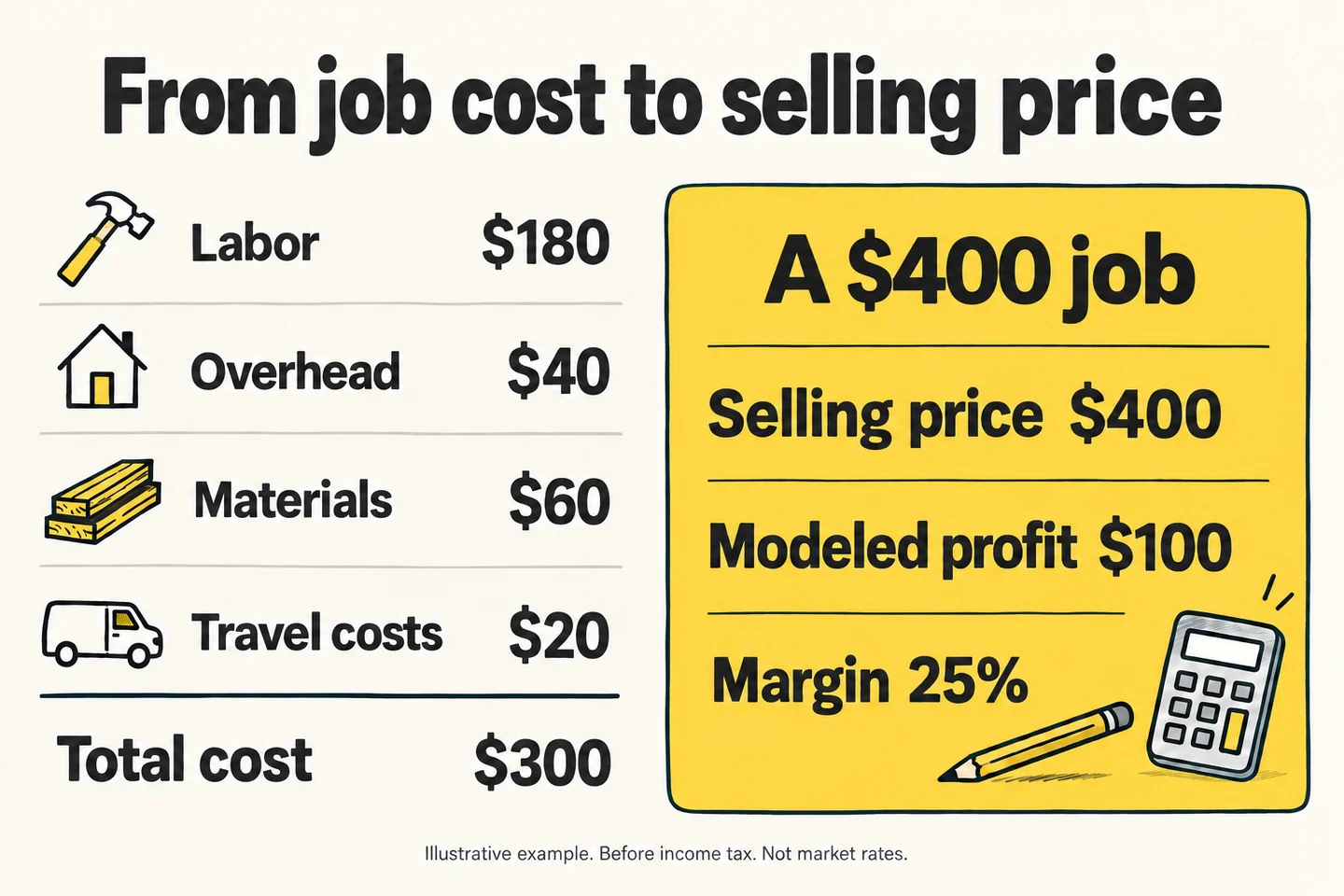
To price handyman jobs, add up your labor, materials, direct job expenses and a share of your overhead. Then calculate a selling price that leaves room for profit.
Handyman job price = total estimated cost ÷ (1 − target margin).
For example, $300 in costs with a 25% target margin gives you a $400 selling price: $300 ÷ 0.75 = $400.
That $300 needs to cover the hardware-store run and cleanup, too. If you only count time with a drill in your hand, part of the job comes out of your pocket.
This guide walks through a small punch-list job, shows the numbers and gives you a checklist for your next estimate. All dollar amounts are in US dollars. The example is hypothetical, not a survey of local handyman rates or a recommended profit target.
1. Define the job before you price it
“A few things around the house” needs a little more detail before it becomes a price. Get a task list, photos, measurements and a clear idea of what the customer will supply. Visit the property when photos can't resolve important unknowns.
For our example, the customer wants you to:
- Adjust two interior doors that rub against their frames.
- Replace four cabinet pulls using the existing holes.
- Install one shelf on a suitable wall.
- Clean up the work areas and remove the small amount of packaging.
Write down your assumptions: the doors and frames are sound, the replacement pulls fit, and the shelf has suitable mounting points. Painting, structural repairs and hidden damage are outside this example's scope.
Decide how you'll handle surprises before starting. If a door needs a new frame, stop and agree on the extra work and price with the customer. A clear scope makes that conversation much easier.
2. Calculate what the whole job costs
Build your estimate from four cost buckets. Use your own records wherever possible instead of copying another handyman's hourly rate.
Labor, including your own time
Count the time to complete the work, pick up materials, travel, coordinate access and clean up. For this job, we'll allow three hours on site and one additional hour for travel, pickup and coordination.
We use $45 per hour as a hypothetical internal allowance for the owner's work. Four hours cost $180. This is a planning input, not the hourly rate shown to a customer, and not a claim about local wages.
If employees do the work, account for their wages and the employer costs that apply to your business. Keep your labor cost separate from the profit you want the business to earn.
Materials and direct job expenses
Include hardware, fasteners, consumables and delivery costs you actually expect to pay. This example allows $60 for materials and $20 for vehicle costs and parking.
The travel hour pays for your time. The vehicle allowance covers a different expense. Check that you haven't also included those same vehicle costs in overhead.
A share of your overhead
Insurance, software, phone service and other business expenses still need paying between jobs. Allocate a realistic share of those costs to your work.
One planning method is monthly overhead divided by the job hours you expect to recover in your prices. If overhead is $1,000 and you expect 100 recoverable job hours, the allowance is $10 per hour. This four-hour job carries $40 of overhead.
Use the same definition of job hours throughout the calculation. Don't assume every working hour will be recoverable, and don't charge the same expense in two buckets.
The SBA's break-even calculator is useful for checking how fixed costs, variable costs and sales prices work together across your business.
3. Choose hourly pricing or a fixed price
Choose the pricing method that fits how well you understand the work. Either way, explain what the customer is agreeing to before you begin.
| Method | When it can fit | What to clarify |
|---|---|---|
| Hourly | Troubleshooting or repair work where the time required is uncertain. | Your rate, any minimum charge, materials, travel charges and when you'll request approval to continue. |
| Fixed price | A clearly defined task or punch list you can estimate with reasonable confidence. | The included work, materials, exclusions and how scope changes are priced. |
A minimum service charge can help cover the time and expense of a small visit. Work it out from your costs and explain it upfront. A 20-minute repair may still require booking, driving and collecting parts.
For our defined punch list, we'll calculate a fixed price. If the condition of the doors or wall is unclear, inspect first or spell out the limits of the estimate.
4. Turn your costs into a selling price
Here's the complete estimate for the example job.
| Cost | Calculation | Amount |
|---|---|---|
| Owner's labor allowance | 4 hours × $45 | $180 |
| Allocated overhead | 4 hours × $10 | $40 |
| Materials | Estimated purchase costs | $60 |
| Vehicle costs and parking | Separate from travel time | $20 |
| Total estimated cost | $180 + $40 + $60 + $20 | $300 |
For illustration, we'll use a 25% target margin after the costs listed above. Enter the percentage as a decimal:
- Selling price: $300 ÷ (1 − 0.25) = $400.
- Modeled profit: $400 − $300 = $100.
- Modeled margin: $100 ÷ $400 = 25%.
This is a pricing model before income tax, not a formal accounting measure of net profit. It includes an allowance for the owner's labor and allocated overhead. Your accounting treatment and actual results may differ.
A 25% markup isn't a 25% margin
Markup is calculated against cost. Margin is calculated against the selling price. QuickBooks explains the difference between markup and margin.
Adding 25% to $300 gives a price of $375. The $75 left over is 20% of $375, so your margin is 20%. To leave 25% of the selling price after the modeled costs, this example needs a $400 price.
Once you've calculated a price, compare it with the value and service you offer and what your customers are willing to pay. If the numbers don't work, revisit the scope, travel radius, purchasing or pricing. A competitor's cheaper quote doesn't make your costs disappear.
5. Check what happens if the job runs long
Before sending a fixed price, test your most important assumptions. What if those doors take an extra hour?
In our model, one more hour adds $45 in labor and $10 in allocated overhead. Estimated costs rise from $300 to $355. At the same $400 price, modeled profit falls to $45, or 11.25% of the selling price.
The extra overhead allocation is a planning allowance; it doesn't mean your monthly insurance bill increases when this particular job runs long. It helps show what happens when the job uses more of your available working time.
For uncertain work, improve the inspection, allow more time or discuss an hourly arrangement. Don't quietly rely on doing everything faster than expected.
6. Send an estimate the customer can understand
Your cost worksheet is for running the business. Your customer needs a clear description of the job, its price and the terms.
Include:
- Your business and customer details, the job address, estimate number and date.
- The specific tasks, quantities and materials included.
- Important assumptions and exclusions.
- The price and any applicable taxes or separately disclosed charges.
- The expected schedule, payment terms and how long the estimate is valid.
- How the customer approves the work and any later scope changes.
Example scope: Adjust two interior doors, replace four cabinet pulls using existing holes, and install one shelf. Includes agreed hardware, installation and cleanup.
Example price: $400 before any applicable taxes. Assumes sound doors, frames and suitable wall mounting points. Painting, structural repairs and hidden damage are excluded. Additional work requires customer approval and a revised price before it begins.
Treat that wording as a scope example, not a complete contract. Add the details and terms that apply to your job.
For a second look at a prepared estimate, try WinPal's estimate checker. It reviews an uploaded estimate; it doesn't replace your inspection, cost records or judgment.
Ready to put the estimate together? See how WinPal handles estimates and invoices, or check WinPal's plans.
7. Compare the estimate with the finished job
After the work is done, record actual hours, material costs, extra trips and any callbacks. Compare those numbers with your estimate while the details are fresh.
Keep notes on what changed. Was the scope incomplete? Did the customer supply the wrong hardware? Did parking take longer than expected? Use that information to improve the next estimate.
A reusable price list becomes more useful when it's built from your completed jobs. Review it when your costs or working conditions change.
Common handyman pricing questions
How much should I charge per hour as a handyman?
Start with the pay you need for your work, the business costs your available job hours must recover and your profit target. Then consider the service, skill and local market you're selling into. The $45 labor allowance in this guide is an internal example, not a recommended customer rate.
Should I charge for picking up materials?
Include the time and direct expenses in your pricing. You can account for them within a fixed price or explain separate charges upfront. Check that you aren't already recovering the same costs elsewhere.
What if the customer supplies the materials?
Remove purchase costs you won't incur, but still account for checking the parts, handling them and installing them. Agree in advance on what happens if something is missing, unsuitable or defective.
Should I discount a handyman job to win the customer?
Check the effect on your numbers first. In this example, a $40 discount reduces the price to $360. With $300 in modeled costs, that leaves $60, a margin of about 16.7%. Offering a smaller scope or combining visits may make more sense than doing the same work for less.
For your next job, start with a written scope and a cost worksheet. Count the whole visit, check the margin and make the estimate easy for the customer to approve.
Same formula, other trades: see it applied to a 12x12 bedroom paint job, a 200 sq ft landscaping install and a water heater swap.