How to Price Landscaping Jobs So the Install Pays and the Mowing Does Too
One formula for installs, a different rhythm for mowing. A 200 sq ft mulch bed with six shrubs priced line by line, plus a per-visit mowing price.
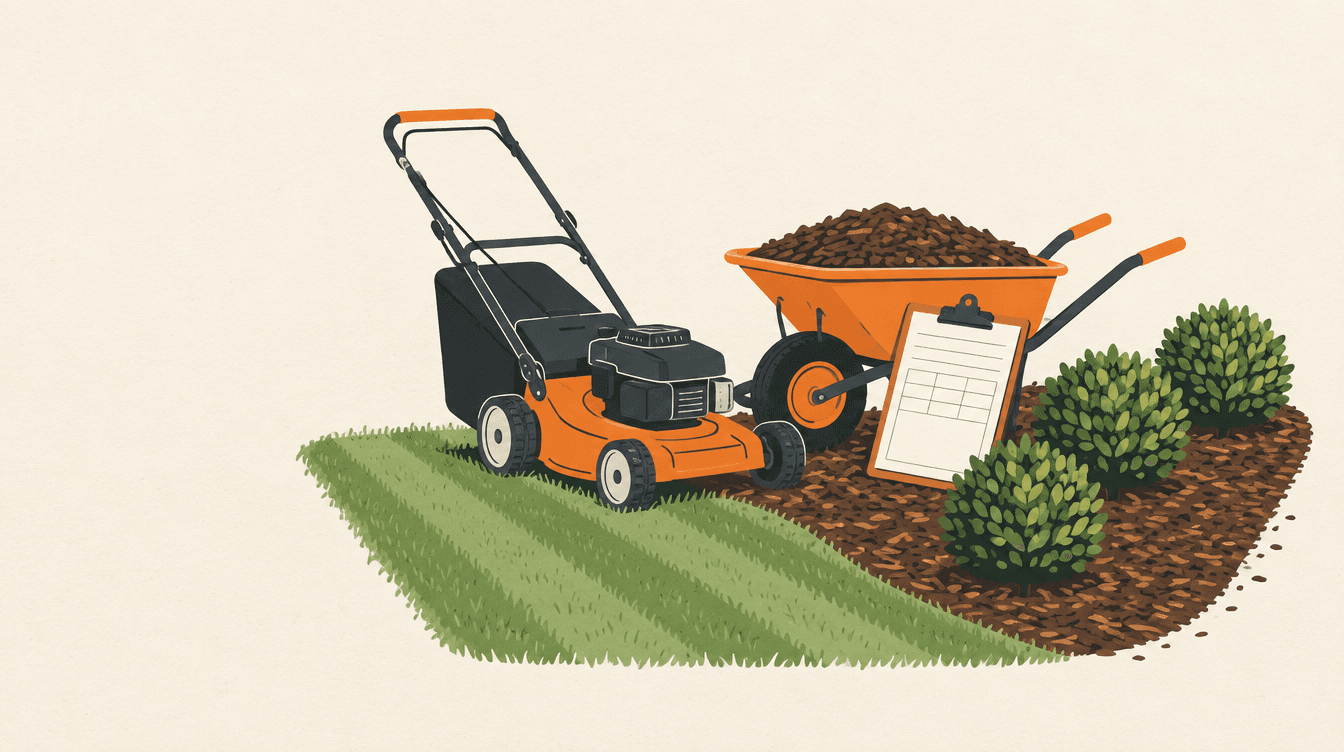
To price a landscaping job, add up your labor hours at what an hour really costs you, materials at cost, disposal and a share of overhead, then divide by one minus the margin you want.
Installs get priced once, per job. Mowing gets priced per visit against a season. Mixing the two is how most solo operators underprice both.
Landscaping job price = (labor + materials + disposal + overhead) ÷ (1 − target margin).
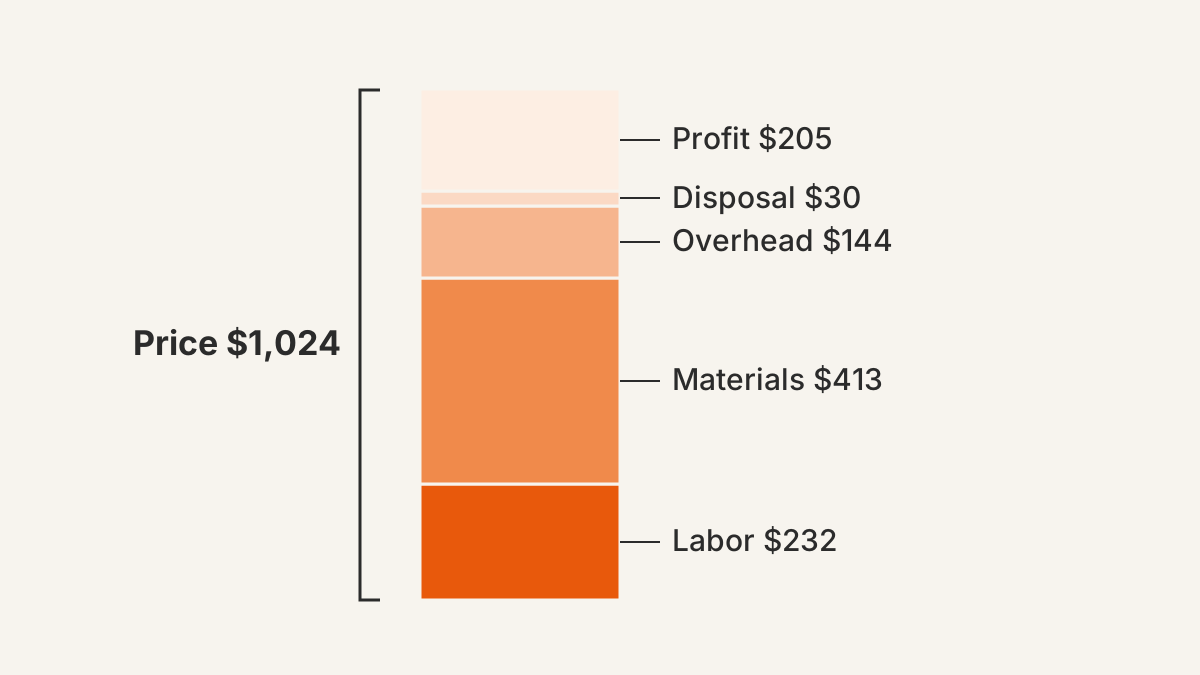
A 200 sq ft mulch bed with six shrubs and edging: $819 in costs ÷ 0.80 = $1,024 at a 20% margin.
Every pricing guide out there agrees on the ingredients. Almost none of them price a job you'd actually do on a Tuesday with one helper.
The one full example we found online is a 240-hour crew job. This one is an eight-hour install and a quarter-acre lawn.
All dollar amounts are in US dollars. The example is hypothetical: coverage figures and rate ranges come from published sources (linked as we go), and the production rates and prices are assumptions to replace with your own.
1. Is an install priced the same way as weekly mowing?
No. An install is a one-time job with materials, disposal and a start and finish, so you price it from cost-plus. Maintenance is a route: you price a visit, multiply by visits in a season, and set a minimum so tiny lots don't eat your morning.
The formula is the same underneath. What changes is where the risk sits.
On an install, the risk is the hours you didn't count. On a route, the risk is the drive between stops. We'll price both.
2. What's the formula for pricing a landscaping job?
Price equals your costs divided by one minus your target margin. Costs are labor at your loaded rate, materials at cost, disposal and a share of overhead. Add the four, divide by 0.80 for a 20% margin, and that's the price. The work is in getting each of the four right for the job in front of you.
A note on "divided by one minus margin," because Grow Group makes the same point and it's worth repeating: a 20% markup on $1,000 of cost gives $1,200, but $200 is only a 17% margin on that price. To keep 20% of the price, you divide by 0.80 and get $1,250.
Markup and margin are different numbers. Decide which one you mean. It's the same trap on a $400 handyman job, just with smaller numbers.
3. How do I figure out my labor rate?
Start with what the hour costs you (wage plus taxes and workers comp), then add overhead per billable hour, then add margin. That's how $60 to $100 an hour becomes normal, not greedy.
The BLS median wage for grounds maintenance workers was $19.27 an hour in May 2025. A solo owner paying himself $22 and adding about 30% for self-employment tax, insurance and comp is at roughly $29 loaded.
That's our labor cost. Not the price. The cost.
Published billed rates for comparison: HomeGuide lists $50 to $100 an hour for a two-person crew; SynkedUP lists $65 to $145 per man-hour, with startups at $65 to $75. When someone on a forum asks whether $100 an hour is too much, the honest answer is "for what, and with what overhead?" We'll get there in the example.
4. How do I count the hours before I've done the job?
Break the job into tasks and estimate each one, then add setup, the drive and the dump run. Then track your actual time, because job two should be tighter than job one.
Published production rates are thin in this trade. SiteRecon's rate guide, developed with the National Association of Landscape Professionals, uses 2.5 cubic yards of mulch per hour hand-spread with a wheelbarrow. For planting shrubs and setting edging we couldn't find a credible published rate, so the example uses assumptions and says so.
Time yourself. Write it down. Three jobs from now you'll have your own table, and it'll be worth more than anyone else's.
5. How much should I mark up plants and mulch?
Published guidance runs 10 to 30% on general materials (Insurance Canopy, citing Jobber, Lawn Love and Angi) and, for plants, about 3 times the retail price installed, which covers the plant, the labor and a warranty (GreenPal). Pick one rule, write it in your price list and stop reinventing it per job.
In the example below we keep it simple: materials go in at cost and the margin covers everything. You could instead price plants as their own marked-up line and run a thinner margin on labor. Both land in the same place if you check the total.
Just don't do both, or your plants get marked up twice and your estimate loses to the guy down the street.
One more line to add: Jobber suggests a 5 to 10% waste allowance on materials. Mulch settles, one shrub arrives root-bound. Round up.
6. Worked example: a 200 sq ft mulch bed with six shrubs and edging
The job: strip a weedy 10 ft by 20 ft bed along a fence, plant six 3-gallon shrubs, install 60 linear feet of edging, mulch 3 inches deep. Solo, one truck, one trailer.
Materials at cost
| Item | Basis | Cost |
|---|---|---|
| Mulch, 2 cu yd | 200 sq ft × 3 in × 0.0031 = 1.86 yd, round up (AgriLife formula); $55/yd, inside HomeGuide's $25 to $100 per yard bulk range | $110 |
| Delivery | within HomeGuide's $50 to $150 range | $75 |
| Six 3-gallon shrubs | $18 each at wholesale, assumption | $108 |
| Edging, 60 lnft | $2/ft, within HomeGuide's $1 to $5 | $120 |
| Materials | $413 |
Labor hours
| Task | Basis | Hours |
|---|---|---|
| Strip weeds and sod, prep the bed | assumption | 2.0 |
| Plant six shrubs | 20 min each, assumption | 2.0 |
| Spread 2 cu yd mulch | 2.5 yd/hr (SiteRecon) | 0.8 |
| Set 60 ft of edging | 40 ft/hr, assumption | 1.5 |
| Cleanup, load debris | assumption | 0.5 |
| Drive to site and the dump run | assumption | 1.2 |
| Total | 8.0 |
The price
| Line | Basis | Amount |
|---|---|---|
| Labor | 8.0 hr × $29 loaded | $232 |
| Materials | at cost, from above | $413 |
| Disposal | one pickup load of sod and weeds at the local dump; $30 is our assumption, check your county's gate fee | $30 |
| Overhead | $18/hr × 8 hr (see below) | $144 |
| Total cost | $819 | |
| Price at 20% margin | $819 ÷ 0.80 | $1,024 |
| Profit | $1,024 − $819 | $205 |
Where the $18 an hour of overhead comes from: take a year of truck payment, trailer, insurance, phone, software, blades and fuel that isn't job-specific. Say $18,000 (an assumption; yours will differ).
Divide by the hours you actually bill in a year, not the hours you work. If you bill 1,000 hours, that's $18 on every billable hour. Jobber uses the same method.
Does the number make sense? Strip out materials and disposal and the customer is paying $581 for 8 hours, about $73 an hour for one person with a truck and a trailer. Compare that with HomeGuide's $50 to $100 for a crew and SynkedUP's $65 to $145 per man-hour.
Right in the range. And now you know why $100 an hour isn't greedy for a landscaper with two employees and a skid steer.
Also compare the pieces: GreenPal lands around $65 per 3-gallon shrub installed and HomeGuide lists mulch installed at $50 to $150 a yard. Six shrubs and two yards at those rates is roughly $490 to $690 before any bed prep, edging or disposal. Our $1,024 with all of that included isn't out of line.
7. How do I price a recurring mowing contract?
Per visit, from the minutes on site plus drive, times your loaded rate, plus an equipment and overhead share, then margin. Multiply by visits in the season to see what the account is worth, and set a minimum stop charge.
A quarter-acre lot. Mow, trim, blow: 35 minutes on site. Drive between stops: 10 minutes. Call it 0.75 hours.
- Labor: 0.75 hr × $29 = $21.75
- Equipment and overhead: 0.75 hr × $18 = $13.50
- Cost per visit: $35.25
- Price at 20% margin: $35.25 ÷ 0.80 = $44 per visit
- Season, 28 visits: about $1,230
Jobber puts a quarter acre at $25 to $60 per visit. We're in the middle, and we know why. If a lot is so small that the visit prices at $28, your minimum stop charge (say $40) applies, because your drive doesn't get shorter when the lawn does.
Route density is the whole game here. Two stops on the same street cut the drive share in half. Price the lonely lot across town higher, or don't take it.
8. What do I put on the estimate the customer sees?
Line items by task, not by hour. "Bed prep and removal, six shrubs installed, 60 ft steel edging, 2 yards hardwood mulch, debris disposal." The customer reads scope, not your timesheet.
Add what's excluded (irrigation repair, plant warranty terms, watering after day one) and an expiry date, because mulch prices move. If you build the estimate in WinPal, those same line items carry over to the invoice from the same job, so there's nothing to retype.
For a route, the estimate is a per-visit price, the visit count, what a visit includes, and what happens in a rainy week.
9. What if the customer says it's too much?
Cut scope, not rate. Four shrubs instead of six. Plastic edging instead of steel. Two inches of mulch instead of three, with a note that it'll need topping sooner.
Your hour is your hour. The moment you discount it, you've told the customer what it's actually worth.
Common questions about pricing landscaping jobs
How do you properly quote a landscaping job?
Walk the site, measure the areas, list the tasks, estimate hours per task, price materials at cost with a waste allowance, add disposal and overhead, then divide by one minus your margin. Send it as line items by task with exclusions and an expiry date.
Is $100 an hour too much for landscape work?
Not if it covers a real cost. A crew of two with a truck, trailer and equipment can have $50 to $60 an hour in labor cost alone before overhead and profit. Published billed rates run $50 to $100 an hour per crew (HomeGuide) and $65 to $145 per man-hour (SynkedUP).
Build yours from your costs and you'll know whether $100 is high or low for you.
How do you charge for landscaping labor?
Estimate hours by task, multiply by your loaded labor cost, add overhead per billable hour, then apply margin. Show the customer tasks, not hours. Hourly billing is fine for open-ended cleanup work where you can't scope it in advance.
How much should I mark up plants?
Common published guidance is about 3 times retail for plants priced installed as their own line, or 10 to 30% on materials generally. Pick one method and don't stack it with your margin, or the plants get priced twice.
Should I charge by the hour or by the job?
By the job for installs with a defined scope, so you keep the upside when you're efficient. Per visit for maintenance routes. By the hour only when the scope can't be known up front, and say so on the estimate.
What to do on your next landscaping estimate
Measure the bed, run the mulch formula, list the tasks, count the hours including the drive and the dump. Materials at cost, disposal as its own line, overhead per billable hour, then divide by 0.80. Send it as tasks.
Same formula, different trade: here's how it plays out on a $400 handyman job, a 12x12 bedroom paint job and a water heater swap.
Want a second opinion on the last estimate you sent? Upload it to the estimate checker and see if it was priced too low.