How to Invoice as a Contractor and Actually Get Paid
What to put on the invoice, when to send it, and how deposits and change orders show up. Includes a worked $4,800 bathroom job with a $3,980 balance due.
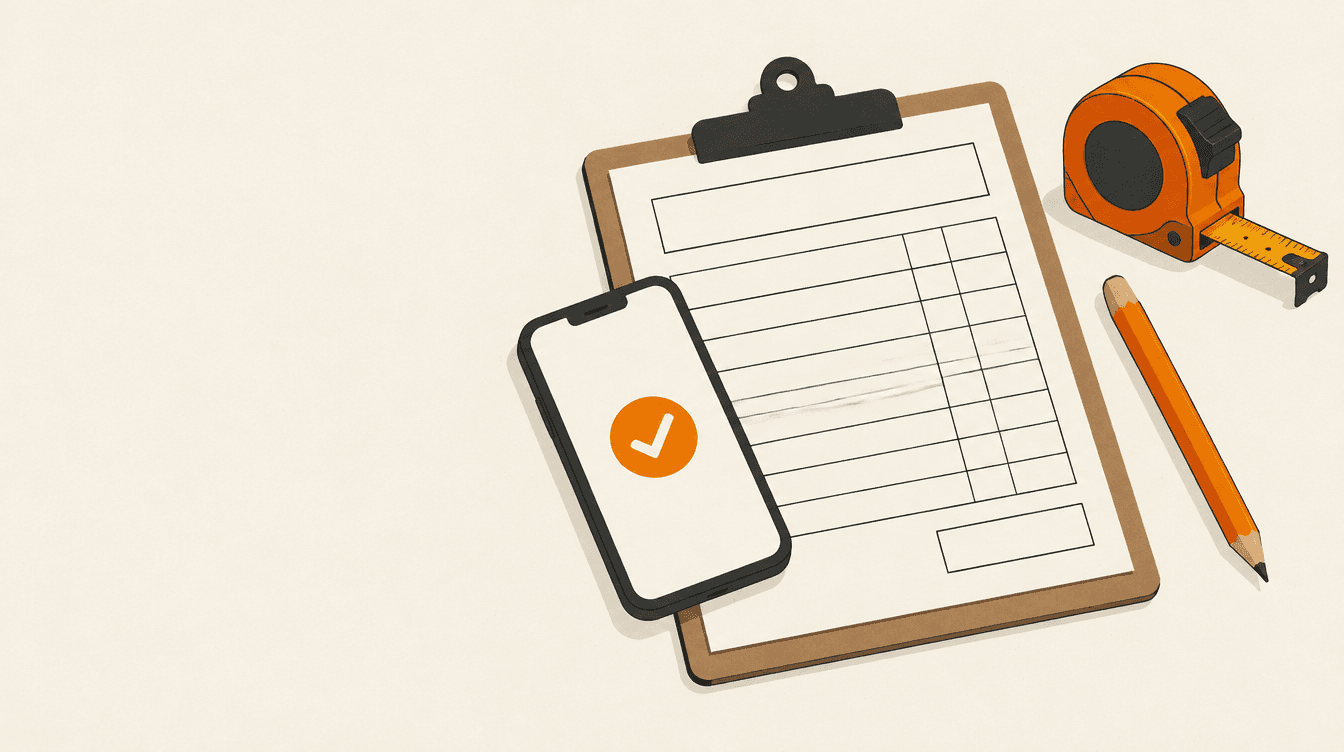
To invoice as a contractor, send the invoice the day the work is done (or the day a milestone is done) and make it match the estimate the customer accepted. Put your business and license details, the customer and job address, an invoice number, the line items, any approved change orders, deposits already paid, tax if your state requires it, the balance due, the due date and how to pay.
Balance due = contract price + approved change orders − payments already received (+ sales tax where it applies).
A $4,800 bathroom refresh with a $380 change order and a $1,200 deposit: $4,800 + $380 − $1,200 = $3,980 due.
The job's done. Now get paid. An invoice that matches the estimate, shows the deposit and arrives the same day gets paid faster than one that shows up two weeks later with a number nobody remembers agreeing to.
This is for trade contractors billing homeowners for residential work: handymen, remodelers, landscapers, electricians, plumbers. If you're a 1099 freelancer billing a company for hours, some of this applies, but deposits and change orders are a trade-contractor problem.
All amounts are in US dollars and the example is hypothetical. Rules on deposits, sales tax and late fees vary by state, so we link the official sources and tell you where to check.
1. What should a contractor invoice include?
Everything the customer needs to pay without calling you, and everything you'd need if the bill were ever disputed. That means who, where, what, how much, by when and how.
- Your business: name, phone, email, and your license number if you hold one. California's contractor board says license numbers should be on all business documents, including contracts (CSLB industry bulletin 20-21). An invoice is a business document. Check your state.
- The customer: name, billing address and the job address if it's different.
- Invoice number and dates: a unique number, the issue date and the due date.
- Reference to the estimate: "Per estimate #1042, accepted on..." so the customer connects this bill to the price they said yes to.
- Line items: the scope in words the customer understands. Labor can be one line; you don't owe anyone your hours on a fixed-price job.
- Change orders: each one as its own line with its number and approval.
- Payments received: deposit and progress payments, shown as credits.
- Tax: if your state taxes labor, materials or both. Tax laws vary by location, so check with your state tax authority (the SBA keeps a list).
- Balance due, terms and how to pay: the number in bold, "due on receipt" or a date, and the payment methods you take.
2. When should you send the invoice?
The same day the work, or the milestone, is finished. Before you leave the driveway if you can.
The customer is happiest standing in the finished bathroom. A week later they're looking at a bill for something that already feels old. Speed is the cheapest collection tool you have.
- Small jobs: one invoice on completion.
- Jobs with materials to buy: a deposit invoice when the estimate is accepted, then a final invoice.
- Longer jobs: progress invoices at milestones written into the contract (demo done, rough-in passed, final walk-through).
3. How do deposits and progress payments show up on an invoice?
Bill the deposit as its own invoice when the customer accepts. On every later invoice, list the full contract price and subtract what's already been paid, so the customer sees the whole picture every time.
Deposits are where state law bites. In California, a home improvement down payment can't be more than $1,000 or 10% of the contract, whichever is less, and progress payments can't run ahead of the work actually completed, per CSLB's contract and payment rules. On a $4,800 job that's a $480 deposit, not $1,200.
Other states set their own limits or none. Check your state's contractor board before you write a deposit percentage into your estimates.
For a bigger job, a progress schedule might look like this:
| Milestone | Share | On a $20,000 job |
|---|---|---|
| Contract signed (deposit) | 5% | $1,000 |
| Demo and rough-in done | 40% | $8,000 |
| Finishes installed | 45% | $9,000 |
| Final walk-through | 10% | $2,000 |
The $1,000 deposit fits under the California cap too. Each invoice in that schedule shows $20,000, the payments so far, and the amount due now.
4. How do change orders show up on the invoice?
As their own lines, each one approved in writing before you did the work. Never fold extra work into the total and hope nobody notices.
The rotted subfloor, the extra outlet, the second coat they asked for on the trim: write it up, price it, get a yes by text or signature, then do it. On the invoice it reads "Change order #1, approved [date], $380." Nobody argues with a line they approved.
The easiest change orders are the ones you saw coming. Price the likely surprises as "if we find" lines on the estimate, the way we do for a water heater swap and a 50 amp garage circuit.
5. Worked example: invoicing a $4,800 bathroom refresh
The job (hypothetical): a handyman replaces a vanity, faucet and toilet, paints, and hangs accessories for an accepted price of $4,800. The customer paid a 25% deposit at signing. Pulling the toilet turned up soft subfloor, and the customer approved a $380 change order by text before the repair.
The final invoice, issued the day of the walk-through:
| Line | Detail | Amount |
|---|---|---|
| Bathroom refresh | Per accepted estimate #1042: vanity, faucet, toilet, paint, accessories | $4,800.00 |
| Change order #1 | Replace about 12 sq ft of soft subfloor behind toilet, approved in writing before work | $380.00 |
| Subtotal | $5,180.00 | |
| Sales tax | Not charged in this example; check your state | $0.00 |
| Less deposit received | 25% of $4,800, paid at signing | −$1,200.00 |
| Balance due | Due on receipt | $3,980.00 |
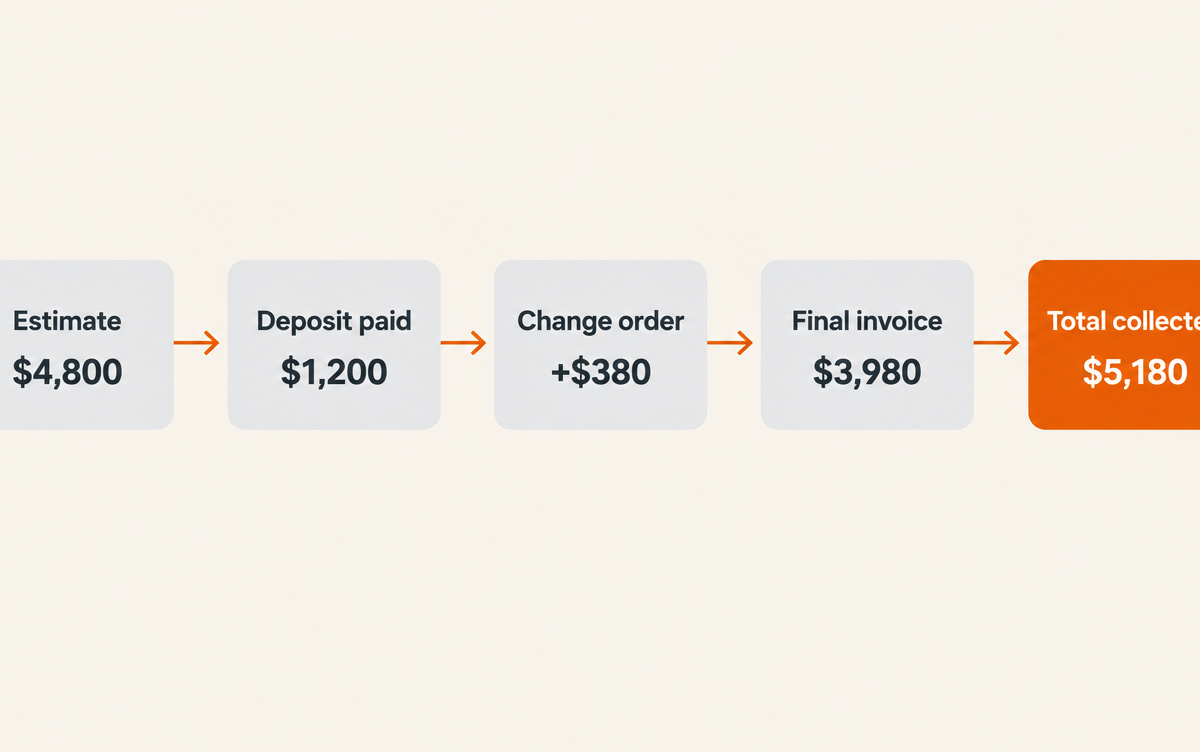
Check the math before you send: $1,200 already paid plus $3,980 due is $5,180, which is the $4,800 contract plus the $380 change order. If those two numbers don't match, something's missing.
And the deposit percentage only works where it's legal. In California this job's deposit would be capped at $480, and the final invoice would read $4,700.
6. What payment terms should you put on the invoice?
For homeowners, "due on receipt" or a short window like 7 days. Net 15 or net 30 is normal for property managers and commercial customers who pay on a cycle. Whatever you pick, put it on the estimate first so the invoice holds no surprises.
Net 30 means payment is due 30 days after the invoice date. Write the actual date on the invoice too ("due November 8"), because nobody counts days.
Late fees only work if they're in the agreement the customer accepted, and states set their own limits on what you can charge. Check yours before you put a percentage in writing.
7. How do you send an invoice so it gets paid faster?
Send it from your phone the same day, as a link the customer can pay from, with a photo of the finished work. Every step between "got the invoice" and "paid" is a reason to put it off.
- Text and email. Text gets opened. Email gets kept. Do both.
- A way to pay right now. Card or bank payment from a link beats "mail a check."
- Proof. One or two photos of the finished job remind the customer what they're paying for.
- Same numbers as the estimate. If the total changed, the change order lines explain why.
In WinPal you can send the invoice from your phone, let the customer pay online, and see what's paid and what's still due. See what a plan costs on the pricing page.
8. What do you do when an invoice is late?
Follow up on a schedule, not when you get annoyed. Assume it was forgotten, not disputed, until you hear otherwise.
- Day after the due date: a short, friendly text with the payment link.
- One week late: a phone call. Ask if anything about the work or the bill is holding it up.
- Two weeks late: a written notice that restates the amount, the due date and any late fee in your agreement.
- Still nothing: your next options are a lien, small claims or a collections service. Lien rights come with state deadlines that can start early in the job, so look up your state's rules with your contractor board before you need them.
Common questions about contractor invoicing
How do I invoice as a self-employed contractor?
The same way: your business name and contact details, the customer, a unique invoice number, issue and due dates, line items that match the accepted estimate, change orders, payments already received, tax if it applies, and the balance due with payment options. Keep a copy of every invoice for your books and taxes.
What should a contractor invoice include?
Your business name, contact details and license number, the customer and job address, an invoice number and dates, line items tied to the accepted estimate, approved change orders, deposits and payments received, sales tax where your state requires it, the balance due, the due date and the payment methods you accept.
Can a contractor invoice before the job is finished?
Yes, if the contract says so. Deposits and progress invoices at agreed milestones are normal on jobs with materials or several stages. Some states limit both: California caps home improvement down payments at $1,000 or 10%, whichever is less, and bars progress payments ahead of completed work.
How do people usually pay contractors?
Check, card, bank transfer or an online payment link, depending on what you accept. Say which methods you take on the estimate and the invoice. A link the customer can pay from on their phone takes "I'll mail you a check" off the table.
Should a contractor charge a late fee?
Only if it was in the agreement before the work started, and only within your state's limits. A late fee nobody agreed to starts an argument instead of a payment. Most of the time a quick reminder with a payment link gets the invoice paid faster than any fee.
What to do with your next invoice
Match it to the estimate, add the change orders, subtract the deposit, put the due date in words and send it before you leave the job. Pricing still feels shaky? Start with how to price a $400 handyman job.
Want the estimate and the invoice in the same place, sent from your phone? Get started with WinPal.