How Much to Charge for Window Cleaning (With the Math)
Build your window cleaning price from minutes per window, your hourly cost and margin. Includes a 24-window house quoted at $437, or $18.21 a window.
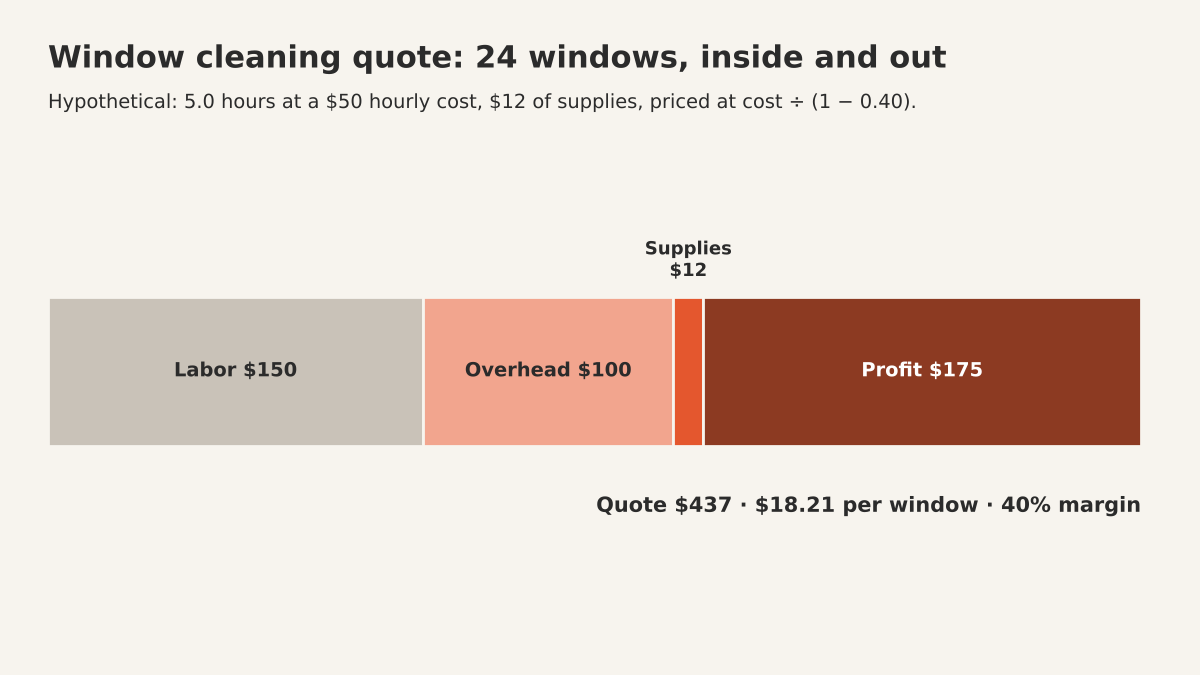
Charge for window cleaning by the time the job takes, then quote it per window so the customer can follow it. Add up your hours (windows, screens, setup and drive), multiply by your cost per hour, add supplies, and divide by (1 − your margin). At a $50 hourly cost and a 40% margin, a 24-window house cleaned inside and out comes to about $437, or $18.21 a window.
Price = (hours × cost per hour + supplies) ÷ (1 − margin)
($250 + $12) ÷ (1 − 0.40) = $436.67, quoted at $437. Hypothetical, worked below.
Per-window and per-pane prices are just that math divided up. If you copy someone else's per-window number without knowing your own time per window, you're guessing with your margin.
Scope: US residential window cleaning, owner-operator or small crew, ground floor to second story. Dollars are a hypothetical example; your rates will differ. Storefront and office contracts follow the same logic as bidding janitorial contracts.
1. Per window, per pane or per hour: which should you quote?
Quote per window or a flat price per house, and build it from per hour. Customers understand "24 windows, inside and out." They don't care how many minutes you spent on each.
| Method | Works best for | Watch out for |
|---|---|---|
| Per window | Standard double-hung and sliders on houses | Define a "window" in the quote (one opening, both sashes) |
| Per pane | French doors, divided-lite and older windows | Twelve small panes take far longer than one big one |
| Per hour | Your cost math, odd jobs, post-construction cleans | Open-ended hourly quotes are hard to say yes to |
| Flat per house | Repeat customers you've timed before | Only after you know the house |
The common thread: every method starts from your time. Time five or six jobs with a stopwatch and you'll have your own minutes per window, which beats any number on a forum.
2. Count the minutes per window, not just the windows
Your price lives in the minutes. Break each window into the pieces that take time:
- Exterior glass (ground floor by hand, second floor by ladder or water-fed pole).
- Interior glass, including moving furniture and laying drop cloths.
- Screens: pull, wipe or wash, reinstall.
- Extras: tracks, sills, hard water stains, paint or sticker removal, skylights.
Then add the time nobody pays for unless you charge it: the walk-around, setup, breakdown, and the drive. The drive counts. A 30-minute round trip is half an hour you can't sell to anyone else.
3. Know your cost per hour
Your cost per hour is what one working hour costs you before profit: your pay (or your tech's wage plus payroll load) and a share of overhead like the truck, insurance, phone, pure-water system and squeegee channels you go through.
In this example we assume $30 an hour for labor and $20 an hour for overhead, so $50 an hour. Those are assumptions, not market data. Get your own number from last year's overhead and billable hours, or run it through the hourly rate calculator.
4. Worked example: 24 windows, inside and out
Hypothetical job: a two-story house, 24 double-hung windows, interior and exterior glass plus screens. You've timed your work at 5 minutes exterior, 4 minutes interior and 1 minute for the screen, so 10 minutes per window.
| Line | Math | Amount |
|---|---|---|
| Window time | 24 windows × 10 min = 240 min | 4.0 hr |
| Setup, walk-around, cleanup | Assumption | 0.5 hr |
| Drive, round trip | Assumption | 0.5 hr |
| Labor | 5.0 hr × $30 | $150.00 |
| Overhead | 5.0 hr × $20 | $100.00 |
| Supplies (solution, scrim, blades) | Assumption | $12.00 |
| Total cost | $262.00 | |
| Price at 40% margin | $262 ÷ 0.60 = $436.67 | $437.00 |
Quoted per window, that's $437 ÷ 24 = $18.21. Your profit is $437 − $262 = $175, a 40.0% margin.
Same house, exterior and screens only: 24 × 6 min = 2.4 hours, plus the same 1.0 hour of setup and drive, is 3.4 hours × $50 = $170, plus $8 of supplies = $178. At 40% margin: $178 ÷ 0.60 = $296.67, so about $297, or $12.38 a window. Notice the per-window price isn't half: setup and drive don't shrink.
5. Margin, not markup
A 40% margin means 40% of the price is profit. To get there with markup, you'd mark cost up 66.7%, not 40%. Mark $262 up 40% and you get $366.80, a 28.6% margin. That's how a busy spring turns into a thin year.
Discounts hit the same way. Give a quarterly customer 10% off the $437 job and you charge $393.30. Your cost is still $262, so your margin drops to 33.4%.
Fine if the route is tight and the driving disappears, painful if it doesn't. Test your own numbers with the profit margin calculator.
6. Set a minimum charge
Every job needs a floor, because the drive and setup cost the same for 3 windows as for 30. In this example, 1.5 hours at $50 plus $5 of supplies is $80 of cost; at 40% margin that's $80 ÷ 0.60 = $133.33, so a $135 minimum.
Write it in the quote: "Minimum service charge $135." Customers who want two windows done will either book more or book someone else. Both are fine.
7. What changes the price
Height and access. Third-story windows, steep slopes and landscaping under the glass add time and risk. If you have employees, OSHA's ladder rules apply: for example, a portable ladder used to reach an upper landing has to extend at least 3 feet above it, and the top step and cap of a stepladder aren't steps (29 CFR 1910.23).
Condition. First cleans after years of neglect, hard water stains and post-construction paint can take far longer than a maintenance clean. Price them as a separate first-visit rate, then quote maintenance visits at your normal number.
Divided lites. Price French and colonial windows per pane, or count each one as two or three windows.
Bundles. Gutters, screens and house washing on the same trip spread your drive over a bigger ticket. Price the add-on with the same math as pricing pressure washing jobs.
Broken glass. Finding a cracked pane after a storm? Note it and photograph it before you touch it. If the homeowner files a claim, the repair contractor's paperwork is a different animal: see the contractor invoice for an insurance claim.
Common window cleaning pricing questions
How much should I charge per window?
Take your cost per hour, multiply by the hours the job takes including setup and drive, add supplies, divide by (1 − margin), then divide by the window count. In our hypothetical, $50 an hour and 10 minutes a window gives $18.21 inside and out and $12.38 outside only, at a 40% margin.
Should I charge per pane or per window?
Per window for standard double-hung and sliding windows, because customers can count them. Per pane for French doors, divided-lite and older multi-pane windows, where a single opening can take much longer. Define both terms in the quote so nobody argues about what a window is.
How do I estimate a window cleaning job without seeing it?
Ask for the window count, number of stories, inside or outside, screens and any hard water or paint, plus a few photos. Quote a range or a price subject to confirmation on site. Then time the job so your next phone quote is better.
How much do you charge for screens and tracks?
Price them by time like everything else. In our example, a screen takes about a minute, so it's built into the per-window price. Tracks and sills that need scrubbing usually take longer, so list them as an add-on per window with its own minutes.
What to do on your next window quote
Count the windows, write down your minutes per window, add setup and the drive, multiply by your hourly cost and divide by (1 − margin). Send it before you leave the driveway. In WinPal you can snap a photo of the house, describe the job out loud and get a first-draft estimate to fix up before sending.
Already sent one this week? Upload it to the estimate checker and see if it's priced too low.