How to Bid Commercial Painting Jobs From the Plans and Specs
Read the specs, take off the plans, turn area into gallons and hours, then price prevailing wage, bonds and retainage. Includes a 4,000 sq ft office suite bid at $11,885.33.

To bid a commercial painting job, read the specs and the finish schedule, take off the paintable area from the plans, convert it to gallons with the product's coverage and to hours with your crew's production rate, cost labor, paint, sundries and overhead, then divide by one minus your margin. Then price the commercial extras residential bids never have: prevailing wage, bonds, retainage and after-hours work.
Bid = (labor + paint + sundries + overhead) ÷ (1 − margin).
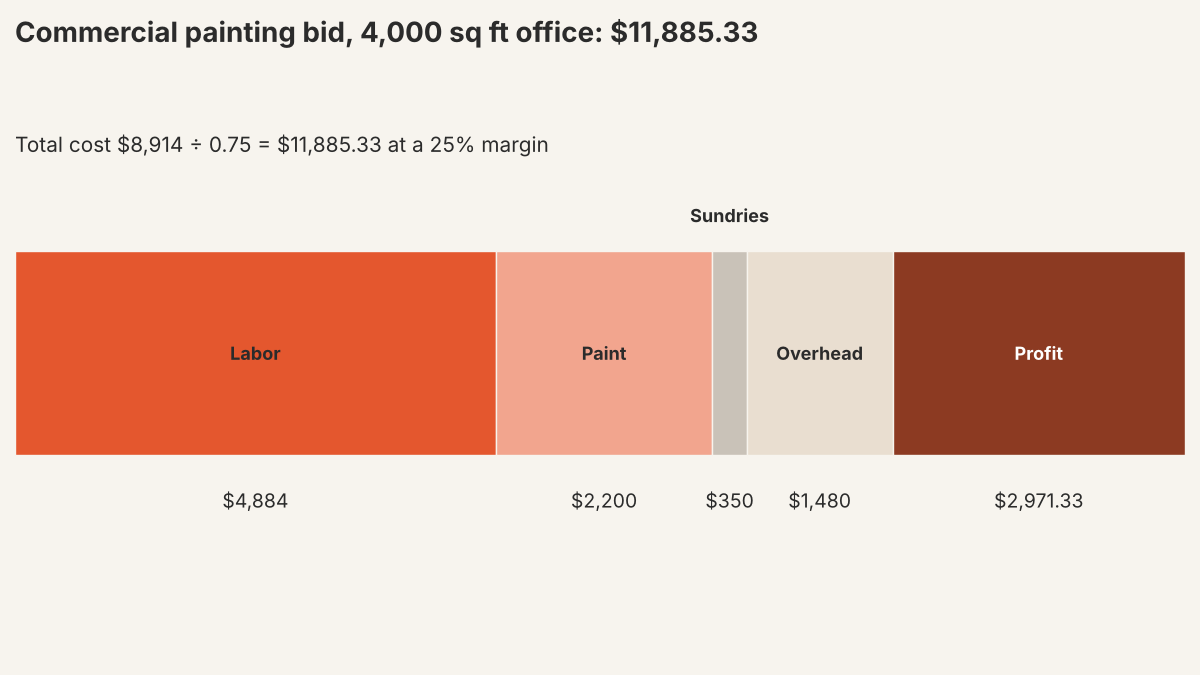
Repainting a 4,000 sq ft office suite, 9,600 sq ft of walls, two coats: $8,914 in costs ÷ 0.75 = $11,885.33 at a 25% margin, about $1.24 per square foot of wall. Hypothetical, worked below.
Commercial work pays in volume and punishes guesses. The building is bigger, the specs are written by someone who won't be holding the roller, and the bid gets compared line by line with other painters' bids.
This guide is for a residential painter or small crew bidding the first office, retail or tenant improvement jobs: the bid documents, the takeoff, the math, a worked bid and the rules that change the price. US dollars, a hypothetical example, your rates swapped in. Homes and single rooms have their own guide: how to price painting jobs.
1. Read the bid documents before you measure anything
On commercial jobs, the documents tell you what to bid. Read them first, or you'll price a product, a sheen or a number of coats nobody asked for.
- Specifications: the painting section names the products, the number of coats, surface prep and who primes new drywall.
- Finish schedule: which room gets which color, sheen and system. Walls, doors, frames and ceilings are often listed separately.
- Addenda: changes issued after the bid went out. Acknowledge every one on the bid form, or you risk the bid being rejected.
- Bid form, due date and walkthrough: fill in the form they give you, on time, and go to the walkthrough even when it's optional.
- Working hours: occupied offices often want evenings or weekends. That changes your labor cost.
New walls? Check what finish level the drywall sub is delivering. A Level 4 wall and a Level 5 wall take primer and paint differently; how to bid a drywall job covers the levels.
2. Take off the paintable area from the plans
Measure surfaces by type and count the items you price by the piece. Wall area is wall length times height for each room; doors and frames are counted, not measured.
| Item | How to take it off | Unit |
|---|---|---|
| Walls | Room perimeter × wall height, by system and sheen | sq ft |
| Ceilings (drywall) | Length × width | sq ft |
| Doors and frames | Count from the door schedule | each |
| Trim, handrails, base | Run length | linear ft |
| Exposed structure, pipes | Scaled from plans or walked | sq ft or linear ft |
Use the plans for the numbers and the walkthrough for the surprises: a lobby with 14 ft walls, rooms you can't get into until 6 p.m., furniture nobody plans to move.
3. Turn area into gallons with the product's coverage
Gallons = area × coats ÷ coverage per gallon. Use the coverage from the specified product's data sheet, and take the low end.
For example, Benjamin Moore lists its Ultra Spec 500 interior eggshell, a product it recommends for commercial and institutional interiors, at 350 to 400 sq ft per gallon at the recommended film thickness (Ultra Spec 500 eggshell technical data sheet). Porous patches, new drywall and deep colors eat more, so 350 is the safer number to bid.
4. Turn area into hours with your crew's production rate
Hours = area × coats ÷ your production rate in square feet per hour. Your own rate is the only one worth using, because it reflects your crew, your rollers and the way you cut in.
Time a crew on a big open wall and on a chopped-up office row and you'll see two different numbers. The example uses 175 sq ft per hour per coat for rolled walls, as an assumption. Price doors and frames per piece, and give prep, masking and floor protection their own hours.
5. Cost labor, paint, sundries and overhead
Multiply the hours by a loaded labor rate, price the gallons at your contractor price, add an allowance for sundries and spread overhead across the hours.
For a reference point, the national median wage for construction and maintenance painters is $23.75 an hour (O*NET, from BLS 2025 wage data). The example uses $33 an hour loaded, about 39% on top of that median, which is an assumption. Build your own with the hourly rate calculator.
- Sundries: caulk, patching compound, spot primer, tape, plastic, roller covers. An allowance per job beats counting tubes.
- Overhead: vehicle, insurance, ladders and sprayers, your time estimating jobs you don't win. Spread a year of it over your billed hours.
6. Worked example: repainting a 4,000 sq ft office suite
Hypothetical bid. A 4,000 sq ft office suite, repaint of all walls in eggshell, two coats, 24 doors and frames. The takeoff from the plans gives 9,600 sq ft of wall. Ceilings are acoustic tile and not in scope. Work happens evenings while the tenant is open during the day.
| Takeoff | Calculation | Result |
|---|---|---|
| Paint, two coats at 350 sq ft per gallon | 9,600 × 2 ÷ 350 = 54.9 | 55 gallons |
| Wall hours at 175 sq ft per hour per coat | 9,600 × 2 ÷ 175 = 109.7 | 110 hr |
| Doors and frames at 0.75 hr each (assumption) | 24 × 0.75 | 18 hr |
| Prep, masking, protection, nightly setup (assumption) | 20 hr | |
| Total labor hours | 110 + 18 + 20 | 148 hr |
| Cost line | Qty | Rate | Cost |
|---|---|---|---|
| Labor, loaded (assumption) | 148 hr | $33 | $4,884 |
| Paint (assumption) | 55 gal | $40 | $2,200 |
| Sundries (allowance) | 1 | $350 | $350 |
| Overhead (assumption) | 148 hr | $10 | $1,480 |
| Total cost | $8,914 | ||
| Bid at 25% margin ($8,914 ÷ 0.75) | $11,885.33 |
That's $2,971.33 of profit after wages, including yours, and about $1.24 per square foot of wall. Round the bid the way the bid form asks for it.
Want to see 20% or 30% instead? The profit margin calculator shows margin and markup side by side. A 25% markup on the same costs leaves only a 20% margin.
7. The commercial rules that change your price
Public and larger commercial jobs carry contract rules that change your costs and your cash flow. Read for these before you price.
- Prevailing wage. Federal contracts over $2,000 for construction, alteration or repair, including painting and decorating, must state minimum wages based on what the Secretary of Labor determines is prevailing locally (40 U.S.C. § 3142). Price your labor line from that wage determination, not your usual rate. Your state may have its own prevailing wage rules for state and local jobs.
- Bonds. The FAR requires performance and payment bonds on federal construction contracts over $150,000 (FAR 28.102-1). Private owners and general contractors may ask for bonds too. The bond premium is a cost line.
- Retainage. A commercial contract may hold back a percentage of each payment until the job is finished. If this contract held 5%, that's $594.27 of the example bid you wait for. Progress billing explains how the holdback works on each invoice.
- After-hours and access. Night or weekend premiums, a lift rental, a building that only lets you in through the loading dock. Each one is a line.
Check the contract and your state's rules before you bid; this is the general picture, not legal advice.
8. Where to find commercial painting bids
For small commercial work, start with general contractors and property managers. Get on the bid lists of the GCs who build tenant improvements in your area, and ask the property managers you already work for who handles their other buildings.
Federal opportunities are posted on SAM.gov Contract Opportunities, and cities, counties and school districts post their own on their purchasing pages. Expect formal bid forms, insurance minimums and a hard deadline.
9. What the commercial painting bid should say
Match the bid to the spec, then say clearly what you included and what you didn't. The GC is comparing your number to other bids, and the clearest exclusions keep you from eating someone else's scope.
- Spec section and addenda acknowledged, by number.
- Surfaces and systems included, with coats and sheens.
- Exclusions: ceilings, exterior, wallcovering, drywall repair beyond spot patching, moving furniture.
- Working hours and access assumptions.
- Price, retainage, billing schedule and payment terms. The wording is in contractor payment terms.
- How added work is priced and approved: a written change order before you start it.
- How long the price is good for.
In WinPal you can describe the job out loud on the walkthrough and get a first-draft estimate to fix up before you send it, then send each invoice from the same job.
Common commercial painting bid questions
How do you bid a commercial painting job?
Read the specs and finish schedule, take off the surfaces from the plans, convert area to gallons with the product's coverage and to hours with your production rate, then cost labor, paint, sundries and overhead and divide by one minus your margin. Add prevailing wage, bonds and retainage if the contract has them.
How much should you charge per square foot for commercial painting?
Build the bid from hours and gallons, then divide by the wall area to check it. The example comes to about $1.24 per square foot of wall for two coats with doors included. Tall walls, more coats, night work or prevailing wage push that number up, so don't bid from a number you didn't build.
How is a commercial painting bid different from a residential one?
The documents decide the scope: specs, a finish schedule and addenda instead of a homeowner's color list. You bid on a set form, by a deadline, against other painters. Commercial contracts also add things a homeowner never asks for, like retainage, bonds, prevailing wage on public work and after-hours schedules.
Do you need a bond to bid commercial painting jobs?
It depends on the job. Federal construction contracts over $150,000 require performance and payment bonds under FAR 28.102-1, and other owners or general contractors may ask for bid or performance bonds on smaller jobs. Read the bid documents, and if a bond is required, include the premium in your price.
What to do on your next commercial bid
Read the documents, take off the surfaces, convert to gallons and hours, cost the job, divide by one minus your margin, then add the contract rules before you sign the bid form.
Already sent a painting bid? Upload it to the estimate checker and see if it's priced too low.