How to Bid a Drywall Job Without Losing Money on the Finishing
Measure the board, write the level of finish, and price hanging and finishing on their own lines. Includes a 14 × 20 ft room bid at $3,120 to Level 4.
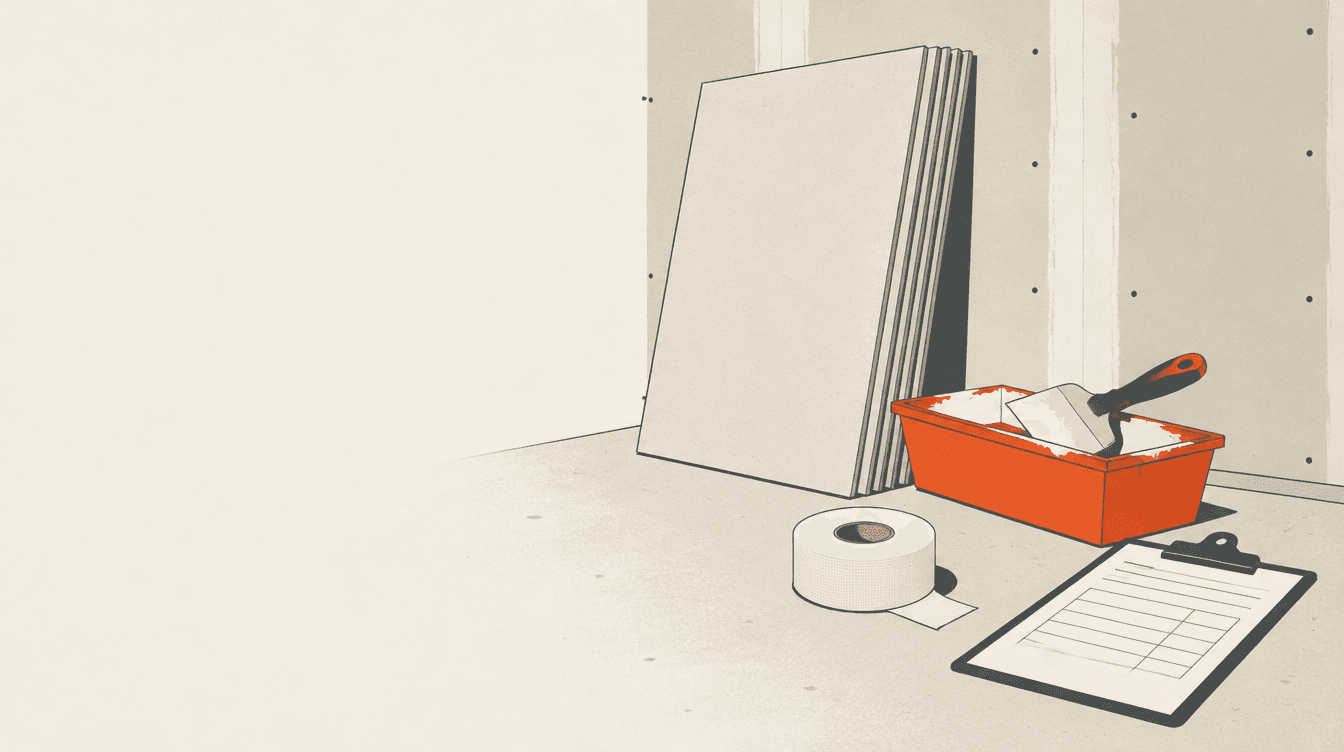
To bid a drywall job, measure the board area of the walls and ceilings, add waste and convert it to sheets, then price hanging and finishing as separate labor lines, add board, mud, tape, fasteners, delivery and overhead, and divide by one minus your margin. Write the level of finish into the bid, because Level 4 and Level 5 are different jobs at different prices.
Price = (hanging labor + finishing labor + materials + overhead) ÷ (1 − margin).
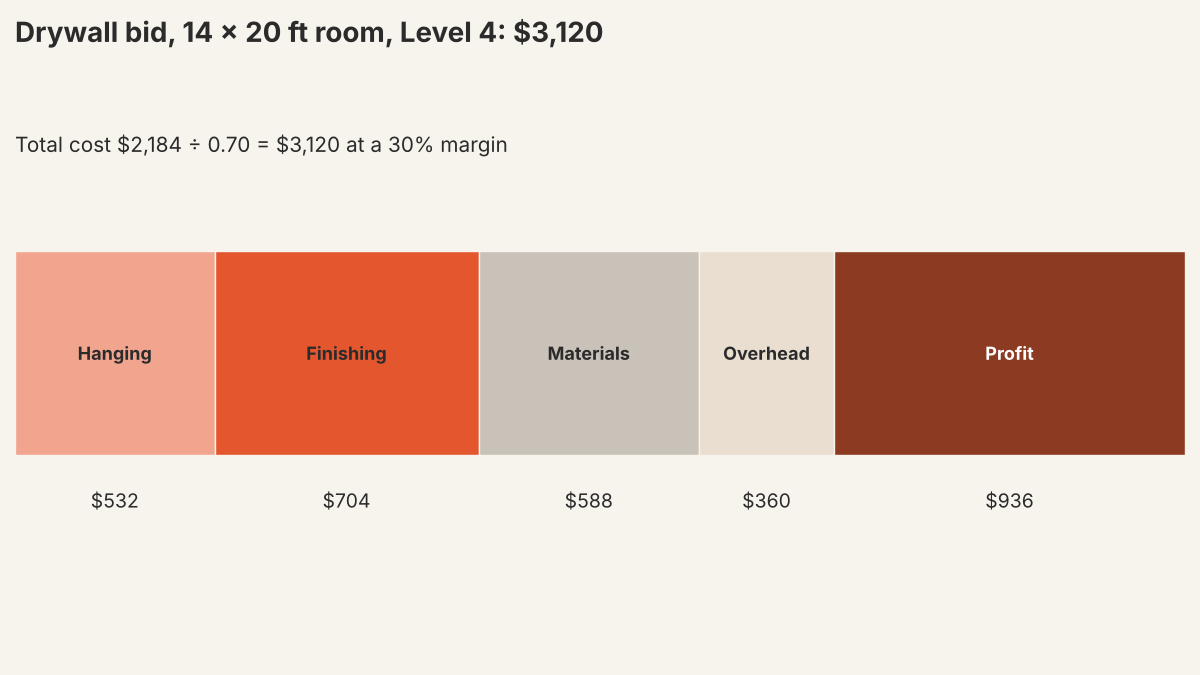
A 14 × 20 ft room with 8 ft walls, hung and finished to Level 4: $2,184 in costs ÷ 0.70 = $3,120 at a 30% margin, about $164 a sheet. Hypothetical, worked below.
Drywall bids go wrong in the finishing. Hanging is fast and easy to count. Taping, three coats and sanding spread over several trips, and every extra trip comes out of your pocket if the bid only counted sheets.
This guide is for residential hang-and-finish work and small remodels: the takeoff, the labor, the materials, a full worked bid and what the bid should say. US dollars, a hypothetical example, your rates swapped in. For a whole project with other trades in it, start with how to estimate construction costs.
1. Measure the board: walls, ceilings, sheets and waste
Measure every surface that gets board, in square feet, then divide by the sheet size and add waste. Walls are the room's perimeter times the wall height. Ceilings are length times width.
- Walls: add the wall lengths and multiply by the height. A 14 × 20 ft room with 8 ft walls is 68 ft × 8 ft = 544 sq ft.
- Ceilings: 14 × 20 = 280 sq ft. Ceilings hang slower, so keep them on their own line.
- Openings: skip deducting doors and windows on small rooms. You cut around them, and the cutoffs end up in the dumpster anyway.
- Sheets: divide by 32 sq ft for a 4 × 8 sheet or 48 sq ft for a 4 × 12. Longer sheets mean fewer joints to tape.
- Waste: add a waste factor for cuts and breakage. This guide uses 10% as an assumption; track your own on the next few jobs.
Note the things that slow you down while you measure: ceilings over 9 ft, stairwells, lots of corners, a second-floor carry with no window to pass sheets through.
2. Write the level of finish into the bid
The level of finish decides how many coats you apply, so it decides your finishing hours. The Gypsum Association's GA-214 standard defines six levels, 0 to 5 (GA-214-2022 quick reference guide).
| Level | What GA-214 calls for | Typically specified for |
|---|---|---|
| 1 | Tape set in joint compound | Areas above ceilings, attics, concealed spaces |
| 2 | Tape embedded and wiped, 1 coat on fasteners and accessories | Under tile, garages, storage |
| 3 | 1 more coat on joints and angles, 2 coats on fasteners | Walls getting a medium or heavy texture |
| 4 | 2 more coats on flat joints, 1 on angles, 3 coats on fasteners | Smooth walls with flat paint or light texture |
| 5 | Level 4 plus a skim coat over the entire surface | Glossy or dark paint, critical lighting |
Smooth walls with flat paint are typically Level 4 under GA-214. A customer who wants a dark accent wall in semi-gloss under a big window is asking for Level 5, whether they know the term or not.
Put the level in writing. “Finish walls smooth” invites an argument at the walkthrough. “Level 4 finish per GA-214, ready for primer” doesn't.
3. Price hanging and finishing as separate labor lines
Hanging and finishing are different work, often done by different people at different rates, so price them on separate lines. Count hours from your own past jobs, then multiply by a loaded rate: wage plus payroll taxes, workers' comp, insurance and paid time off.
For a reference point, the national median wage is $28.33 an hour for drywall and ceiling tile installers and $32.82 an hour for tapers (O*NET, drywall installers; O*NET, tapers; both from BLS 2025 wage data). The example loads each by about 34%, to $38 and $44 an hour, which is an assumption. The hourly rate calculator builds your own rate from your numbers.
- Hanging hours: from your own speed on similar rooms, with ceilings and tall walls counted slower.
- Finishing hours: every coat is a trip, and each one waits for the last to dry. Count the drive and setup for each visit, not just the knife time.
- Sanding and cleanup: the part everyone forgets to bid. It belongs in finishing.
4. Add materials: board, mud, tape, fasteners and the haul
Materials are the easy part to count and the easy part to underprice, because supplier prices move. Get a current quote for board and mud before you send the bid.
- Board: the sheet count from step 1 at your supplier's price. Moisture-resistant or fire-rated board costs more; list it separately.
- Joint compound: USG says to expect about two 4.5 gallon pails of its UltraLightweight all purpose compound to finish 1,000 sq ft of wallboard (USG FAQ). Level 5 needs more for the skim coat.
- Tape, screws, corner bead: a small allowance per job is simpler than counting screws.
- Delivery and haul-off: boom delivery or a carry fee, plus the scrap you take to the dump.
5. Worked example: a 14 × 20 ft room hung and finished to Level 4
Hypothetical bid. A garage converted to a family room, 14 × 20 ft with 8 ft walls, new board on the walls and ceiling, Level 4 finish, ready for the painter's primer. Framing and insulation are done by others.
| Takeoff | Calculation | Result |
|---|---|---|
| Walls | 68 ft × 8 ft | 544 sq ft |
| Ceiling | 14 ft × 20 ft | 280 sq ft |
| Board area | 544 + 280 | 824 sq ft |
| Sheets, 4 × 12, with 10% waste | 824 × 1.10 ÷ 48 = 18.9 | 19 sheets |
| Mud, 2 pails per 1,000 sq ft | 824 ÷ 1,000 × 2 = 1.6 | 2 pails |
| Cost line | Qty | Rate | Cost |
|---|---|---|---|
| Hanging labor, loaded (assumption) | 14 hr | $38 | $532 |
| Finishing labor, 3 coats plus sanding (assumption) | 16 hr | $44 | $704 |
| Board, 1/2 in. 4 × 12 (assumption) | 19 sheets | $22 | $418 |
| Joint compound (assumption) | 2 pails | $20 | $40 |
| Tape, screws, corner bead (allowance) | 1 | $55 | $55 |
| Delivery and haul-off (assumption) | 1 | $75 | $75 |
| Overhead (assumption) | 30 hr | $12 | $360 |
| Total cost | $2,184 | ||
| Price at 30% margin ($2,184 ÷ 0.70) | $3,120 |
That leaves $936 of profit after everyone's wages, including yours. The price works out to $3.79 per square foot of board, or $164.21 a sheet.
Watch the markup trap. A 30% markup on $2,184 is $2,839.20, which is only a 23.1% margin. The profit margin calculator shows both side by side.
6. Bid per sheet, per square foot or by the job?
Bid by the job and show the per-sheet or per-square-foot number as a check, not the other way around. A per-sheet price is quick to quote, but it only works if you built it from a job like the one in front of you.
The example comes to $164.21 a sheet. That number holds for an empty room with 8 ft walls and Level 4. Put it on a stairwell with 16 ft walls, a ceiling full of can lights or a Level 5 finish, and it's wrong before you start. Price the job, then divide to see if the number looks sane.
Small repairs are the opposite case. A two-foot patch takes three trips no matter how small it is, so set a minimum charge that covers those trips. The handyman pricing guide covers minimum service charges and travel charges.
7. When the drywall bid changes
Three situations change the math enough to rebid, not just adjust.
- Level 5. In the example, a skim coat adds about 8 finishing hours, a pail of mud and the overhead on those hours: $468 in cost. The price goes from $3,120 to $3,788.57, or $4.60 per square foot.
- Finishing only. When someone else hangs, you inherit their joints. Walk it before you bid, and price per square foot of board only after you've seen the hanging.
- Hidden damage on remodels. Pull a wall and find rot, wet insulation or bad framing, and that's a change order, not a favor. Write it up before you fix it; construction change orders covers the paperwork.
8. What the drywall bid should say
A drywall bid should say exactly what's included, to what standard, and what's not yours. The arguments you want to avoid are about the finish and who cleans up, not the price.
- Rooms and surfaces included, with the board area and board type.
- Level of finish per GA-214, by area if it changes.
- What's excluded: framing, insulation, primer, paint, texture, electrical box cutouts moved after hanging.
- Who handles delivery, dumpster and daily cleanup.
- Price, deposit, payment schedule and due dates. The wording is in contractor payment terms.
- How changes are priced, and that they're approved in writing first.
Say who primes. A painter bidding behind you on a commercial job reads the same finish schedule; how to bid commercial painting jobs shows that side of it.
In WinPal you can snap a photo of the room, describe the job out loud and get a first-draft estimate to fix up before you send it, then invoice from the same job when the last coat dries.
Common drywall bidding questions
How do you bid a drywall job?
Measure the wall and ceiling area, add waste and convert to sheets. Price hanging and finishing labor separately with loaded rates, add board, mud, tape, fasteners, delivery and overhead, then divide by one minus your margin. Write the level of finish into the bid. The example room comes to $3,120 at 30%.
How much should I charge per sheet of drywall?
Build the job price first, then divide by the sheets. The example works out to $164.21 a sheet hung and finished to Level 4, but that only holds for similar rooms. Tall walls, lots of corners, small rooms or Level 5 all push the per-sheet number up, so don't bid from a number you didn't build.
How do you bid drywall finishing only?
Walk the hung board first, count the joints and corners, and confirm the level of finish. Price your finishing hours per trip, including drying time between coats, add mud and sanding supplies, then overhead and margin. Write in that you're not responsible for repairing poor hanging unless it's priced as extra.
How many sheets of drywall do I need for a room?
Add the wall area (perimeter times height) and the ceiling area, multiply by one plus your waste factor and divide by the sheet size: 32 sq ft for 4 × 8, 48 sq ft for 4 × 12. The example room is 824 sq ft, so 19 sheets of 4 × 12 with 10% waste.
What to do on your next drywall bid
Measure walls and ceilings, add waste, count sheets, write the finish level, price hanging and finishing on their own lines, add materials and overhead, and divide by one minus your margin.
Already sent a drywall bid? Upload it to the estimate checker and see if it's priced too low.