Progress Billing: How to Bill a Job as the Work Gets Done
Bill long jobs as the work gets done: a schedule of values, percent complete and retainage, with a worked $36,000 kitchen remodel.
Progress billing means invoicing a job in pieces as the work gets done, instead of one bill at the end. You break the contract into a schedule of values, estimate how complete each line is on billing day, and bill the value of the work done to date minus what you've already billed.
Due now = work completed to date − amount billed before (− retainage, if your contract has it).
On a $36,000 kitchen remodel: $17,600 of work done to date − $6,300 billed last time = $11,300 due now.
Without it, you fund six weeks of labor and materials out of your own account and hope the final invoice clears. With it, the money follows the work.
This guide is for small contractors and remodelers billing jobs that run longer than a few weeks, including subs billing a general contractor. Amounts are in US dollars, the example is hypothetical, and the rules quoted are examples to check against your own state.
1. What is progress billing?
Progress billing is a way to invoice a construction job in installments based on how much of the work is actually complete. Each bill covers the value of the work finished since the last one, measured line by line against a schedule of values that adds up to the contract price. It's also called progress invoicing or a pay application.
It fits jobs where you'd otherwise be carrying a lot of cost before you get paid:
- Remodels and additions that run more than a few weeks.
- Sub work for a general contractor, where monthly pay applications are often written into the subcontract.
- Any job with big material buys early, like cabinets, windows or a roof.
A two-day job doesn't need it. Bill on completion, like you would for a flooring install that wraps up in a few days.
2. Progress billing or milestone payments: which fits your job?
Milestone payments are fixed amounts tied to events, like 30% when demo is done. Progress billing is a percentage of each line, measured on a billing date. Milestones are simpler; progress billing tracks the real work more closely.
| Milestone payments | Progress billing | |
|---|---|---|
| When you bill | When an event is reached | On a set date, often monthly |
| How much | A fixed share of the contract | Value of work completed to date |
| Best for | Homeowner jobs up to a few weeks | Longer jobs, GC and commercial work |
| Paperwork | An invoice per milestone | A schedule of values plus each pay application |
If milestones are enough for your job, our guide to contractor payment terms walks through a deposit and milestone schedule on a $12,000 remodel.
3. How do you set up a schedule of values?
List the major parts of the job as lines, give each line a dollar value, and make the lines add up exactly to the contract price. That list is your schedule of values, and every progress bill is measured against it.
- Use the phases you actually work in: demo, framing, rough-in, drywall, finishes, punch list. Six to twelve lines is plenty on a residential job.
- Price each line honestly. Each line carries its share of labor, materials, overhead and profit.
- Get it approved before the first bill. Send it with the contract and get a yes in writing.
Don't front-load it. Putting extra value on the early lines gets you paid sooner, but owners and GCs spot it, and if the job stalls you've been paid for work you haven't done.
On commercial jobs the standard paperwork is the AIA pair: the G702 application for payment and the G703 continuation sheet, which "breaks the contract sum into portions of the work in accordance with a schedule of values" (AIA Contract Documents). On a homeowner job, a one-page table does the same work.
4. How do you calculate a progress bill?
Multiply each line's value by its percent complete, add the lines up, then subtract what you've already billed. Five steps:
- Walk the job on billing day and estimate the percent complete for each line. Take photos.
- Work completed to date per line = line value × percent complete.
- Add the lines for the total completed to date.
- Subtract previous billings, the total of every progress bill you've sent before.
- Subtract retainage on the new work if your contract has it. What's left is due now.
Percent complete is a judgment call, so make it one you can defend. "Rough-in 80%: all plumbing in, two circuits left" holds up. "Rough-in, about 80%" invites an argument.
5. Worked example: progress billing on a $36,000 kitchen remodel
The job (hypothetical): a $36,000 kitchen remodel with seven lines in the schedule of values. Bill #1 went out at the end of month one. Here's bill #2.
| Line | Value | % done (bill #1) | % done now | Done to date |
|---|---|---|---|---|
| Demo and haul-off | $3,000 | 100% | 100% | $3,000 |
| Framing and rough carpentry | $4,500 | 40% | 100% | $4,500 |
| Plumbing and electrical rough-in | $7,500 | 20% | 80% | $6,000 |
| Drywall and paint | $4,000 | 0% | 50% | $2,000 |
| Cabinets and countertops | $10,500 | 0% | 20% | $2,100 |
| Tile and flooring | $4,500 | 0% | 0% | $0 |
| Trim, fixtures and punch list | $2,000 | 0% | 0% | $0 |
| Total | $36,000 | $17,600 |
Bill #1 covered $3,000 of demo, 40% of framing ($1,800) and 20% of rough-in ($1,500): $6,300.
Bill #2: $17,600 done to date − $6,300 billed before = $11,300 due now. The job is about 49% complete, and $18,400 is left to bill.
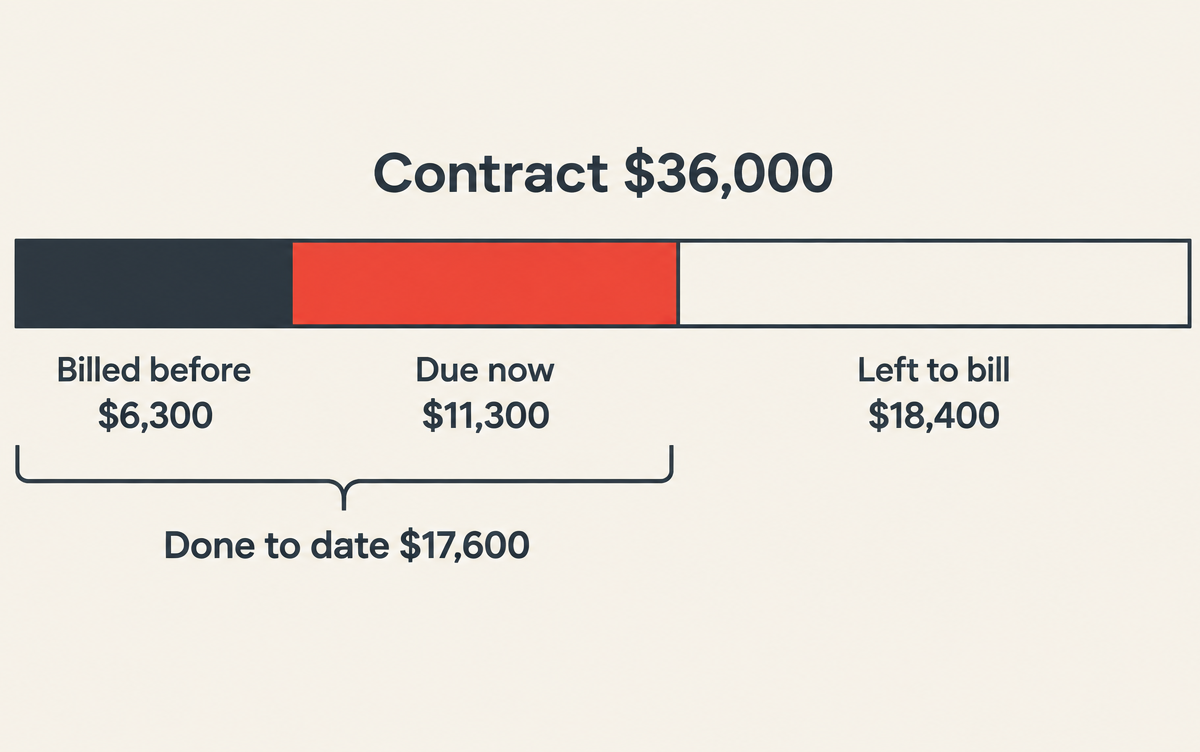
On the invoice itself, show the contract sum, the work done to date, previous billings and the amount due now. Attach the schedule of values. Nobody pays faster for a mystery number.
6. What is retainage, and how does it change the bill?
Retainage is a percentage of each progress payment the owner or GC holds back until the job is finished. It shows up mostly on commercial and GC work. If your contract has it, you bill the full amount and show the retainage as a deduction.
Same bill #2 with 5% retainage:
- Retainage held to date: 5% × $17,600 = $880.
- Done to date less retainage: $17,600 − $880 = $16,720.
- Billed before, less its retainage: $6,300 − $315 = $5,985.
- Due now: $16,720 − $5,985 = $10,735, which is $11,300 less 5%.
Retainage limits vary. In California, retention on private works contracts entered on or after January 1, 2026 can't exceed 5% of any payment or 5% of the contract price, but the cap doesn't apply to residential projects that aren't mixed-use and are four stories or fewer (California Civil Code § 8811). On federal fixed-price construction contracts, the contracting officer may hold up to 10% only when progress isn't satisfactory (FAR 52.232-5).
Check your state's rules, and read the retainage clause before you sign. That 5% can be most of your profit on the job.
7. How do change orders fit into progress billing?
Each approved change order becomes a new line in the schedule of values, and the contract sum goes up by its amount. From then on you bill it by percent complete like any other line.
Say the homeowner approves $1,200 of under-cabinet lighting. The contract becomes $37,200, and line 8 reads "CO #1: under-cabinet lighting, $1,200". Never fold extra work into an existing line; that's how you end up arguing about what 80% means.
Get every change approved in writing before you do it. Our guide to construction change orders covers how to price and write one.
8. What are the rules for progress payments on home improvement jobs?
Some states limit what you can collect ahead of the work. In California, a home improvement down payment can't exceed $1,000 or 10% of the contract, whichever is less, and any other payments must be based on work already completed or materials delivered (CSLB contract and payment rules).
Progress billing fits that rule naturally: you only bill for work that's done. Other states set different limits or none, so check your state's contractor licensing board before you write payment terms into a contract.
9. How do you get progress bills paid on time?
Send each bill on the date the contract says, with the schedule of values, photos and a clear due date. A bill that's easy to check gets approved faster.
- Bill on schedule, even when you're busy. A late bill is a late payment.
- Show your work: photos of each line you're billing, dated.
- Write the due date, not just "net 15".
- Make it easy to pay online, straight from the invoice.
In WinPal you can send invoices from your phone, let clients pay online, and keep track of what's paid and what's due. The basics of a clean contractor invoice are in our guide to how to invoice as a contractor.
Common questions about progress billing
What's the difference between progress billing and a progress invoice?
Progress billing is the method: billing a job in installments as work is completed. A progress invoice is one of those installments, the document you send on billing day. Each progress invoice shows the contract sum, the work completed to date, what was billed before, any retainage and the amount due now.
What is AIA billing?
AIA billing is progress billing on the American Institute of Architects forms. The contractor fills in the G702 application for payment and the G703 continuation sheet, which lists the schedule of values and the work completed on each line. The architect reviews it and certifies the amount due. You'll see it mostly on commercial and GC jobs.
How do you calculate percent complete?
For each line, compare the work done to the total work on that line. Use what you can count: outlets roughed in out of the total, square feet of drywall hung, cabinets set. Cost spent is a weaker guide, because materials bought aren't work done. Write a short note per line so the number holds up.
What happens if you overbill on a progress bill?
You've been paid for work you haven't finished. If the job stops, you may owe money back, and owners and GCs who catch it start checking every bill line by line. On some home improvement contracts it can also break state payment rules. Bill what's done, and catch up on the next bill if you were conservative.
How often should you send progress bills?
Whenever the contract says. Many longer jobs and GC subcontracts set a monthly billing date; some residential contracts bill every two weeks. Pick a fixed rhythm, put it in the contract, and send on that date every time so the customer knows when to expect it.
What to do on your next long job
Write the schedule of values with the contract, get it approved, and bill the work done to date on a fixed date. Subtract what you've billed before, show retainage if there is any, and attach photos.
Want to send the invoice from the job site and see what's still owed? Get started with WinPal.