Contractor Invoice for an Insurance Claim: What It Must Show
Put the claim number, the adjuster's line items, approved supplements and the paid deductible on the invoice. Includes a $15,060 hail roof invoice with a $3,960 balance.

A contractor invoice for an insurance claim has to do two jobs: bill your customer, and prove to the adjuster that the work on the claim got done. So it carries the claim number, the insured's name, the property address and date of loss, then your line items in the same order and units as the adjuster's estimate, any approved supplements on their own lines, the deductible paid, payments received and the balance due.
Approved scope + approved supplements − insurance payments received − deductible paid = balance due.
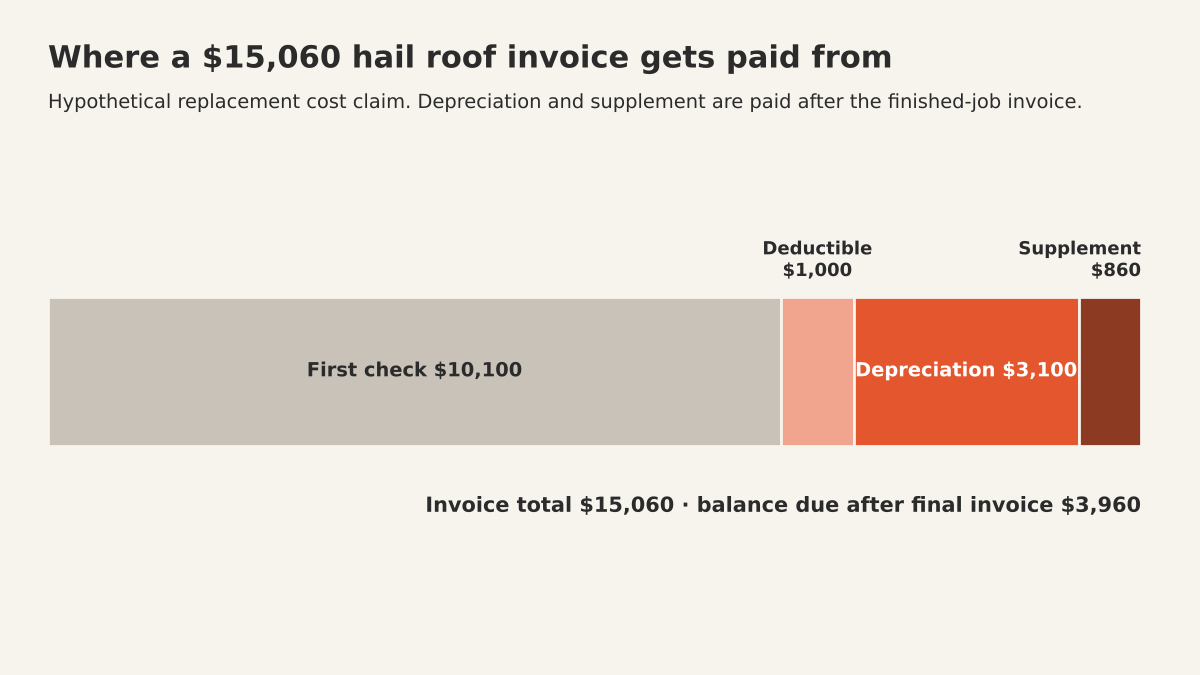
Hail roof: $14,200 + $860 − $10,100 − $1,000 = $3,960. Hypothetical, worked below.
Why it matters: on a replacement cost claim, the last check usually waits on your invoice. Texas' Department of Insurance tells homeowners the insurer pays the amount it held back for depreciation "after it gets the bill for the finished job." A vague invoice means a slow final payment, and that money is yours.
Scope: US, residential storm and water claims (roofs, siding, gutters, interior repairs), dollars in a hypothetical example. This is the paperwork side, not legal or claims advice. For a regular job, start with how to invoice as a contractor.
1. What does an insurance claim invoice need that a normal invoice doesn't?
It needs the claim's identity and a scope the adjuster can check line by line. Everything on a normal invoice still applies: your business name and license number where your state requires it, invoice number and date, customer, payment terms.
Add these to the header:
- Claim number, exactly as it appears on the adjuster's estimate.
- Insured's name and property address, matching the policy, not just the person who called you.
- Date of loss (the storm date or the day the pipe let go).
- Insurance company and adjuster name, with the estimate date or version you priced from.
- Completion date, because the depreciation release turns on finished work.
Leave the policy number off unless the customer or carrier asks for it. The claim number is what the desk adjuster searches for.
2. Match the adjuster's estimate line by line
Write your line items in the adjuster's order, with the same descriptions and units: squares for roofing, linear feet for drip edge and gutters, each for vents and boots. When your invoice and their estimate read like the same document, the review is quick.
If your own estimate grouped things differently, regroup them for the invoice. Don't argue with the format. Argue with missing items, through a supplement.
Keep each line honest. Bill what you installed, at the quantity you installed. Charging the carrier for work you didn't do, or for a full replacement when you patched, can be insurance fraud, and it's your name on the invoice.
3. Put supplements on their own lines
A supplement is a request to the insurer for work the original estimate missed: drip edge the code requires, decking you found rotten after tear-off, a second layer nobody saw from the ground. Treat it like a change order: documented, priced, approved before it shows up as billed.
On the invoice, list each approved supplement separately with its approval date or reference, under the original scope. Don't fold it into a bigger number on an existing line. The adjuster needs to see what changed and that someone on their side said yes.
Supplement not approved yet? Then it's not on the insurance invoice. Bill it to the homeowner only if they agreed to pay it themselves, in writing.
4. Show the deductible and the payments received
The homeowner owes the deductible. Texas law says it flat out: "A person insured under a property insurance policy shall pay any deductible applicable to a first-party claim made under the policy" (Tex. Ins. Code § 707.002).
Texas also lets the insurer withhold the recoverable depreciation "until the insurer receives reasonable proof of payment by the policyholder of any deductible," such as a canceled check or card statement (§ 707.004). So show the deductible as a payment received, with the date and method. That line can be what releases your final check.
And don't offer to "cover" the deductible. In Texas, a seller who waives, absorbs or rebates it without the insurer's consent commits an offense, and contracts of $1,000 or more expected to be paid from claim proceeds must carry a boldface notice saying so (Tex. Bus. & Com. Code § 27.02).
Other states have their own rules; check yours before you write the contract.
5. Know which check you're waiting for
On a replacement cost policy, the money usually comes in two pieces. Texas' home insurance guide explains it: the first check is "the estimated cost of repairs, minus depreciation and your deductible," and the depreciation comes after the bill for the finished job.
| Term | What it means on your invoice |
|---|---|
| RCV (replacement cost value) | The full approved price of the repair. Your invoice total should land here, plus approved supplements. |
| Depreciation | The part held back for age and wear. Recoverable on most replacement cost policies once the work is done. |
| ACV (actual cash value) | RCV minus depreciation. The first check is ACV minus the deductible. |
| Deductible | The homeowner's share. Show it as paid. |
If the home has a mortgage, the TDI guide says the repair check is made out to both the homeowner and the mortgage company, which may release money as the work is done. Build that delay into your payment terms so you're not floating the whole job.
6. Attach the proof
Send the invoice with the evidence, not after a second request. Your packet:
- Before, during and after photos, dated, with the same areas shot each time (each slope, each elevation, each room).
- Photos of anything supplemented: the rotten decking, the second layer, the missing drip edge.
- Material receipts or delivery tickets when the carrier asks for them.
- A signed certificate of completion if the carrier uses one.
- Proof of the deductible payment.
In WinPal you can snap a photo of the job, describe it out loud and get a first-draft estimate to fix up. When the work is done, you invoice from your phone off the same job and let the client pay online, so nothing gets retyped between the estimate and the invoice.
7. Worked example: a hail roof claim
Hypothetical job: a hail-damaged roof on a house with a replacement cost policy. The numbers are illustrative, not typical claim values.
- Adjuster's estimate (RCV): $14,200. Depreciation held back: $3,100. Deductible: $1,000.
- First check (ACV minus deductible): $14,200 − $3,100 − $1,000 = $10,100.
- After tear-off you find the drip edge the code requires was missing from the scope. You document it and the carrier approves an $860 supplement. In this example the adjuster applies no depreciation to it; yours may.
| Invoice line | Amount |
|---|---|
| Approved scope, per adjuster estimate (claim number on header) | $14,200.00 |
| Supplement 1, drip edge, approved (date and reference) | $860.00 |
| Invoice total | $15,060.00 |
| Less insurance payment received (first check) | −$10,100.00 |
| Less deductible paid by homeowner (date, method) | −$1,000.00 |
| Balance due | $3,960.00 |
The $3,960 is the $3,100 of recoverable depreciation plus the $860 supplement. The insurer pays $15,060 − $1,000 = $14,060 in total; it already sent $10,100, so $3,960 is left, and your invoice is what triggers it.
Now check your margin. Say your cost on this roof is $11,295. At the original $14,200, your margin is ($14,200 − $11,295) ÷ $14,200 = 20.5%. With the supplement, it's ($15,060 − $11,295) ÷ $15,060 = 25.0%.
Run it the other way with price = cost ÷ (1 − margin): $11,295 ÷ (1 − 0.25) = $15,060. The supplement was your margin. Check your own numbers with the profit margin calculator.
8. When the insurance invoice works differently
The homeowner adds upgrades. Better shingles or a color change the policy doesn't cover go on a separate invoice to the homeowner, or a clearly separate section. Never blend them into the claim lines.
The policy pays actual cash value only. Then there's no depreciation check coming. The homeowner owes the gap between ACV and your price, so say that before you start, not after.
You're a sub to a restoration contractor. You invoice the contractor who holds the claim, not the carrier. Keep the claim number on it anyway; it helps them build their packet.
Doing a small add-on after a storm, like washing the windows once the tear-off dust settles? That's a regular service job. Price it like one: here's how much to charge for window cleaning.
Common questions about invoicing insurance claims
Does the contractor send the invoice to the insurance company or the homeowner?
Send it to the homeowner, who is the insured and your customer, with a copy to the adjuster when the homeowner authorizes it or the carrier asks for it. The homeowner is the one who signed your contract and owes the deductible. Some carriers want the invoice uploaded to the claim file before they release recoverable depreciation, so ask the adjuster early.
Why is the insurance company asking for an invoice after the work is done?
Because on a replacement cost policy, the depreciation it held back is released after the repair is finished, and your final invoice is the proof. Texas' Department of Insurance describes this two-check process in its home insurance guide. Send a complete invoice with completion photos and the deductible shown as paid to avoid a second round.
Can my invoice be higher than the adjuster's estimate?
Only for work the carrier approved through a supplement, or for items the homeowner agreed to pay for separately, in writing. Anything above the approved scope without approval is the homeowner's bill, not the insurer's. Document the extra work with photos and submit a supplement before the work is billed.
Can a contractor waive the deductible?
Don't. In Texas the insured must pay it (Ins. Code § 707.002), and a seller who waives, absorbs or rebates it without the insurer's consent commits an offense (Bus. & Com. Code § 27.02). Other states have their own rules, so check yours and show the deductible as paid on the invoice.
What to do on your next claim job
Start the invoice when you start the job: claim number in the header, the adjuster's line order, a photo folder per slope or room, and a supplement the day you find something missing. Then the final invoice is a five-minute job, not a weekend.
Not sure your estimate covers the job before you hold it up against the adjuster's? Upload it to the estimate checker and see if it's priced too low.