How to Price Flooring Jobs So the Prep Work Gets Paid Too
Measure, add waste, price the tear-out and prep, then add overhead and margin. Includes a worked $4,986 vinyl plank job.
To price flooring jobs, measure the square footage, add a waste factor to get the material you'll buy, then add every hour of labor (tear-out, prep, install, trim), your materials, disposal and overhead. Divide that cost by one minus your margin. Quote the customer one price for the job, and keep a minimum charge for small rooms.
Price = (materials + labor + disposal + overhead) ÷ (1 − margin).
A 480 sq ft vinyl plank job that costs you $3,490, priced at a 30% margin: $3,490 ÷ (1 − 0.30) = $4,986, or about $10.39 a square foot installed.
The install is the easy part to price. The carpet tear-out, the low spot by the patio door and 140 feet of quarter round are where flooring margins go to die.
This guide is for flooring installers, handymen and remodelers pricing residential jobs. Amounts are in US dollars and the example is hypothetical: the rates and costs are placeholders to replace with your own, not market prices.
1. Should you price flooring by the square foot or by the job?
Build the price from square feet and your own hours, then quote the customer one number for the job. Square footage tells you how much material and install time you need. Your hours tell you what the tear-out, prep and trim cost.
A flat per-square-foot install rate treats an empty, flat slab the same as a furnished bedroom with old carpet and a dip in the subfloor. Those jobs aren't the same, so they shouldn't be the same price.
Work the method once and you'll get your own per-square-foot number as a by-product, good for quick quotes. It's the same approach as our guide to pricing painting jobs.
2. How do you measure a flooring job?
Measure each room's length and width, multiply, and add the rooms up. Then add a waste factor and round up to full cartons. That's the material you buy; the room area is what you install.
- Rooms: 12 × 14 ft = 168 sq ft. Measure closets and hallways separately and add them.
- Odd shapes: split them into rectangles and add the pieces.
- Waste: cuts, end pieces and damaged boards. This example uses 10%, a starting point for straight-lay plank in simple rooms. Diagonal layouts, herringbone and lots of small rooms need more. Use the number from your own past jobs.
- Cartons: divide by the square feet per carton and round up. You can't buy 21.3 boxes.
- Trim: measure the walls in linear feet for baseboard or quarter round, and count the doorways for transitions.
Write the leftover cartons into the estimate: they stay with the customer for future repairs, and they paid for them.
3. What goes into the cost of a flooring job?
Five things: materials, labor, prep, disposal and overhead. Most low prices come from forgetting prep and overhead.
- Materials: flooring with waste, underlayment if the product needs it, transitions, trim, adhesive, leveling compound, fasteners and blades.
- Labor: every hour from unloading to sweeping up. Moving furniture, tear-out, prep, install, trim and cleanup all count.
- Prep: scraping, patching, leveling, moisture checks. It's labor plus material, and it's the line that changes most between jobs.
- Disposal: dump fees or a dumpster, plus the time to haul.
- Overhead: truck, tools, insurance, phone, software, marketing. Divide last year's total by your billable hours.
If you don't know your hourly labor and overhead yet, the contractor hourly rate calculator works them out from your own numbers.
4. Why subfloor prep needs its own line
Because the manufacturer requires it, and the customer can't see it. Most floating floors need a flat subfloor before they go down, and a floor that isn't flat becomes your callback.
One waterproof vinyl plank install guide, for example, says the subfloor "must be flat; 3/16” in 10’ or 1/8” in 6’" (vinyl plank installation instructions sold at Lowe's). Read the guide for the product you're installing before you quote; prep you skip can put the warranty at risk.
Check flatness with a long level on the walk-through. If you can't check, say on the estimate that leveling is extra at a stated hourly rate plus materials. Then it's a line the customer agreed to, not a surprise.
5. Worked example: a $4,986 vinyl plank job
The job (hypothetical): two bedrooms and a hallway, 480 sq ft. Tear out carpet and pad, level two low spots, install click-lock luxury vinyl plank with attached pad, add quarter round and three transitions. Loaded labor is $55 an hour and overhead is $15 an hour.
| Labor task | Hours |
|---|---|
| Move furniture, set up | 1.5 |
| Tear out carpet and pad, haul out | 4 |
| Prep: scrape, patch, level two low spots | 3 |
| Install 480 sq ft of plank | 12 |
| Transitions and quarter round | 3.5 |
| Cleanup | 1 |
| Total | 25 |
Material: 480 sq ft + 10% waste = 528 sq ft, which is exactly 22 cartons at 24 sq ft each.
| Cost line | Math | Cost |
|---|---|---|
| Vinyl plank | 528 sq ft × $2.50 | $1,320 |
| Quarter round | 140 linear ft × $1.10 | $154 |
| Transitions | 3 × $28 | $84 |
| Leveling compound | 2 bags × $38 | $76 |
| Adhesive, caulk, nails, blades | $46 | |
| Labor | 25 hr × $55 | $1,375 |
| Disposal | Dump fee | $60 |
| Overhead | 25 hr × $15 | $375 |
| Total cost | $3,490 | |
| Price at 30% margin | $3,490 ÷ 0.70 | $4,986 |
$3,490 ÷ 0.70 = $4,985.71, rounded to $4,986. That leaves $1,496 of profit, which is 30% of the price.
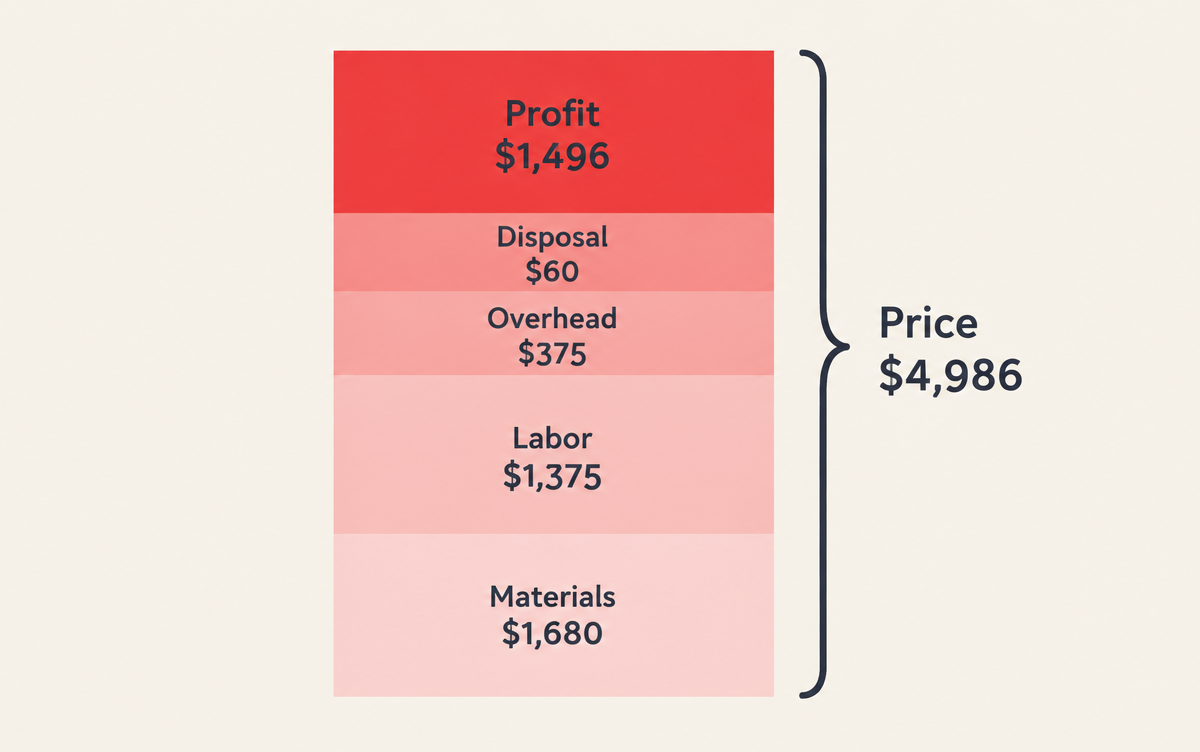
Your per-square-foot numbers for this job: $4,986 ÷ 480 = about $10.39 installed with materials. Labor and overhead alone cost you $1,750 ÷ 480 = about $3.65 a square foot. That's your floor, not the internet's.
Margin is your call. We used 30%; the profit margin calculator shows the price at any margin and what a discount does to it.
6. How do you price stairs, small rooms and customer-supplied flooring?
Stairs by the step, small rooms with a minimum charge, and customer-supplied material as labor only, with your margin still on it.
- Stairs: time one step with nosing, then multiply. At 45 minutes a step, 13 steps is 9.75 hours. At $55 labor plus $15 overhead, that's $682.50 of cost and $975 at a 30% margin, before materials.
- Small rooms: a 50 sq ft laundry room still needs the drive, setup, cuts and cleanup. Set a minimum around half a day. With these numbers, 4 hours × $70 = $280 of cost, or $400 at 30%, plus materials.
- Customer buys the flooring: price your labor, prep, trim, disposal and overhead the same way. Say in writing that you don't warranty the material, and that a short order means a second trip at your hourly rate.
Customer bought 5% extra for a herringbone hallway? Find out before install day, not halfway down the hall.
7. What changes the price on a flooring job?
Anything that adds hours, material or risk. Put it on the estimate, not on the day.
- What's coming up: carpet pulls fast. Glued-down vinyl, ceramic tile and mortar beds take far longer.
- Subfloor condition: soft spots, squeaks, water damage or a slab that's out of flat.
- Layout: diagonal or herringbone means more cuts and more waste.
- Furniture and appliances: moving a fridge and a piano is labor, and a risk.
- Doors and trim: undercutting door jambs, trimming doors, new baseboard instead of quarter round.
- Older homes: old resilient flooring or its backing can contain asbestos. The EPA says "Don't sand or try to level asbestos flooring or its backing" and to have removal done by trained, qualified people (EPA). If you suspect it, stop and get it tested before you price the tear-out.
Jobs run long. If the prep in the example takes 3 extra hours, that's $210 more cost. Profit drops from $1,496 to $1,286, and your margin from 30% to about 26%.
Want to see how the money flows on bigger jobs, like a whole-house floor inside a remodel? That's where progress billing comes in.
8. How do you write the flooring estimate?
One price for the job, broken into lines the customer can follow: tear-out, prep, material, install, trim, disposal. Say what's included and what's extra.
- Material: product name, color, square feet ordered including waste.
- Prep: what's included, and the hourly rate for anything beyond it.
- Exclusions: moving appliances, painting baseboards, asbestos testing.
- Payment terms: deposit for materials, balance on completion.
In WinPal you can build the estimate from a photo and a voice note, send it from your phone, and invoice the job when the floor's done. If you already handle small flooring jobs with other repairs, our guide to pricing handyman jobs uses the same math.
Common questions about pricing flooring jobs
How much should I charge per square foot to install flooring?
Work it out from your costs instead of copying a rate. Price one job with your hours, materials, prep, disposal, overhead and margin, then divide by the square feet. In our hypothetical vinyl plank job that came to about $10.39 a square foot with materials, and about $3.65 a square foot of labor and overhead cost alone.
How do you estimate a flooring job?
Measure every room, add a waste factor and round up to full cartons. List the labor tasks with hours: furniture, tear-out, prep, install, trim and cleanup. Add materials, disposal and overhead, then divide by one minus your margin. Walk the job first to check the subfloor and what's coming up.
How much waste should I add for flooring?
Use your own records first. Our example uses 10% for straight-lay plank in simple rooms. Diagonal and herringbone layouts, many small rooms or lots of closets need more, and the product's install guide may give its own figure. Round up to full cartons, and leave the extras with the customer.
How do you bid a flooring job for beginners?
Start with your costs, not a competitor's price. Time yourself on your first few jobs by task, keep receipts for materials and dump fees, and work out your overhead per hour. Then price every job with the same formula: costs divided by one minus your margin. Your numbers get sharper with each job.
What to do on your next flooring estimate
Measure, add waste, list every hour from furniture to cleanup, price the prep, add overhead, and divide by one minus your margin. Check it against your minimum.
Already sent one? Upload it to the estimate checker and see if it was priced too low.
Want to quote from the driveway and invoice from the truck? Get started with WinPal.