How to Price Pressure Washing Jobs From Your Own Costs
Measure, time each surface, add chemicals, equipment and overhead, then set a margin. See a $925 house wash and driveway, plus a $225 minimum charge.
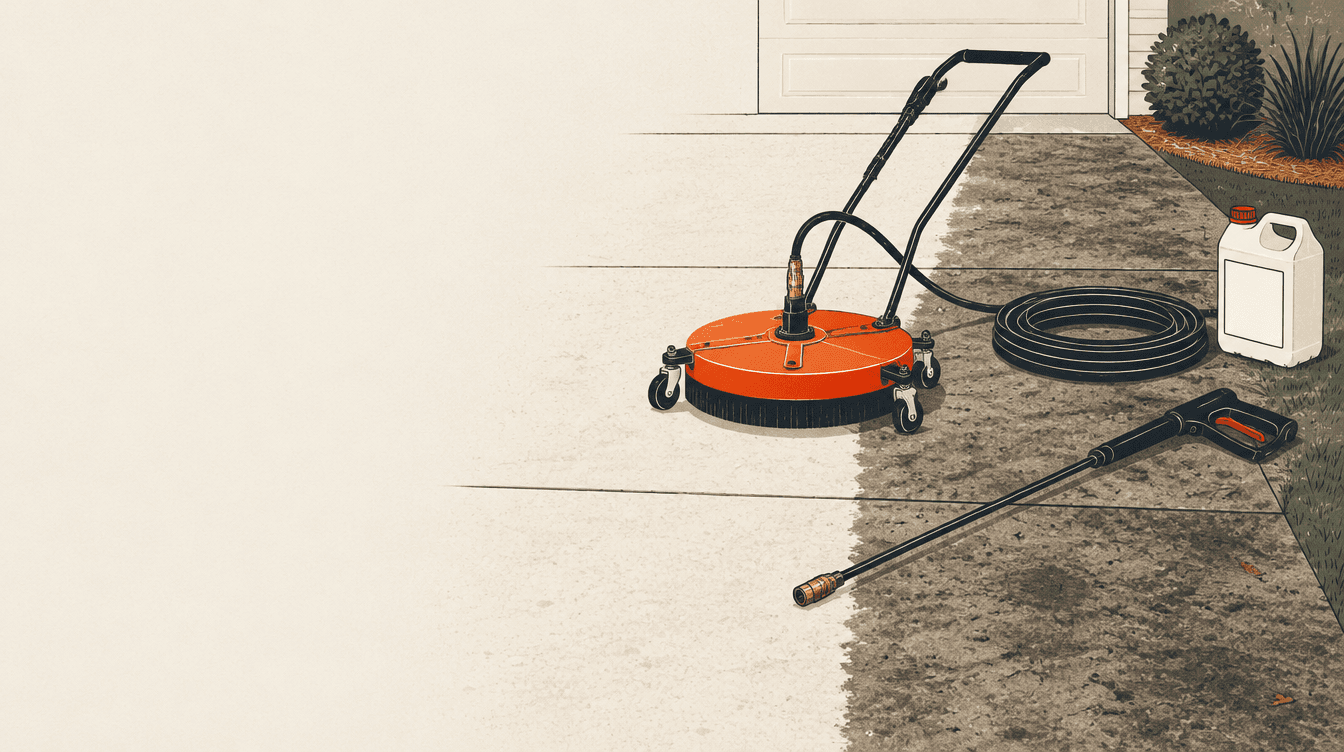
To price pressure washing jobs, measure each surface in square feet, work out the hours from your own production rates, then add labor, chemicals, equipment and fuel, and your overhead. Divide that cost by one minus your margin. Set a minimum charge so small jobs still pay for the drive and the setup.
Price = (labor + chemicals + equipment and fuel + overhead) ÷ (1 − margin).
A house wash plus driveway that costs you $555, priced at a 40% margin: $555 ÷ (1 − 0.40) = $925.
The per-square-foot number you saw in a Facebook group was built on somebody else's rig, chemicals and overhead. Build yours from your own costs and you'll know exactly what you're making on every driveway.
This guide is for owner-operators and small crews pricing residential house washing and flatwork, with a short section on commercial bids. All amounts are in US dollars and the example is hypothetical: the production rates and costs are examples to replace with your own, not market rates.
1. Should you price pressure washing by the square foot, the hour or the job?
Quote the customer a price for the job, and build that price from square feet and your own hours. Square footage tells you how long it'll take. Your costs per hour tell you what that time is worth.
Pure hourly pricing punishes you for owning a better surface cleaner. Copying someone's per-square-foot rate means pricing your business with their numbers.
The method below gives you your own per-square-foot rate as a by-product, so you can quote fast later and know it holds up. It's the same approach we use in our guide to pricing painting jobs.
2. How do you measure a pressure washing job?
Siding is wall perimeter times wall height. Flatwork is length times width. Measure each surface separately, because each one cleans at a different speed.
- House siding: a 40 × 30 ft two-story house has a 140 ft perimeter. At about 17 ft of wall, that's 2,380 sq ft. Call it 2,400 and don't bother subtracting windows.
- Driveway: 18 ft wide × 50 ft long = 900 sq ft.
- Walkway: 3 ft × 50 ft = 150 sq ft.
- Decks and fences: board area, plus railings or both faces of the fence. Wood goes slower than concrete.
A satellite view in a mapping app gets you close enough to quote by phone. Walk the job before you start anyway: oil stains, rust, a missing spigot and fragile plants all change the price.
3. How long will the job take?
Divide each surface's square footage by your production rate for that surface, then add setup, breakdown and the drive. Your production rate is how many square feet you actually finish in an hour with your rig, including pre-treat and rinse.
Nobody else's rate is yours. A 4 GPM machine and a 20-inch surface cleaner don't move like an 8 GPM trailer rig. Time your next five jobs by surface and you'll have numbers you can trust.
| Surface or task | Example rate (hypothetical) | On this job | Hours |
|---|---|---|---|
| Siding, soft wash | 800 sq ft/hr | 2,400 sq ft | 3.0 |
| Concrete, surface cleaner and post-treat | 350 sq ft/hr | 1,050 sq ft | 3.0 |
| Setup and breakdown | 0.75 | ||
| Drive, round trip | 0.5 | ||
| Total | 7.25 |
The drive counts. So does rolling up 200 ft of hose.
4. What does a pressure washing job cost you?
Four things: labor, chemicals, equipment and fuel, and overhead. Most low prices come from forgetting the last two.
- Labor: every hour on the job, including setup and the drive, times what an hour of you or your tech costs. This example uses $40 an hour.
- Chemicals: sodium hypochlorite, surfactant, degreaser and post-treat, priced per job from what you actually pay your supplier. This example uses $45 for the house and $15 for the concrete.
- Equipment and fuel: engine and pump wear, surface cleaner, hoses, tips, gas. Take what you spend on fuel, repairs and replacements in a year and divide by your spraying hours. This example uses $10 per spraying hour.
- Overhead: truck, insurance, phone, software, marketing. Divide last year's total by the hours you bill. $20,000 a year over 1,000 billable hours is $20 an hour.
The contractor hourly rate calculator works out your labor and overhead per hour from your own numbers if you don't have them yet.
5. Worked example: a $925 house wash and driveway
The job (hypothetical): a solo operator soft washes 2,400 sq ft of vinyl siding on a two-story house and surface cleans a 900 sq ft driveway and 150 sq ft walkway. Hours come from the table in section 3: 6 hours spraying plus 1.25 hours of setup, breakdown and driving.
| Cost line | Math | Cost |
|---|---|---|
| Labor | 7.25 hr × $40 | $290 |
| Chemicals | $45 house + $15 concrete | $60 |
| Equipment and fuel | 6 spraying hr × $10 | $60 |
| Overhead | 7.25 hr × $20 | $145 |
| Total cost | $555 | |
| Price at 40% margin | $555 ÷ 0.60 | $925 |
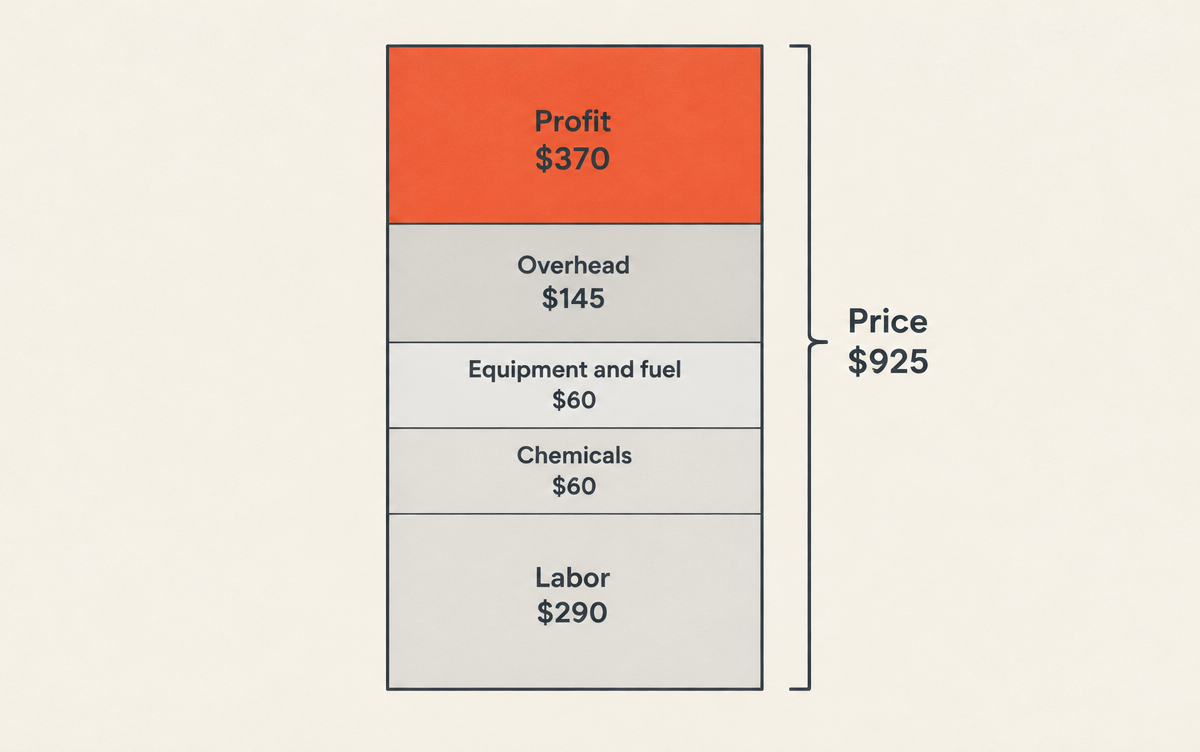
On the estimate the customer sees, split it by surface. Give each surface half the setup and drive time (3.625 hours each), its own chemicals, and its own 3 spraying hours:
| Estimate line | Your cost | Price | Per sq ft |
|---|---|---|---|
| House soft wash, 2,400 sq ft of siding | $292.50 | $487.50 | about $0.20 |
| Driveway and walkway, 1,050 sq ft of concrete | $262.50 | $437.50 | about $0.42 |
| Total | $555.00 | $925.00 |
House: 3.625 hr × $40 = $145 labor, $45 chemicals, 3 hr × $10 = $30 equipment, 3.625 hr × $20 = $72.50 overhead. That's $292.50, and $292.50 ÷ 0.60 = $487.50. The concrete line is the same math with $15 of chemicals: $262.50 ÷ 0.60 = $437.50.
Those per-square-foot numbers are yours now: about 20 cents on siding and about 42 cents on concrete, for this rig and these costs. Use them for quick quotes, and re-check them when your costs change.
Margin is a decision, not a statistic. We used 40% here; the profit margin calculator shows the price at any margin and what a discount does to it.
6. What should your minimum charge be?
Whatever the smallest job costs you, divided by one minus your margin. With the numbers above, that's $225.
A one-hour patio still takes the full drive and setup. Say 0.5 hr driving, 0.5 hr setup and breakdown, and 1 hr spraying:
- Labor: 2 hr × $40 = $80
- Overhead: 2 hr × $20 = $40
- Equipment and fuel: 1 hr × $10 = $10
- Chemicals: $5
That's $135 of cost, and $135 ÷ 0.60 = $225. Quote anything smaller at $225, or bundle it with something else on the same property.
7. What changes the price on a pressure washing job?
Anything that adds time, chemicals or risk. Price it on the estimate, not on the day.
- Heavy mildew or oxidation: more dwell time, more chemical, sometimes a second pass.
- Height: second and third stories, ladder work and steep grades slow you down.
- Oil, rust and gum: extra chemicals and time. Promise improvement, not perfection.
- Water: no outdoor spigot or weak flow means hauling water or a slower day.
- Wash water rules: some cities make you keep wash water out of storm drains or collect it. Fort Worth, Texas, for example, requires a $25 business permit plus a $25 registration per wash unit, and fines up to $2,000 per occurrence for violations (City of Fort Worth). Check your city and county.
- Add-ons on the day: the customer wants the back patio too. Price it and get a yes before you start, the same way you'd handle a change order on a bigger job.
Jobs run long. If heavy mildew adds one hour on the siding in the example, that's $40 labor, $20 overhead and $10 equipment: $70 more cost.
Your profit drops from $370 to $300 and your margin from 40% to about 32%. Price like it'll run long.
Adding window cleaning to the same trip? The math is the same, built from minutes per window instead of square feet. See how much to charge for window cleaning.
8. How do you bid commercial and recurring pressure washing jobs?
The same way: measure, time it, cost it, add margin. Then price per visit and say how often.
Walk the site first. Storefronts, dumpster pads and drive-thrus come with grease, gum, traffic and after-hours access, and some properties need wash water recovery. Every one of those is hours or equipment.
A monthly visit to a clean pad goes faster than the first deep clean, so the recurring price can be lower. Base the discount on the hours you actually save, not on the hope of keeping the account.
In WinPal you can build the estimate from a photo and a voice note, then send it from your phone and invoice the job when you're done.
Common questions about pricing pressure washing
How much should I charge per square foot for pressure washing?
Work it out from your own costs instead of copying a rate. Price one job with your hours, chemicals, equipment, overhead and margin, then divide each surface's price by its square feet. In our hypothetical example that came to about 20 cents on siding and 42 cents on concrete. Your rig and costs will give different numbers.
How do you bid pressure washing jobs?
Measure each surface, estimate hours from your production rates, add setup and driving, then cost labor, chemicals, equipment, fuel and overhead. Divide by one minus your margin. Walk the site for stains, height, water access and runoff rules. Send a written estimate with each surface as its own line and your minimum charge stated.
What's a good minimum charge for pressure washing?
The price of your smallest realistic job: drive, setup, about an hour of work and breakdown, plus overhead and margin. With $40 labor, $20 overhead and a 40% margin, our hypothetical came to $225. If you live in traffic or run a big trailer rig, yours will be higher. Under the minimum, you're paying to work.
Should I charge more for a two-story house?
Yes, because it takes longer. Your measurement already counts the extra wall area, and higher walls usually clean slower: more reach, more ladder work, more care around windows. Use a slower production rate for upper stories, or time your own two-story jobs and price from that.
Do I charge the customer for water?
Usually you use the customer's outdoor spigot, and the estimate should say so. If there's no spigot or the flow is too low, you'll be hauling water or using a tank, which adds time and fuel. Price that as its own line so the customer knows why.
What to do on your next pressure washing estimate
Measure every surface, time it with your own rates, add labor, chemicals, equipment, fuel and overhead, then divide by one minus your margin. Check it against your minimum.
Already sent one? Upload it to the estimate checker and see if it was priced too low.
Want to quote from the driveway and invoice from the truck? Get started with WinPal.