Plumbing Flat Rate Pricing Guide: Build a Price Book That Pays
Set one hourly selling rate, time each task as a full visit and price parts at cost plus markup. Includes five worked price book lines, from a $120 fill valve to a $500 toilet.
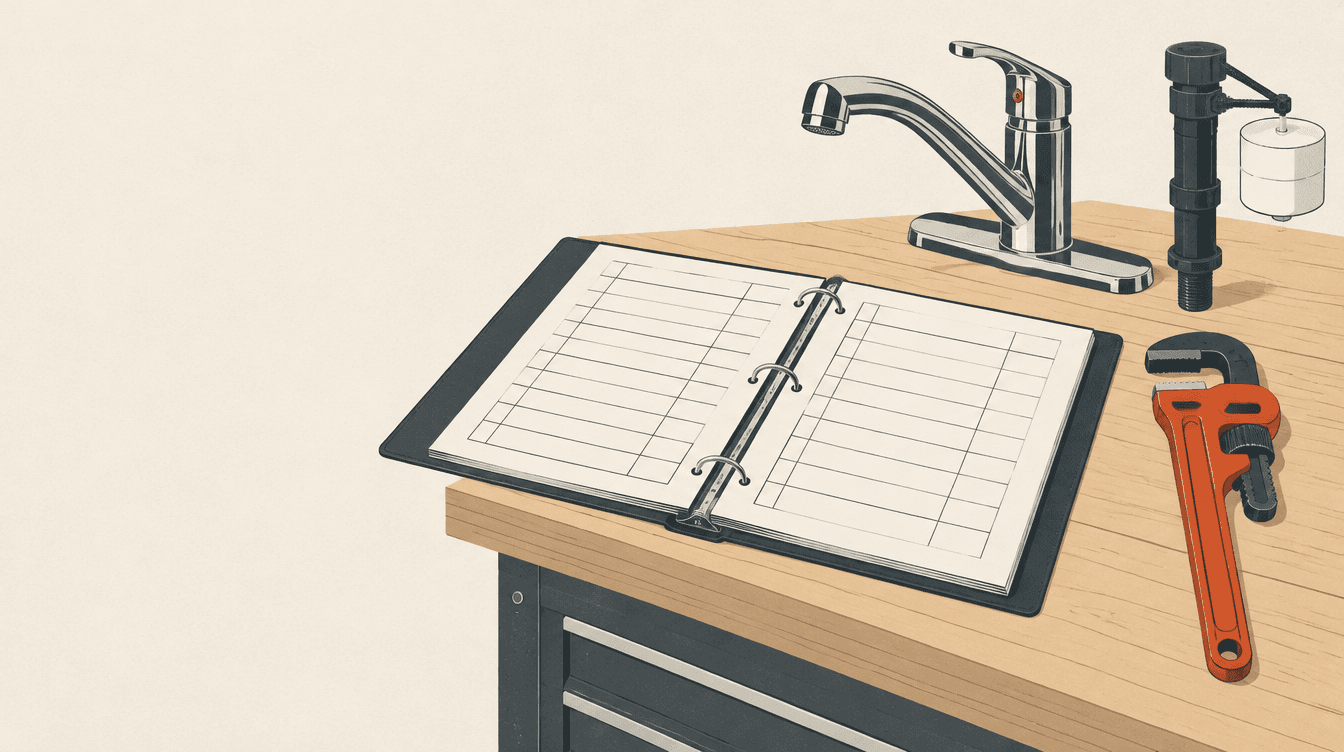
A plumbing flat rate pricing guide (your price book) is a list of the jobs you do most, each with one fixed price the customer sees before you start. Every price comes from the same formula: task hours at your hourly selling rate, plus parts at cost with your markup, rounded up.
Flat rate = task hours × (hourly cost ÷ (1 − margin)) + parts × (1 + markup).
A toilet replacement: 2.0 hours × $93.33 + $250 in parts × 1.25 = $499.17, which goes in the book at $500. Hypothetical, worked below.
A price book is how a one-truck shop quotes like a big one. You stop doing math in the customer's kitchen, every tech charges the same, and the customer gets a yes-or-no number instead of a meter running.
This guide builds a small residential service price book from scratch: the task list, the hourly rate behind it, the parts rules, the tiers and the update schedule. US dollars, hypothetical numbers, your rates swapped in. For pricing one bigger job end to end, start with how to estimate a plumbing job.
1. What a plumbing price book is (and isn't)
A plumbing price book is a menu of standard tasks, each with a written scope and a fixed price. It's not a list of what other plumbers charge. It's your costs, turned into prices you can say out loud with a straight face.
Flat rate means the customer pays the book price whether the job takes 40 minutes or 70. You carry the time risk. In return you keep the upside when you're fast, and the customer approves faster because nobody's watching the clock.
That only works if the times in the book are honest and the exclusions are written down. A book built from your best-day times is a discount program.
2. Pick the 20 to 30 jobs you do most
Start with your last six to twelve months of invoices and pull the repeat jobs. You'll likely find a short list covers a big share of your calls.
- Toilets: fill valve, flapper, wax ring reset, full replacement.
- Faucets and fixtures: cartridge, kitchen faucet, lav faucet, shower valve trim.
- Drains: sink line clear, tub line clear, main line clear from an accessible cleanout.
- Appliances: garbage disposal, dishwasher hookup, ice maker line.
- Water heaters and valves: tank replacement, T&P valve, main shutoff, hose bibb.
Give each line a short code and a one-sentence scope: what's included, what's not. "Replace toilet fill valve, includes new supply line if needed, excludes shutoff valve replacement." That sentence saves an argument later.
3. Set the hourly selling rate everything runs on
Your hourly selling rate is your loaded labor cost plus overhead per billable hour, divided by one minus your margin. Every task price in the book is built on this one number, so get it right once.
For a reference point, the national median wage for plumbers, pipefitters and steamfitters is $30.67 an hour (O*NET, from BLS 2025 wage data). Add payroll taxes, workers' comp and insurance, and an hour of a plumber costs about $40. That 30% load is an assumption; the hourly rate calculator builds yours from your own numbers.
Then overhead: truck, insurance, license, phone, software, tools, the office hours. Divide a year of it by your billable hours, not by 2,080. The example uses $30 per billable hour, also an assumption.
| Rate build | Per billable hour |
|---|---|
| Loaded labor (assumption) | $40.00 |
| Overhead (assumption) | $30.00 |
| Hourly cost | $70.00 |
| Selling rate at 25% margin ($70 ÷ 0.75) | $93.33 |
That's margin, not markup. A 25% markup on $70 is $87.50 and leaves only 20% of the price as profit. The profit margin calculator shows both side by side. The same cost-per-hour, divide-by-margin math prices a monthly cleaning contract in how to bid on janitorial contracts.
4. Time each task, including the parts nobody bills
Book times are the whole visit, not the wrench time. Use your own invoices and a stopwatch on the next few calls, then add a standard allowance for the work around the work.
The example adds 0.5 hours to every line for drive share, setup, protecting floors, testing, cleanup and writing the invoice. If your average drive is longer, make it bigger. If you charge a separate trip fee, take it out of the book times so you don't charge it twice.
Use your normal pace, not your best day. If a task sometimes runs long for reasons that aren't your fault (a seized shutoff, a cracked flange), keep that out of the base time and make it its own priced add-on.
5. Parts: cost plus markup, on its own line in your math
Price parts at your cost times one plus your markup. The example uses 25% on every part. Keep parts separate from the labor margin so you don't stack a margin on top of a markup.
Use your supply house account price, including the fittings, supply lines and wax rings that ride along with the main part. A $4 fitting you forgot is $4 of profit gone, every time that line gets used.
Cheap parts can carry a higher markup, because the trip and handling cost the same for a $10 part and a $100 one. Pick a rule, write it at the front of the book and stick to it.
6. Worked example: five lines of a residential price book
Hypothetical book for a one-truck residential service shop. Selling rate $93.33 an hour, 25% parts markup, every price rounded up to the next $5. Task hours include the 0.5-hour allowance.
| Task | Hours | Parts cost | Math | Book price |
|---|---|---|---|---|
| Replace toilet fill valve | 1.0 | $18 | $93.33 + $22.50 = $115.83 | $120 |
| Replace garbage disposal, 1/2 hp | 1.5 | $130 | $140.00 + $162.50 = $302.50 | $305 |
| Replace kitchen faucet, standard | 1.5 | $160 | $140.00 + $200.00 = $340.00 | $340 |
| Replace kitchen faucet, upgraded | 1.5 | $300 | $140.00 + $375.00 = $515.00 | $515 |
| Replace toilet, standard | 2.0 | $250 | $186.67 + $312.50 = $499.17 | $500 |
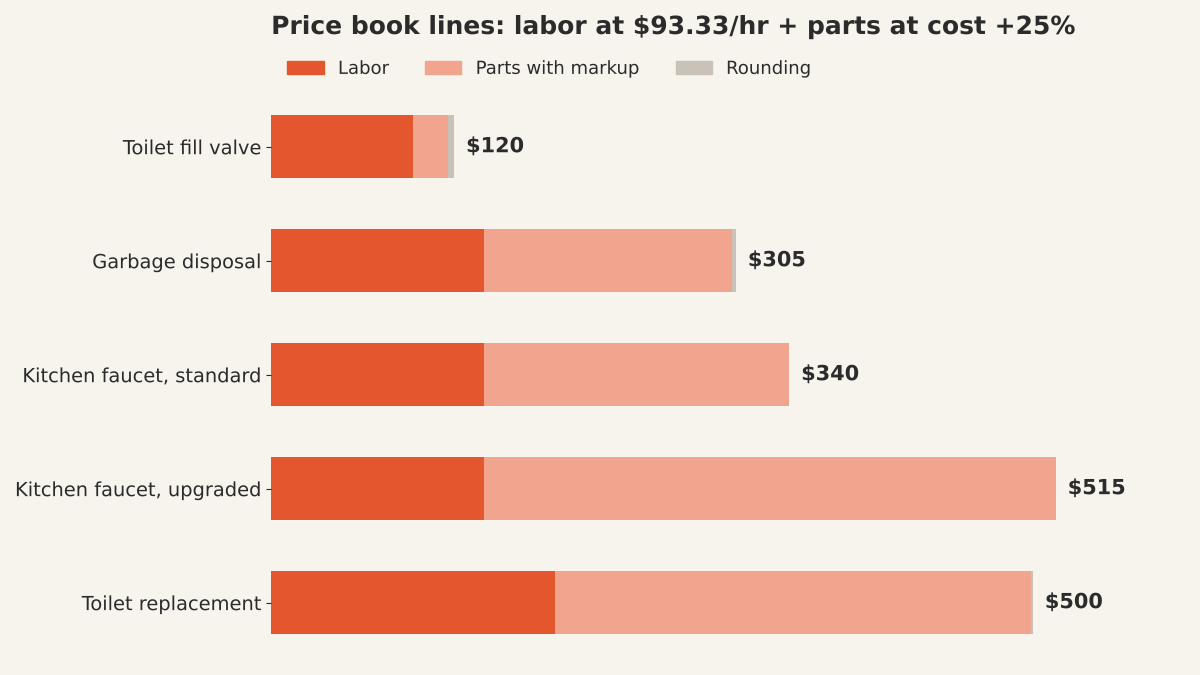
Check what each line actually keeps. The toilet replacement costs you 2.0 × $70 + $250 = $390, so $500 leaves $110, or 22% of the price. The fill valve keeps $32 on $120 (26.7%) because labor is most of it. Lines that are mostly parts keep a lower percentage, which is why the parts markup matters.
The book sets the price; your estimate is what the customer approves. A flat rate quoted before the work is a firm price, which is the difference covered in quote vs estimate.
7. Good, better, best tiers and add-ons
Tiers give the customer a choice on the same task, and the choice is usually the part. Same labor, different faucet. In the example, the standard kitchen faucet is $340 and the upgraded one is $515.
Keep tiers to two or three per task. More than that and the customer stalls. Write the difference in plain words: brand line, finish, warranty length, what's included.
Add-ons are the priced "if we find" items: replace the angle stop, replace the supply line, add an expansion tank. Put them in the book at the same rate and markup, so a surprise becomes a line the customer already saw instead of a phone call.
8. Service call fees, diagnostics and after-hours
A diagnostic or service call fee pays for the visit when there's no book task yet. A simple rule is one hour at your selling rate: $93.33, so $95 in the example. Decide whether it's credited toward the repair and say so on the estimate.
After-hours and emergency work gets a multiplier on the book price, not a different book. At 1.5×, the $120 fill valve is $180 on a Sunday night. Write the hours that count as after-hours at the front of the book.
Anything open-ended (a drain you can't see, a leak behind a wall you haven't opened) stays time and materials until you know the scope. Then it can become a flat rate.
9. Update the book when part prices move
Re-price the book at least once a year, and whenever a supplier price change lands. Plumbing parts don't drift up slowly; they jump.
The Producer Price Index for plumbing fixture fittings and trim rose about 5.1% from July 2025 to July 2026, and about 12.7% over the two years from July 2024 (BLS PPI series WPU1054 via FRED). On the $250 of parts in the toilet line, 5.1% is about $16 more per job at the book price ($250 × 0.051 × 1.25).
Keep part costs in one column of the book so an update is a column change, not a rewrite. Re-time a task when your crew or methods change. And if your loaded labor or overhead moves, change the selling rate once and let every line follow.
Common plumbing flat rate pricing questions
How do you calculate flat rate pricing for plumbing?
Multiply the task's full visit time by your hourly selling rate, which is hourly cost divided by one minus your margin. Add parts at cost times one plus your markup, then round up. With a $93.33 rate and 25% markup, a 2-hour toilet replacement with $250 of parts comes to $500.
What is flat rate pricing for plumbers?
It's charging a fixed, published price per task instead of billing hours. The customer approves the number before work starts and pays it whether the job runs short or long. The plumber carries the time risk, so book times and written exclusions have to be realistic.
Is flat rate or hourly better for a small plumbing shop?
Flat rate works best for repeat jobs you can time well: fixtures, toilets, disposals, water heaters. Hourly, or time and materials, fits diagnostics and open-ended work where the scope isn't known yet. Most small shops run both and convert a job to flat rate once they can see it.
Should I buy a plumbing price book or build my own?
A bought book gives you a task list and suggested times to start from. The prices still have to come from your own labor cost, overhead and margin, because a price set for someone else's costs can leave you underwater. Build or adjust every line with your own selling rate.
What to do with your price book this week
Pull your top 20 jobs from last year's invoices, set one hourly selling rate, time each task as a full visit, price parts at cost plus markup, round up and write the scope sentence. In WinPal you can build an estimate from a voice note on site and send it before you leave the driveway.
Already quoted a flat rate this month? Upload that estimate to the checker and see if it's priced too low.