Quote vs Estimate: Which One to Send (and When the Number Binds You)
An estimate is a range that can move. A quote is a price you have to hold. Here's when to send each, the fine print that protects you, and a $920 door-frame job worked from phone estimate to signed quote.

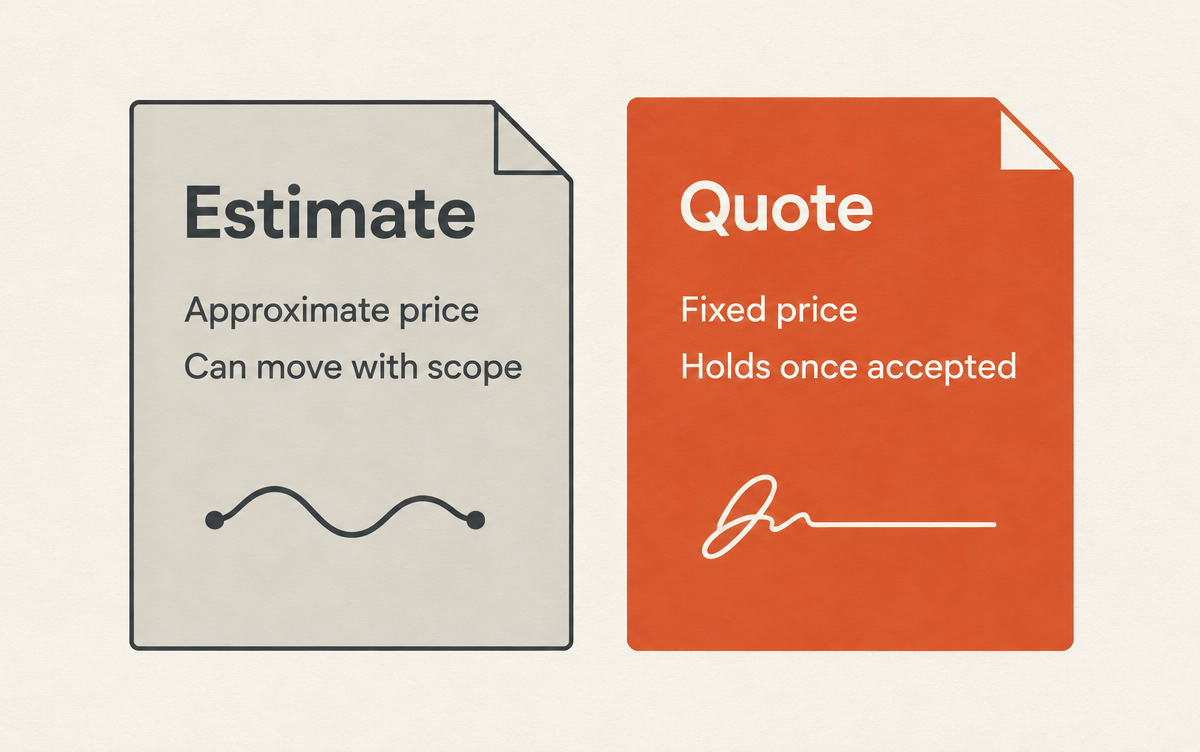
A quote is a fixed price for a defined scope of work. An estimate is your best guess at the price, and it can move when the job turns out different from what you saw. Send an estimate when you haven't seen the job or the scope is still open. Send a quote when you've measured it, priced it and you're ready to hold the number.
That's the whole quote vs estimate question: can the number move?
Estimate = a range for a job you haven't fully scoped. Quote = one price for a scope you've written down. Anything outside that scope = a change order, not an argument.
Phone estimate: $650 to $950. Written quote after the site visit: $920. Rot in the subfloor the quote excluded: a $240 change order.
Customers mix the two up constantly, and the mix-up always costs you, never them. The handyman who said "probably around 700" on the phone is the one explaining the $920 invoice.
This guide covers what each document commits you to, when to send which, the three lines that keep an estimate from being read as a quote, and a hypothetical door-frame job worked from phone estimate to signed quote to change order. US dollars, US rules, and a "check your state" wherever the law comes in.
What's the difference between a quote and an estimate?
An estimate is an approximate price based on what you know so far, and the final bill can come in higher or lower. A quote is a firm price for a specific, written scope, and once the customer accepts it you're expected to do that work for that money. The difference isn't the word on the top of the page. It's whether the number can move.
| Estimate | Quote | |
|---|---|---|
| What it is | An educated guess, usually a range | A fixed price for a defined scope |
| When you send it | Before a site visit, or when the scope is still open | After you've measured, priced and written the scope |
| Can the number change? | Yes, and you should say so on the document | Only through a change order the customer signs |
| If you're wrong | You bill actual costs, within reason, and you explain why | You eat the difference unless the scope changed |
One more thing the table can't show: customers hear "quote" when you say "estimate." If you say a number out loud, assume they'll remember it as a promise. Put the range in writing the same day.
Is a quote legally binding? Is an estimate?
A written quote that the customer accepts is generally treated as a contract: you've offered to do a defined scope for a stated price and they've said yes. An estimate is not a promise of price, but it's not nothing either. If you bill double a written estimate with no explanation, you'll have a hard time collecting. Courts and licensing boards look at what the document says, not what you called it.
Two state rules show how seriously this gets taken. In California, the Contractors State License Board says home improvement work over $500 in combined labor and materials must be in a written contract with the agreed price, and any change to that price "MUST be done with a written change order that becomes a part of the contract." The down payment on a California home improvement job is capped at $1,000 or 10 percent of the contract price, whichever is less.
Minnesota goes further on estimates. Under the state's Truth in Repairs Act (Minn. Stat. 325F.58), a shop that gives a written estimate for covered repairs (over $100, to a vehicle, appliance or dwelling used for personal purposes) can't charge more than 110 percent of that estimate unless it immediately gives the customer a revised written estimate and gets authorization to continue. The same law lets the shop charge for making the estimate only if it told the customer about the charge first.
Your state probably has its own version of one or both. The safe habits are the same everywhere: write the scope, write the price, write what's excluded, and get a signature before you buy materials. Check your state licensing board before you rely on any of this; it's not legal advice.
When to send an estimate, a quote, or nothing yet
Match the document to how much you actually know. Here's the rule most small contractors land on after a few burned jobs.
| Situation | Send | Why |
|---|---|---|
| Customer describes the job over the phone or by text | Estimate, as a range | You haven't seen it. A single number becomes a promise. |
| You've done the site visit and measured | Quote | You know the scope. Hold the number and win the job. |
| Hidden conditions are likely (rot, old wiring, slab you can't see under) | Quote for what you can see, with exclusions | The visible work gets a fixed price. The hidden work gets a stated rate. |
| Customer is comparing four contractors on price alone | Quote, itemized | A range reads as "doesn't know." A clean quote reads as "done this before." |
| Scope keeps changing while you talk | Nothing yet | Ask them to write down what they want. Then quote that. |
| Repair work where the fault isn't diagnosed | Estimate for diagnosis, quote for the fix | Two documents, two prices. Nobody is surprised. |
The number itself comes from your costs, not from the customer's face. If you haven't built it yet, start with how to price handyman jobs: labor, materials, overhead, then margin.
The three lines that keep an estimate from becoming a quote
An estimate protects you only if it says, in plain words, that it's an estimate. Put these three lines on every one, near the number, in the same font size as the number.
- "This is an estimate, not a fixed price." Say it in those words. A heading that reads "Estimate" in small gray type doesn't count.
- "Based on what I could see on [date]." That ties the number to the information you had. New information, new number.
- "Final price will be set in a written quote after a site visit." Or, for small jobs: "Final price billed at $X per hour plus materials, not to exceed $Y without your approval." The not-to-exceed line is what keeps a customer from feeling ambushed.
Give the estimate a range, not a point. "$650 to $950" tells the customer where the job lives. "$700" tells them the job costs $700, whatever you meant.
What every quote needs so you can hold the number
A quote is only as strong as its scope. If the scope is one line, every surprise is a fight. If it's six lines plus exclusions, every surprise is a change order.
- Scope. What you'll do, in the order you'll do it, with quantities and materials named. "Replace exterior door jamb and brick mold, reset existing door, flash and caulk" beats "fix door."
- Exclusions. The two or three things most likely to turn up that you're not pricing. Subfloor repair. Paint. Hauling the old concrete.
- Price and what it includes. One number. Tax, disposal and the trip to the supply house are in it or listed separately, but they're somewhere.
- Validity date. "Good for 30 days." Material prices move; your quote shouldn't have to move with them forever.
- Deposit and payment schedule. When money changes hands. The options and the state limits are in contractor payment terms.
- Change order clause. "Work outside this scope is priced and approved in writing before it starts." The one paragraph that turns surprises into paid work. How to write one is in construction change orders.
- Signature line. No signature, no quote, no job. A text that says "go ahead" is not a signed scope.
In WinPal you can build the quote from a photo of the job and a voice note describing the scope, then send it for the customer to accept from their phone. The same job becomes the invoice later, so the scope you quoted is the scope you bill.
Worked example: a rotted door frame, from estimate to quote
Hypothetical job. A customer texts a photo of a back door that won't latch. The bottom of the jamb looks soft. You can't tell how far the rot goes from the photo.
Day 1, by text: the estimate. "Looks like the jamb and brick mold need replacing and the door reset. Estimate $650 to $950 depending on how far the rot goes. This is an estimate, not a fixed price. Final price in a written quote after I see it Thursday."
Day 3, after the site visit: the quote. The rot stops at the jamb. The subfloor feels solid but you can't see under the threshold. You build the number from cost, then apply margin.
| Line item | Qty | Rate | Cost |
|---|---|---|---|
| Labor, loaded rate (you, including payroll costs) | 6 hr | $55 | $330 |
| Jamb and brick mold kit | 1 | $140 | $140 |
| PT lumber and flashing | 1 | $65 | $65 |
| Fasteners, caulk, shims | 1 | $25 | $25 |
| Disposal | 1 | $40 | $40 |
| Overhead (truck, insurance, phone) | 6 hr | $15 | $90 |
| Total cost | $690 | ||
| Price at 25% margin ($690 ÷ 0.75) | $920 |
The quote says: "Replace exterior door jamb and brick mold, reset existing door, flash and caulk. $920. Excludes subfloor or framing repair under the threshold; if found, priced as a change order at $55 per hour plus materials before work continues. Good for 30 days." The customer signs it Thursday night.
Margin, not markup. $690 ÷ 0.75 gives $920 and keeps 25 percent of the price ($230) as profit. Adding 25 percent to cost would give $862.50 and only 20 percent of the price. The profit margin calculator shows the gap for any cost.
Day 5, on the job: the change order. You pull the threshold and find 2 square feet of rotted sheathing. You stop, snap a photo and send a change order: 2 hours of labor ($110) plus overhead ($30) plus a sheet of sheathing ($40), cost $180, priced at $180 ÷ 0.75 = $240. The customer approves it from her phone before you cut anything.
Invoice: $920 plus $240 equals $1,160, and nobody is arguing, because the quote said this could happen and the estimate said the quote would come.
Quote vs estimate vs bid vs proposal
Four words, two of which matter for most residential work. A bid is a quote submitted in competition, usually against a written scope the customer or a general contractor wrote, with a deadline. If you're pricing a bathroom remodel against three other contractors, you're bidding, and the bid is a quote.
A proposal is a quote wrapped in a pitch: your approach, timeline, references, and the price. It earns its keep on larger jobs where the customer is choosing a contractor, not just a number.
The types of estimate (rough order of magnitude, budget, definitive) matter more on construction jobs than on service calls; the breakdown is in how to estimate construction costs. For a trade where the materials are sold by volume and the truck charges you for coming out, like concrete, the quote has to carry the supplier's minimums too; see how to price concrete jobs.
Common quote vs estimate questions
Can a contractor charge more than the estimate?
Usually yes, within reason, because an estimate isn't a fixed price. "Within reason" is the catch: some states cap how far a final bill can drift from a written estimate without the customer's okay, and every state's licensing board gets complaints about it. The clean move is to stop, explain, and get approval in writing before the bill grows.
How long is a quote valid?
As long as the quote says. Thirty days is a common choice for small residential work because material prices and your schedule both move. Put the date on the document ("good through November 13, 2026") rather than a vague "prices subject to change," which protects nobody.
Should I charge for an estimate?
Charge for the site visit when it takes real time or diagnosis, and say so before you drive out (Minnesota's repair law, for one, only allows an estimate charge the customer was told about in advance). A phone or photo estimate is free because it's a range, not work. Many contractors credit the visit fee against the job if the customer signs the quote, which makes the fee easy to say yes to.
Is a verbal quote binding?
It can be, which is exactly why you shouldn't give one. A number said out loud with a "yes" from the customer is a deal in their mind and possibly in a small-claims judge's. Say "I'll put that in writing tonight" and then do it. Written quotes also let you include the exclusions a verbal one never carries.
Does an estimate need to be in writing?
Not by law in most places, but always in practice. A written range with the three protective lines (estimate not a price, based on what I saw, final price after site visit) is what you point to when the customer remembers "$700" and you said "$650 to $950." It takes thirty seconds and it ends the argument before it starts.
What to do on your next job
Phone or text: send a written range with the three lines. Site visit: build the cost, divide by one minus your margin, write the scope and exclusions, get the signature. Then anything outside the scope is a change order, not a debate.
Upload your last quote to the estimate checker and see whether the number you held was too low to begin with.