How to Price Concrete Jobs: From Yards on the Truck to a Number You Can Hold
The concrete itself is less than a quarter of the job. Here's how to price concrete from the truck up, with a 12 x 20 patio worked from 2.96 yards to a $3,176 quote.
To price a concrete job, add up everything the pour costs you (the concrete and its delivery fees, the base, forms and reinforcement, every hour of labor across prep, pour and strip, equipment, and a share of overhead), then divide by one minus your margin. The concrete itself is often less than a quarter of that total.
Price = total cost ÷ (1 − margin).
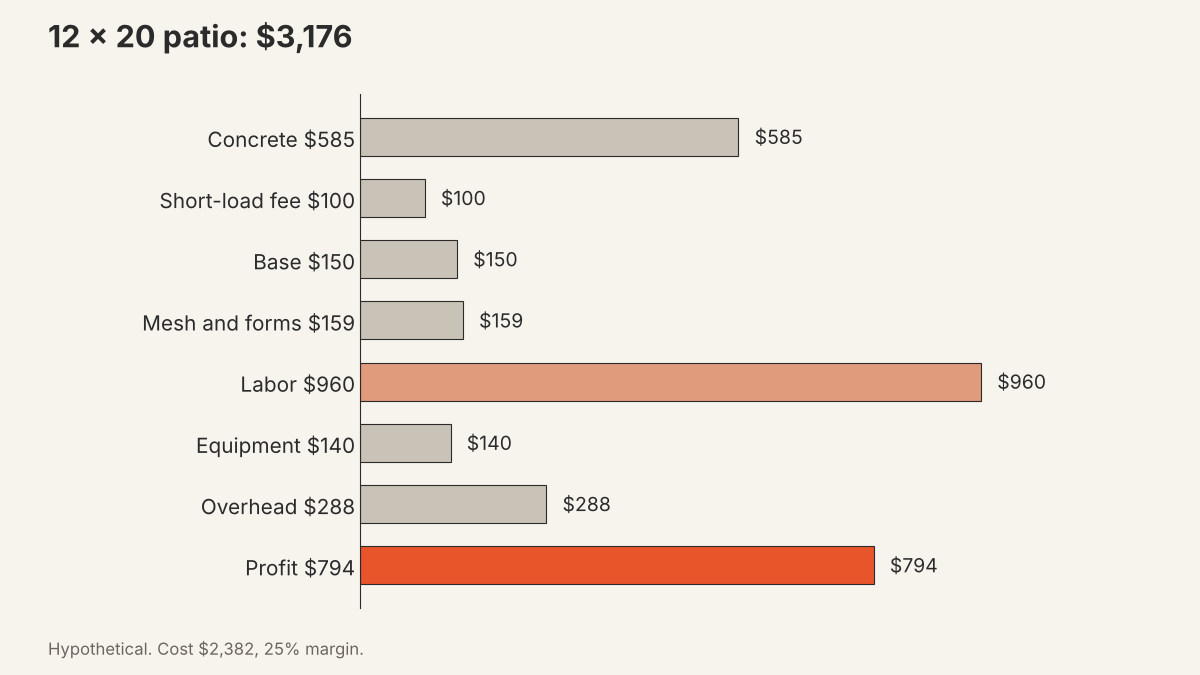
A 12 × 20 ft broom-finish patio: $2,382 in costs ÷ 0.75 = $3,176 at a 25% margin, or $13.23 per square foot. Hypothetical, worked below.
Concrete is unforgiving about pricing because the product is perishable and the truck charges by the minute. Forget the short-load fee and your margin noticed before the chute came down.
This guide prices small residential flatwork: patios, pads, walkways, driveways. US dollars, a hypothetical worked example, and the plant questions to ask before you quote.
1. Measure the pour and order the right number of yards
Cubic yards = length (ft) × width (ft) × thickness (ft) ÷ 27. A 12 × 20 patio at 4 inches is 240 × 0.333 = 80 cubic feet, or 2.96 cubic yards. Then add extra: the National Ready Mixed Concrete Association says the quantity ordered "should be 4% to 10% more than an estimate calculated from the plan dimensions," because of uneven subgrade, spillage and what stays in the chute (NRMCA CIP 31). At 8 percent that's 3.2 yards, so you order 3.25 and bill the concrete you ordered, not the concrete you measured.
Two things people get wrong here. First, thickness: a slab that's 5 inches at the edge and 4 in the middle because the grade was rough is a 25 percent overage you didn't price. Second, bagged concrete: for anything over about half a yard, the truck is cheaper per yard and faster per hour, even with a short-load fee. The concrete calculator does the yards, bags and the waste allowance for slabs, footings and pads if you'd rather not do it on the tailgate.
2. Call the plant before you quote
The per-yard price is one of five numbers you need from the plant, and the other four are where small jobs lose money. Ask for all of them and write them on the estimate.
- Price per yard, delivered, for the mix you want. ConcreteNetwork puts the US average at $179.95 per cubic yard in 2025, with most of the country between $160 and $195 (updated July 14, 2026). Your plant is the only number that counts; air entrainment, fiber, hot or cold weather admixtures and color are all extra.
- Minimum load and short-load fee. Trucks carry 8 to 12 yards (NRMCA). Send one out with 3, and most plants add a flat fee or bill per missing yard. Some set the minimum at 4 yards, some at 6. Ask.
- Delivery, fuel or environmental charge. Sometimes it's in the per-yard price. Sometimes it's a line you find on the invoice.
- Waiting time. Plants give you a set number of minutes to unload, then charge by the minute. If your crew is still setting mesh when the truck arrives, that's a cost.
- Strength and slump. NRMCA says 3,500 to 5,000 psi covers most applications and most placements want a 3 to 5 inch slump. Say what you want so you're not arguing about a stiff load at 7 a.m. The producer is responsible for the slump for 30 minutes after the requested time or arrival, whichever is later (NRMCA CIP 31), which is one more reason to be ready when the truck is.
3. Base, forms, reinforcement and the stuff that isn't concrete
Everything under and around the slab gets its own line. None of it is expensive on its own. All of it together is a few hundred dollars that a per-yard quote never includes.
- Base. Crushed stone, usually 4 inches for a patio, priced by the yard and compacted. The volume math is the same as the slab: 240 sq ft × 4 inches is about 3 yards, and you'll want a little more because it compacts.
- Forms. 2x4s, stakes, nails and form release for the perimeter. A 12 × 20 is 64 linear feet of edge. Reuse lumber where you can, but price it new; the stakes don't come back clean.
- Reinforcement. Wire mesh for a patio or walkway, #4 rebar on a grid where cars or equipment will sit. Mesh is priced by the sheet or roll, rebar by the stick, plus chairs and tie wire.
- Extras the drawing doesn't show. Expansion joint against the house, a vapor barrier under an interior slab, cure and seal, and the sod or dirt you haul out of the hole.
If you came to concrete from landscaping, the hardscape math in how to price landscaping jobs carries over: measure, count every trip, then margin.
4. Labor: count the hours for three visits, not one
A patio is three trips. Day one you dig, grade and compact the base. Day two you set forms and mesh and take the pour. Day three you strip forms, backfill and clean up.
Count every person-hour on every trip, including the drive and the time standing at the chute waiting for the truck.
Use your loaded labor rate, not the wage. Loaded means wage plus payroll taxes, workers' comp and the rest of what an hour of a person actually costs you; the hourly rate calculator builds it from your own numbers. Your own hours count at the same rate. If you're the one screeding, that's labor, not profit.
5. Equipment, disposal and overhead
Plate compactor rental, a power trowel if you're troweling, a pump if the truck can't reach, and the dump run with the sod and spoil. Rentals come with minimums (a half day usually costs the same as four hours), so price the minimum.
Overhead is the truck, insurance, phone, software and the office hours nobody bills. Spread it over the hours you can bill in a year and add it per person-hour, or add a flat percentage to the job. Either way it's a line, not a feeling.
6. Margin, not markup
Margin is profit as a share of the price. Markup is profit as a share of the cost. Dividing cost by one minus your margin gets you the price that actually keeps that margin; multiplying cost by one plus a markup gets you less than you think.
On $2,382 of costs, a 25 percent margin is $2,382 ÷ 0.75 = $3,176, with $794 kept. A 25 percent markup is $2,382 × 1.25 = $2,977.50, and $595.50 of that is only 20 percent of the price. The profit margin calculator shows both for any cost so you don't quote one and expect the other.
7. Worked example: a 12 × 20 broom-finish patio
Hypothetical job. A 12 × 20 ft patio off a back door, 4 inches thick, broom finish, wire mesh, 4 inches of crushed stone base, new forms, and the truck can back up to the forms. Crew of three. Prices are assumptions for a mid-cost US market; swap in yours.
| Line item | Qty | Rate | Cost |
|---|---|---|---|
| Ready-mix, 3,500 psi (2.96 yd + 8%, ordered as 3.25) | 3.25 yd | $180 | $585 |
| Short-load fee (plant minimum 4 yd) | 1 | $100 | $100 |
| Crushed stone base, 4 in | 3 yd | $50 | $150 |
| Wire mesh, 5 × 10 sheets | 6 | $14 | $84 |
| Forms: 2x4s $40, stakes $20, nails and release $15 | 1 | $75 | $75 |
| Labor, loaded (3 people: 3 hr base, 2 hr forms and mesh, 2.5 hr pour and finish, 0.5 hr strip) | 24 hr | $40 | $960 |
| Plate compactor rental $80, dump run $60 | 1 | $140 | $140 |
| Overhead | 24 hr | $12 | $288 |
| Total cost | $2,382 | ||
| Price at 25% margin ($2,382 ÷ 0.75) | $3,176 |
That's $13.23 per square foot, with $794 of profit on top of everyone's wages, including yours. ConcreteNetwork's homeowner range for a patio is $5 to $18 per square foot and $6.50 to $10.50 for a plain slab, so this job sits in the range a customer will have seen, and you know exactly which lines made it land there.
8. Three ways a concrete job eats its own margin
The truck is late, or you are. One extra clock hour for a three-person crew is 3 person-hours at $52 (loaded rate plus overhead), or $156 straight out of the $794. Two of those and you've lost nearly 40 percent of the profit. Order the truck for when the forms will be done, not when you hope they will be.
The truck can't reach. A loaded mixer weighs about 80,000 pounds (NRMCA CIP 31) and won't cross a lawn or a residential curb without leaving a mark or getting stuck. If the pour is behind the house, price a pump or price the wheelbarrow hours, and say which one on the quote.
The finish changes at the fence line. "Can you stamp it?" after the base is in is a different job: more labor per square foot, release agent and color, and sealer. Price it as a change order before the truck is ordered, not as a favor after. The template is in construction change orders.
9. What a concrete quote should say
Write the quote so the customer can see the slab you priced, because the slab they picture is always bigger and thicker. Dimensions and thickness. Base depth. Reinforcement type. Finish. Where the truck will park and what happens to the lawn.
What's excluded: permits, grading beyond the slab, hauling anything that isn't in the hole today. A fixed price, a date it's good through, and a deposit that covers the concrete order, since the plant wants to be paid whether the customer pays you or not; the options are in contractor payment terms.
And call it what it is. If you've measured and priced it, it's a quote and you hold the number. If you're going off a text message and a guess at thickness, it's an estimate with a range, and it should say so. The difference, and what each one commits you to, is in quote vs estimate.
In WinPal you can build the quote from a photo of the site and a voice note with the dimensions, send it for the customer to accept, and turn the same job into the invoice when the forms come off.
Common concrete pricing questions
How much should I charge per square foot for concrete?
Whatever your costs divided by one minus your margin comes to, then check it against the market. In the worked example that's $13.23 per square foot for a small patio with base and mesh. Per-square-foot rates are useful for a sanity check and a phone range; they're not how you build the price, because a 100 square foot pad and a 1,000 square foot driveway don't share a rate.
How much do concrete contractors mark up?
Think in margin instead. A 25 percent margin (cost ÷ 0.75) is a common target on small residential flatwork; a 25 percent markup (cost × 1.25) sounds the same and keeps 20 percent of the price, not 25. Whatever number you pick, apply it to every line including the short-load fee and the dump run, not just the concrete.
What is a short-load fee?
A charge the plant adds when your order is under its minimum, often 4 to 6 yards, because the truck and driver cost the same whether they carry 3 yards or 10. It's a flat fee at some plants and a per-missing-yard charge at others. Put it on the quote as its own line so the customer sees why a small pour isn't cheap per yard.
Should I charge for forms if I reuse the lumber?
Yes. Price the forms as if the lumber is new. Some of it comes back, the stakes and the time setting and stripping it don't, and the customer is paying for a formed slab, not for your lumber pile. Treat whatever you salvage as a small bonus on the next job.
When should I bid concrete by the yard instead of by the job?
Almost never on residential flatwork. By-the-yard pricing hides prep, forms and the short-load fee, which is exactly where small jobs lose money, and it makes the customer shop your per-yard number against the plant's. Quote the finished slab as one price with the dimensions and finish written down.
What to do on your next pour
Run the yards with 8 percent extra, call the plant for all five numbers, count the hours three visits deep, add overhead, divide by one minus your margin. Then write the slab you priced on the quote.
Upload your last concrete quote to the estimate checker and see whether the number covered the truck, the base and the hours, or just the concrete.