HVAC Price Book: How to Build Flat Rate Prices That Pay
Build an HVAC flat rate price book from one hourly selling rate and a sliding parts markup chart. Worked example: a $125 capacitor, a $690 inducer motor and what each line keeps.
An HVAC price book is your list of repeat service and repair tasks, each with one flat rate the customer approves before you start. Every line runs on the same math: task hours at your hourly selling rate, plus the part at cost times a multiplier from your parts markup chart, rounded up.
Flat rate = task hours × (hourly cost ÷ (1 − margin)) + part cost × multiplier.
A dual run capacitor swap: 0.75 hours × $104.29 + $18 × 2.5 = $123.21, which goes in the book at $125. Hypothetical, worked below.
A book stops the math at the condenser. Every tech quotes the same number, the customer says yes or no to a price instead of a running clock, and you keep the upside when the job goes fast.
This guide builds a small residential HVAC flat rate price book: what goes in it, the selling rate, a sliding parts markup chart, five worked lines, add-ons, diagnostics and after-hours. US dollars, hypothetical numbers, your costs swapped in. For pricing a full install or change-out as a bid, start with how to price HVAC jobs.
1. What goes in an HVAC price book, and what stays a bid
Repeat repairs and maintenance you can scope once you've found the problem go in the book. Installs, change-outs and duct jobs stay as written bids, because every house is different.
Typical book sections for a residential shop:
- Electrical parts: run capacitors, start kits, contactors, relays, fuses and disconnects.
- Motors: condenser fan motors, blower motors, inducer motors.
- Drains and water: clear and treat a condensate drain, replace a condensate pump, float switches.
- Controls: thermostats, igniters, flame sensors, pressure switches.
- Maintenance: AC and furnace tune-ups, filter swaps, coil cleaning.
- Refrigerant: a per-pound line by type, priced from your last invoice.
Write each line's scope like a contract line, because it is one. "Replace one dual run capacitor, same rating, on an accessible outdoor unit. Excludes diagnosis, refrigerant and any other failed part." That sentence is what you point to when the customer asks why the contactor is extra.
2. Set the hourly selling rate every line runs on
Your hourly selling rate is loaded labor plus overhead per billable hour, divided by one minus your margin. Set it once and every price in the book follows.
For a reference point, the national median wage for HVAC mechanics and installers is $29.33 an hour (O*NET, from BLS 2025 wage data). Add payroll taxes, workers' comp and insurance at about 30% and an hour of a tech costs about $38. That load is an assumption; the hourly rate calculator builds yours from your own numbers.
Overhead is the van, license, insurance, recovery machine, gauges, phone, software and the hours on the office side. Divide a year of it by billable hours, not 2,080. The example uses $35 per billable hour, also an assumption.
| Rate build | Per billable hour |
|---|---|
| Loaded labor (assumption) | $38.00 |
| Overhead (assumption) | $35.00 |
| Hourly cost | $73.00 |
| Selling rate at 30% margin ($73 ÷ 0.70) | $104.29 |
That's margin, not markup. A 30% markup on $73 is $94.90, which keeps only 23% of the price. The profit margin calculator shows both side by side.
3. Time each task as a full visit
Book hours are the whole visit, not wrench time. Drive share, setup, shutting the unit down, the repair, the test run, cleanup and writing up the ticket all count.
The example adds 0.5 hours to the first task on every visit for that. If you charge a separate trip fee, take the allowance out so you don't bill it twice.
Use your normal pace, not your best day in October. Rooftop units, attic air handlers and crawlspaces become access add-ons on the ticket instead of padding baked into every line.
4. Build an HVAC parts markup chart
An HVAC parts markup chart is a sliding scale: a high multiplier on cheap parts and a lower one on expensive parts. Handling an $18 capacitor costs you about the same as handling a $320 inducer motor, so a flat percentage underprices the small stuff and overprices the big stuff.
Here's a hypothetical chart. The multiplier is what you multiply your part cost by. The last column shows how much of the parts price you keep, which is 1 − 1 ÷ multiplier.
| Your part cost | Multiplier | Markup | Margin on the part |
|---|---|---|---|
| $0 to $25 | 2.5× | 150% | 60% |
| $25.01 to $100 | 2.0× | 100% | 50% |
| $100.01 to $250 | 1.75× | 75% | 42.9% |
| $250.01 to $500 | 1.5× | 50% | 33.3% |
| Over $500 | 1.25× | 25% | 20% |
These tiers are an example, not an industry standard. Set yours from what your parts cost, how often you warranty them and what your market will pay, then write the chart at the front of the book and use it on every line.
Customers can look up a capacitor online. That's fine.
They're not paying for the part, they're paying for the diagnosis, the right part on the truck at 6 p.m. and the warranty on the repair.
5. Worked example: five lines of an HVAC flat rate price book
Hypothetical book for a one-van residential service shop. Selling rate $104.29 an hour, parts priced from the chart above, every price rounded up to the next $5. Task hours include the 0.5-hour visit allowance.
| Task | Hours | Part cost | Math | Book price |
|---|---|---|---|---|
| Replace dual run capacitor | 0.75 | $18 | $78.21 + $18 × 2.5 = $123.21 | $125 |
| Replace contactor | 1.0 | $22 | $104.29 + $22 × 2.5 = $159.29 | $160 |
| Clear and treat condensate drain | 0.75 | $5 | $78.21 + $5 × 2.5 = $90.71 | $95 |
| Replace condenser fan motor | 1.5 | $140 | $156.43 + $140 × 1.75 = $401.43 | $405 |
| Replace furnace inducer motor | 2.0 | $320 | $208.57 + $320 × 1.5 = $688.57 | $690 |
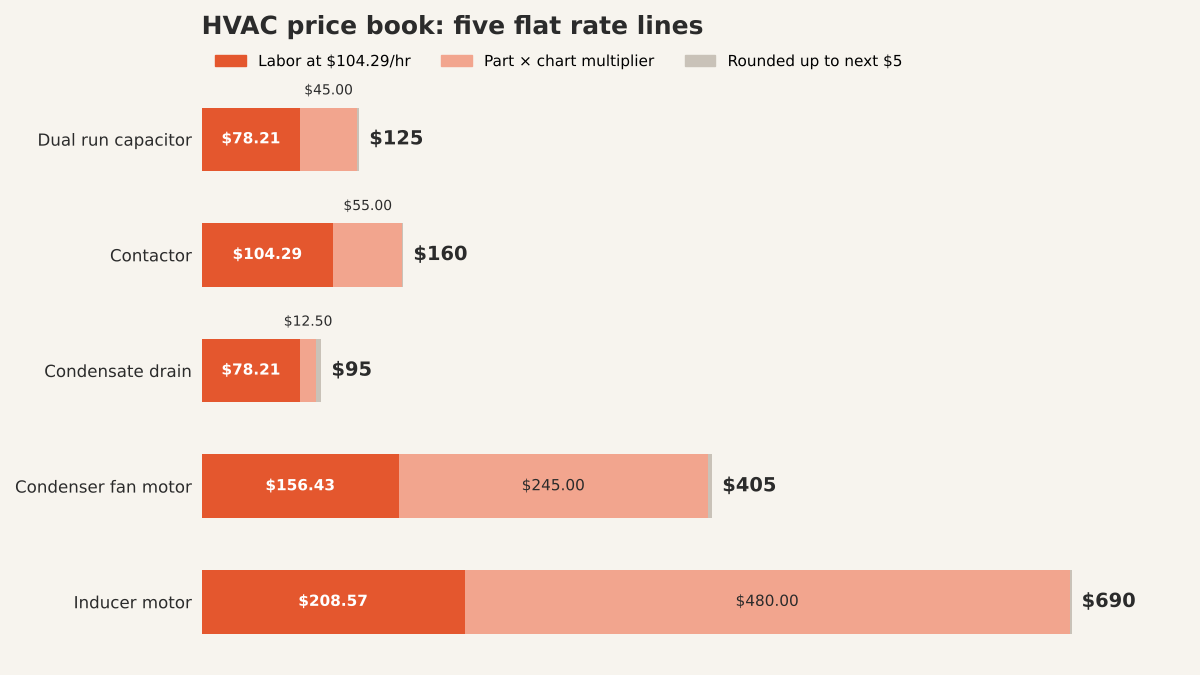
Now check what each line keeps. The capacitor costs you 0.75 × $73 + $18 = $72.75, so $125 keeps $52.25, or 41.8% of the price. The inducer motor costs $466 and keeps $224, or 32.5%.
Big-part lines keep a smaller share but more dollars, which is the point of a sliding chart.
Run the capacitor with a flat 25% markup instead and it's $78.21 + $22.50 = $100.71, so $105 in the book. You keep $32.25 instead of $52.25. Do that on a few hundred capacitor calls a summer and your margin noticed.
The book sets the number; the estimate is what the customer approves. A flat rate quoted before the work is a firm price, the difference covered in quote vs estimate.
6. Add-on lines for the second repair on the same visit
Add a "same visit" price for parts you often find together. It carries the wrench time and the part, not the visit allowance, because the drive and setup are already paid for.
In the example, a capacitor found during another repair is 0.25 hours × $104.29 + $18 × 2.5 = $71.07, so $75 in the book instead of $125. It still keeps $38.75 on a $36.25 cost.
Add-ons also keep you honest on tune-ups. If a tune-up finds a weak capacitor, the customer sees the add-on price in the book instead of a number that feels made up in the driveway.
7. Diagnostics, refrigerant, after-hours and tiers
A diagnostic fee covers the visit when you don't have a book task yet. A simple rule is one hour at your selling rate: $104.29, so $105 in the example. Decide whether it gets credited toward the repair and print that rule in the book.
Refrigerant gets its own per-pound line by type, priced from your most recent invoice and checked every time you restock. Don't bake it into the repair price, because the amount changes job to job.
After-hours and weekend work gets a multiplier on the book price, not a second book: at 1.5×, the $125 capacitor is $187.50 on a Sunday in July. Tiers give the customer a choice on the same task, usually the part: a standard motor or a better one with a longer warranty. Two or three tiers per task is plenty.
8. Keep the book current
Keep part costs in one column, so a supplier price change is a column update, not a rewrite. Re-run the parts multiplier whenever you restock at a new price, and re-price the whole book at least once a year.
If your labor or overhead moves, change the selling rate once and every line follows. Check the book against real tickets too: if a task keeps running past its book hours, fix the hours, not the tech.
The same build, rate first and parts second, runs a plumbing book in the plumbing flat rate pricing guide and an electrical one in the electrical flat rate pricing guide. Bidding a new build or a whole-house change-out for a general contractor instead? That's a bid, not a book line: see how to bid construction jobs.
Common HVAC price book questions
How do you calculate HVAC flat rate pricing?
Multiply the task's full visit time by your hourly selling rate, which is hourly cost divided by one minus your margin. Add the part at cost times the multiplier from your parts markup chart, then round up. With a $104.29 rate and a 2.5× multiplier, a 0.75-hour capacitor swap with an $18 part comes to $125.
What is a good HVAC parts markup chart?
A sliding scale: the highest multiplier on the cheapest parts and the lowest on the most expensive. The hypothetical chart here runs from 2.5× on parts under $25 down to 1.25× over $500. There's no official standard, so set your tiers from your own costs, warranty claims and market, then use them on every line.
Should I buy an HVAC price book or build my own?
A bought book gives you a task list and suggested times, which saves weeks of setup. The prices still have to come from your own labor cost, overhead, margin and part costs, because a price built on someone else's costs can leave you underwater. Re-price every line with your own selling rate and parts chart.
Is flat rate or hourly better for HVAC service?
Flat rate works best for repeat repairs you can time well once you've found the problem: capacitors, contactors, motors, drains, tune-ups. Hourly or a diagnostic fee fits troubleshooting you can't scope yet. Most small shops run both: a diagnostic to find it, then a book price to fix it.
What to do with your price book this week
Pull your top 25 repairs from last year's tickets, set one hourly selling rate, time each task as a full visit, write your parts markup chart, add same-visit add-ons, round up and write the scope sentence. In WinPal you can turn a voice note on site into an estimate and send it before you leave the driveway.
Already quoted a repair this week? Upload that estimate to the checker and see if it's priced too low.