Electrical Flat Rate Pricing Guide: Build Your Price Book
How to build an electrician price book from your own costs: one selling rate, parts markup, each-additional device lines, footage adders and copper updates. Five lines worked out, from an $80 receptacle to a $315 surge protector.

A flat rate electrical pricing guide (your electrician price book) is a list of the service jobs you do most, each with one fixed price the customer approves before you start. Every line comes from the same formula: task hours at your hourly selling rate, plus parts at cost with your markup, rounded up. Permits ride on top as a pass-through.
Flat rate = task hours × (hourly cost ÷ (1 − margin)) + parts × (1 + markup).
A GFCI receptacle swap: 1.0 hour × $93.33 + $25 in parts × 1.25 = $124.58, which goes in the book at $125. Hypothetical, worked below.
A price book lets a one-truck shop quote like a big one. You stop doing math at the panel, every tech says the same number, and the customer gets a yes-or-no price instead of a meter running.
This guide builds a small residential electrical price book: the task list, the rate behind it, the parts rule, each-additional device lines, footage adders, tiers, and what to do when copper jumps. US dollars, hypothetical numbers, your rates swapped in. For pricing one bigger job end to end, like a 50 amp garage circuit, start with how to price electrical jobs.
1. What goes in the book, and what stays time and materials
An electrical price book covers repeat service work you can scope from the doorway: devices, fixtures, fans, smoke alarms, dedicated circuits with an easy run, surge protectors. Each line has a code, a one-sentence scope and a fixed price.
Troubleshooting stays hourly. A dead circuit, a breaker that trips at night, a buzzing panel: you don't know the scope until you find the fault. Charge a diagnostic, find it, then quote the fix from the book.
Flat rate means you carry the time risk. If a swap runs 20 minutes long, that's on you. So the book only works if the times are honest and the exclusions are written down.
2. Pick the 25 to 40 tasks you do most
Pull six to twelve months of invoices and sort by what repeats. Most residential service shops land on a list like this:
- Devices: standard and tamper-resistant receptacles, GFCI receptacles, switches, dimmers, USB receptacles.
- Lighting: replace a fixture, add a recessed light, exterior light, motion light.
- Fans: replace a fan, replace a light with a fan, add a fan-rated box.
- Safety: smoke and CO alarms, whole-home surge protector.
- Circuits: dedicated 20 amp circuit, 240 volt appliance circuit, EV charger circuit with an accessible run.
Write the scope like a contract line, because it is one. "Replace one ceiling light fixture on an existing box and circuit, ceiling under 10 ft, standard fixture included, excludes box replacement and drywall repair." That sentence is what saves you when the box turns out to be loose.
3. Set the hourly selling rate every line runs on
Your hourly selling rate is loaded labor plus overhead per billable hour, divided by one minus your margin. Set it once and every price in the book follows it.
For a reference point, the national median wage for electricians is $30.38 an hour (O*NET, from BLS 2025 wage data). Add payroll taxes, workers' comp and insurance at about 30% and an hour of an electrician costs about $40. That load is an assumption; the hourly rate calculator builds yours from your own numbers.
Overhead is the truck, license, insurance, phone, software, tools and the hours you spend on the office side. Divide a year of it by billable hours, not 2,080. The example uses $30 per billable hour, also an assumption.
| Rate build | Per billable hour |
|---|---|
| Loaded labor (assumption) | $40.00 |
| Overhead (assumption) | $30.00 |
| Hourly cost | $70.00 |
| Selling rate at 25% margin ($70 ÷ 0.75) | $93.33 |
That's margin, not markup. A 25% markup on $70 is $87.50, which keeps only 20% of the price. The profit margin calculator shows both side by side.
4. Time each task as a full visit
Book time is the whole visit, not the screwdriver time. Kill the power, test, protect the floor, do the work, test again, clean up, write the invoice. All of that is billable time even if nobody sees it.
The example adds 0.5 hours to the first task on every visit for drive share, setup, testing and cleanup. If you charge a separate trip fee, take that allowance out so you don't bill it twice.
Use your normal pace, not your best day. Things that sometimes go wrong for reasons outside your control, like a backstabbed receptacle that crumbles or a box with no room, become priced add-ons instead of padding in the base time.
5. Parts at cost plus markup
Price parts at your cost times one plus your markup. The example uses 25% on everything. Keep the parts markup separate from the labor margin so you never stack one on top of the other.
Count the small stuff that rides along: wire nuts, a pigtail, a new cover plate, a fan brace, the staples. Forget a $3 plate on a line you sell 200 times a year and that's $600 of profit you gave away.
Some shops use a sliding markup, higher on cheap parts and lower on expensive ones, because handling a $6 receptacle costs about the same as handling a $140 surge protector. Pick one rule, write it at the front of the book and stick to it.
6. Worked example: five lines of an electrical price book
Hypothetical book for a one-truck residential service shop. Selling rate $93.33 an hour, 25% parts markup, every price rounded up to the next $5. Task hours include the 0.5-hour visit allowance.
| Task | Hours | Parts cost | Math | Book price |
|---|---|---|---|---|
| Replace receptacle, tamper-resistant | 0.75 | $6 | $70.00 + $7.50 = $77.50 | $80 |
| Replace GFCI receptacle | 1.0 | $25 | $93.33 + $31.25 = $124.58 | $125 |
| Replace light fixture, standard fixture included | 1.25 | $60 | $116.67 + $75.00 = $191.67 | $195 |
| Install ceiling fan, customer's fan, fan-rated box included | 1.5 | $15 | $140.00 + $18.75 = $158.75 | $160 |
| Install whole-home surge protector at the panel | 1.5 | $140 | $140.00 + $175.00 = $315.00 | $315 |
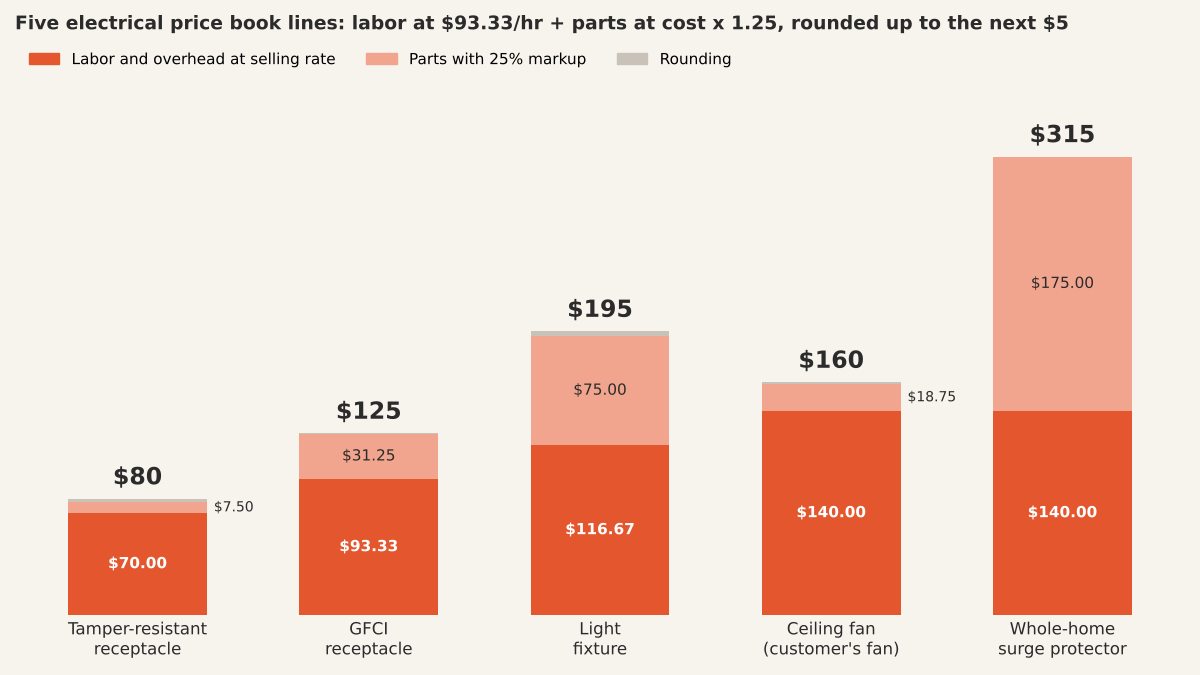
Now check what each line keeps. The surge protector costs you 1.5 × $70 + $140 = $245, so $315 leaves $70, or 22.2% of the price. The tamper-resistant receptacle costs $58.50 and keeps $21.50, or 26.9%, because it's mostly labor. Lines that are mostly parts keep a lower share, which is why the parts markup matters as much as the rate.
The book sets the number; the estimate is what the customer approves. A flat rate quoted before the work is a firm price, the difference covered in quote vs estimate.
7. Each-additional device lines
This is where electrical books differ from most trades. Nobody replaces one receptacle. If the book only has a single-device price, you either overcharge a whole-house swap or quietly discount it in the driveway.
Add an "each additional, same visit" line for every device. It carries the wrench time and the parts, not the visit allowance. In the example, an additional tamper-resistant receptacle is 0.25 hours × $93.33 + $7.50 = $30.83, so $35 in the book.
Six receptacles in one visit: $80 for the first plus 5 × $35 = $255. Six single-device prices would be $480, and the customer would be right to balk. Each additional line still keeps $11.50 on a $23.50 cost, because the trip is already paid for.
8. Footage adders and access
New circuit lines need a base run written into the scope, like "up to 25 ft of cable through an open basement or attic". Anything longer gets an adder per 10 ft, priced the same way as everything else.
Hypothetical adder: 0.25 hours per 10 ft at $93.33, plus $8 of cable at cost marked up 25% = $33.33, so $35 per 10 ft. The cable cost is an assumption; use your supply house price for the gauge you're running.
Access is a separate add-on, not a guess baked into the base. Fishing a finished wall, cutting and patching, a second story, a crawl space: price each one as its own line so the customer sees why the number moved.
9. Permits, tiers, service calls and after-hours
Permits and inspection fees go on the estimate as a pass-through at cost, plus the time to pull the permit and meet the inspector. Keep them out of the book price, because fees vary by city and change on their own schedule.
Tiers give the customer a choice on the same task, and the choice is almost always the part. Same labor, a basic fixture or a better one, a standard surge protector or one with a longer warranty. Two or three tiers per task is plenty.
A diagnostic fee covers the visit when you don't have a book task yet. A simple rule is one hour at your selling rate: $93.33, so $95 in the example. After-hours work gets a multiplier on the book price, not a separate book: at 1.5×, the $125 GFCI is $187.50 on a Saturday night.
10. Update the book when copper moves
Wire is the part of an electrical book that moves fastest, and lately it's moved a lot. The Producer Price Index for copper wire and cable rose about 30.8% from September 2025 to September 2026, and about 46.3% over two years from September 2024 (BLS PPI series WPU10260314 via FRED).
Run that through the footage adder. If $8 of cable now costs about $10.47, the adder is 0.25 × $93.33 + $10.47 × 1.25 = $36.42, so it rounds up to $40 per 10 ft instead of $35. A long circuit run with an old adder is where copper eats your margin first.
Keep part costs in one column so an update is a column change, not a rewrite. Re-price wire-heavy lines whenever your supply house price changes, and the whole book at least once a year. If your labor or overhead moves, change the selling rate once and every line follows.
The same build, rate first and parts second, runs a plumbing book in the plumbing flat rate pricing guide. And put the scope sentence on every estimate you send: if a customer ever stops paying, a written scope and price is what you'll lean on, as covered in can a contractor sue for non-payment without a contract.
Common electrical flat rate pricing questions
How do you calculate flat rate pricing for electrical work?
Multiply the task's full visit time by your hourly selling rate, which is hourly cost divided by one minus your margin. Add parts at cost times one plus your markup, then round up. With a $93.33 rate and a 25% markup, a 1-hour GFCI swap with $25 of parts comes to $125.
Should I buy an electrical price book or build my own?
A bought book gives you a task list and suggested times to start from, which saves weeks. The prices still have to come from your own labor cost, overhead and margin, because a price set for someone else's costs can leave you underwater. Adjust every line with your own selling rate and parts costs.
Is flat rate or hourly better for electricians?
Flat rate works best for repeat service tasks you can time well: devices, fixtures, fans, surge protectors, simple circuits. Hourly fits troubleshooting and open-ended work where you can't see the scope yet. Most small shops run both: a diagnostic fee to find the problem, then a book price to fix it.
How often should an electrician update a price book?
Re-check wire and other copper-heavy lines whenever your supplier's price changes, and re-price the whole book at least once a year. Copper wire and cable prices rose about 31% in the year to September 2026 by the BLS index, so a book priced a year ago can be badly out of date on circuit work.
What to do with your price book this week
Pull your top 25 jobs from last year's invoices, set one hourly selling rate, time each task as a full visit, add each-additional and footage lines, price parts at cost plus markup, round up and write the scope sentence. In WinPal you can turn a voice note on site into an estimate and send it before you leave the driveway.
Already quoted a flat rate this month? Upload that estimate to the checker and see if it's priced too low.