Can a Contractor Sue for Non-Payment Without a Contract?
Usually yes: a handshake or text deal is still a contract, and courts can award the reasonable value of your work. Worked example: a $4,580 deck repair agreed by text with $3,380 still owed.
Yes, in most cases a contractor can sue for non-payment without a written contract. A handshake or a text agreement is usually still a contract, and even with no agreed price, courts can award the reasonable value of the work you did. It's harder to win, the deadlines can be shorter, and in some states an unlicensed contractor can't sue at all.
What you can claim = agreed price + approved extras − payments received. No agreed price? Reasonable value of the work − payments received.
A deck repair agreed by text at $4,200, plus a $380 gate the customer approved by text, minus a $1,200 deposit, leaves $3,380 to collect. Hypothetical, worked below.
The money is rarely the hard part. Proving what was agreed is. Without a signed estimate, your case is built from texts, photos, receipts and the deposit check, so how you kept the paperwork decides how this goes.
This is general information for US contractors, not legal advice. Rules differ by state, and the California sections below are examples, not your state's law.
For anything close to a lawsuit, talk to a local attorney. To make sure the next job has the paperwork, start with contractor payment terms.
1. Is a verbal agreement with a customer a real contract?
Usually, yes. A contract is an offer, an acceptance and something of value exchanged, and none of that has to be on paper for most service work. "Fix the deck for $4,200" and "Sounds good, when can you start?" is a deal.
The exceptions come from the statute of frauds, the rule that certain contracts must be in writing and signed. The most common ones are contracts for the sale or transfer of land, contracts that can't be completed within one year, and sales of goods worth $500 or more (Cornell LII, statute of frauds). A two-week repair job usually isn't on that list.
What the paper does is prove the deal. Without it, it's your word against the customer's on price, scope and what "done" means.
2. What if you never agreed on a price?
You can still ask for the reasonable value of the work. The legal name is quantum meruit, Latin for "as much as one has deserved": a remedy that pays a person the reasonable value of services they provided, often based on the market value of those services (Cornell LII, quantum meruit).
In practice, that means showing your hours, your normal rate and your material receipts, and showing the customer accepted the work. Courts have discretion on the number, so expect to justify every line.
That's why the hours and receipts matter even on a job with a handshake price. If the customer disputes the price, they're your fallback.
3. The license problem: when you can't sue at all
Check this first. In some states, doing work that needs a license without one wipes out your right to collect through the courts, contract or no contract.
California is the strict example. A contractor can't bring or maintain any action to collect compensation for work that requires a license without alleging they were licensed at all times during the work, regardless of the merits (Cal. Bus. & Prof. Code § 7031(a)). The same section lets the customer sue to get back what they already paid an unlicensed contractor (§ 7031(b)).
California also requires home improvement contracts over $500 to be in writing and signed before work starts, change orders included (Cal. Bus. & Prof. Code § 7159(b) and (d)). Skipping that is cause for discipline by the license board (§ 7159(a)(5)(A)). Whether you can still collect depends on the facts, which is a question for a local attorney.
Other states set different license thresholds and contract rules. Look up yours before you spend money on a claim.
4. What to gather before you do anything
Build the file before you send a single angry text. Courts and lien offices care about dates and documents, not how the job felt.
- The agreement. Every text, email, voicemail and quote that mentions price or scope. Screenshot them with the dates showing.
- Approved extras. Any message where the customer asked for or agreed to added work, and the price.
- Payments. The deposit, any progress payments, how they paid and when.
- Proof of work. Before and after photos, dated. Permit and inspection records if there were any.
- Hours and materials. Your time log and supply house receipts, matched to the job.
- The invoice and reminders. When you sent the final invoice and every follow-up.
If the job had a written estimate the customer approved, even by text reply, put it on top. That's the closest thing to a contract you've got.
5. Worked example: a deck repair agreed by text
Hypothetical: you replaced rotted deck boards and railing for $4,200, agreed by text. Mid-job the customer texted asking for a new gate, you replied $380, they said "go ahead". They paid a $1,200 deposit, then stopped answering after the final walk-through.
| Claim basis | Math | Amount owed |
|---|---|---|
| Agreed price (texts) | $4,200 + $380 − $1,200 | $3,380 |
| Reasonable value (if the price is disputed) | 30 hours × $95 + $1,420 materials − $1,200 | $3,070 |
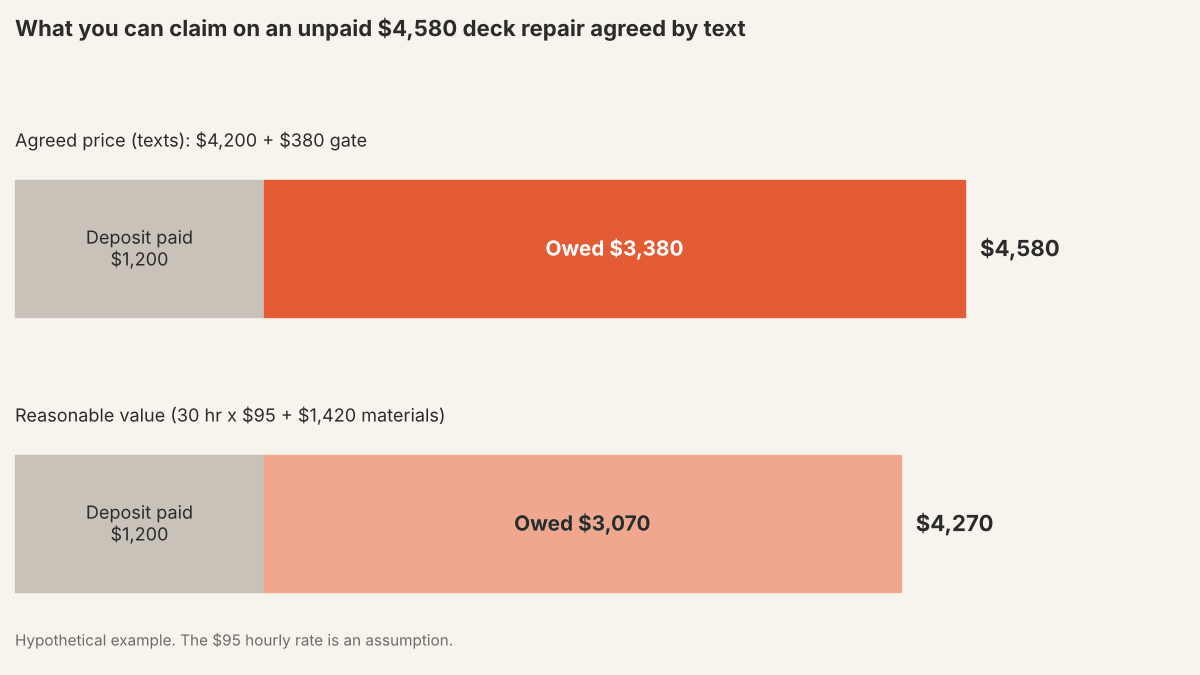
The agreed-price claim is $310 higher and easier to prove, because the texts state the number. The reasonable-value claim is the backup if the customer argues there was never a price. The $95 hourly rate is an assumption: use the rate you actually charge, and be ready to show other invoices at that rate.
Both numbers fit under California's small claims limit for an individual, covered in the next section.
6. The steps, from first reminder to court
Go in order. Each step gives the customer a clear, documented chance to pay, and that record is what a judge or lien office looks at later.
- Send a clean final invoice. Line items, the agreed price, the approved extras, the payments received, the balance and a due date. Here's how to invoice as a contractor.
- Follow up in writing. A short, polite reminder at the due date and again a week later. Keep it factual.
- Send a final demand letter. The amount, how you got it, a specific deadline (for example, 10 days) and what happens next: a lien, small claims or collections. Send it in a way you can prove delivery.
- Check your lien deadline. A mechanics lien puts a claim on the property itself. The deadlines are short and strict. In California, a direct contractor must record the lien before the earlier of 90 days after completion or 60 days after the owner records a notice of completion or cessation (Cal. Civ. Code § 8412). Other states have their own notice and filing rules.
- File in small claims. Cheaper and faster than regular court, usually without a lawyer. In California, an individual can claim up to $12,500 (Cal. Code Civ. Proc. § 116.221); the general limit for other claims is $6,250 (§ 116.220). Check your state's limit and who counts as an individual.
- Collections or an attorney. For bigger balances, or when the customer has a lawyer. Weigh the fee against what you'd recover.
7. How long do you have to sue without a written contract?
Often less time than with one. States set separate deadlines (statutes of limitations) for oral and written contracts, and the oral one is often shorter.
California is a clear example: two years for a contract not founded on a writing (Cal. Code Civ. Proc. § 339) versus four years for one founded on a writing (§ 337). The lien deadline above is far shorter than either.
Don't let an unpaid invoice sit for months hoping it sorts itself out. The clock is running the whole time.
8. How to never be in this spot again
Put the deal in writing before you start, and keep it in writing as it changes. It takes five minutes on the job and saves weeks of chasing.
- A written estimate the customer approves. Scope, price, exclusions, payment schedule. A signature or a "yes" reply is the proof you didn't have above. The difference between a firm price and a range is in quote vs estimate.
- A deposit before materials. Check your state's cap first.
- Change orders in writing. Every extra, priced, approved before you do it. Here's how to write a change order.
- Bill as you go. On longer jobs, progress billing keeps the unpaid balance small if things go wrong.
- Standard prices. A price book with written scopes, like the one in the electrical flat rate pricing guide, makes every quote consistent and easy to back up.
WinPal keeps your estimates, invoices and payments in one app on your phone, so the paper trail builds as you work instead of after the fact.
Common questions about getting paid without a contract
Can a contractor sue for non-payment based on a verbal agreement?
Usually, yes. Most service agreements don't have to be in writing to be enforceable, so a verbal deal is still a contract. The hard part is proof: texts, emails, a deposit, photos and the invoice show what was agreed. Some states bar unlicensed contractors from suing, so check that first.
Is a text message a contract with a customer?
A text exchange where you state a price and scope and the customer clearly accepts can show that a contract exists. Whether it counts as a written contract under your state's rules is a separate question for an attorney. Either way, save the thread with dates, because it's your best evidence.
Can a contractor file a lien without a written contract?
Whether a lien can rest on an oral agreement, and the notice and filing rules, depend on your state, and the deadlines are strict. California requires a direct contractor to record the lien within 90 days after completion, or 60 days after the owner records a notice of completion or cessation, whichever comes first. Miss the deadline and the lien is gone.
Is it worth suing a customer for an unpaid invoice?
Compare the balance with the time, filing fees and odds of collecting a judgment. Small claims often makes sense for residential balances that fit under the state limit. A firm demand letter that names the next step often gets paid before you file anything.
What to do before your next job starts
Send a written estimate with the scope, price and payment schedule, get a yes in writing, take a deposit and write up every change before you do it. Then invoice the day you finish.
Want to check that estimate before it goes out? Upload it to the estimate checker and see if it's priced too low.