How to Bid Construction Jobs: 9 Steps and a Worked Bid
The nine steps from finding a job to following up, with a worked garage conversion bid at $39,720, priced alternates and what all that bidding time really costs you.
To bid construction jobs, pick jobs that fit your crew, read every bid document, walk the site, build a line-by-line estimate, get sub quotes against the same scope, then add contingency, overhead and margin. Write the bid with the scope, exclusions, schedule, payment terms and an expiry date, submit it on time and follow up.
Bid price = (direct costs + contingency + overhead) ÷ (1 − margin).
A garage conversion with $27,630 of direct costs, 5% contingency and 10% overhead costs $31,774.50. At a 20% margin: $31,774.50 ÷ 0.80 = $39,718.13, so the bid goes out at $39,720. Hypothetical, worked below.
The math is the same as any estimate. What changes on a bid is everything around it: deciding which jobs to chase, matching the plans exactly, writing down what you didn't include, and knowing what all that bidding time costs you.
This guide is for small contractors and remodelers bidding residential and light commercial work. US dollars, hypothetical numbers. For the cost buildup itself (takeoffs, labor hours, sub quotes), start with how to estimate construction costs.
1. What are the steps to bid a construction job?
Nine steps, in this order. The estimate is only step five.
- Find jobs that fit. Your trade, your size, your area, your schedule.
- Decide bid or no-bid. Before you spend a day on it.
- Read every bid document. Plans, specs, addenda, the bid form, the contract terms.
- Walk the site. Access, staging, what's behind the walls, what the plans missed.
- Build the estimate. Quantities, labor hours, materials, job costs.
- Get sub and supplier quotes. Same scope to everyone, in writing.
- Price it. Contingency, overhead and margin on top of direct costs.
- Write and submit the bid. Scope, exclusions, alternates, schedule, terms, expiry date. On time.
- Follow up and track it. Win or lose, write down why.
2. Where small contractors find construction jobs to bid
Start with people who already know you: past customers, referrals, general contractors and designers you've worked with. Public bid boards add volume, but there you compete on price against everyone who downloaded the plans.
- Private work: repeat customers, referrals, realtors and property managers, GCs who need a sub for your trade.
- Local public work: city, county and school district purchasing pages post bids for repairs and small projects.
- Federal work: contract opportunities are posted on SAM.gov, and with limited exceptions you must be registered in SAM when you submit an offer (FAR 4.1102).
If you're new to public work, start small. Bonds, prevailing wage rules and payment timelines are different from a homeowner job, and you want to learn them on a $20,000 job, not a $400,000 one.
3. Decide bid or no-bid before you estimate
A bid takes real hours, so qualify the job first. If you can't answer yes to most of these, pass and spend the time on a job you can win.
| Question | Bid if |
|---|---|
| Is it your kind of work? | You've done this scope profitably before |
| Can your crew fit it in? | The start date works with your schedule |
| How many bidders? | You know, and it's a short list |
| Who's paying? | The owner or GC has a record of paying on time |
| Are the plans complete? | You can price it without guessing at half the scope |
| Can you carry the cash? | The payment terms and retainage won't stall you |
Saying no is part of bidding. The jobs you skip leave more hours for the ones you can win, and a job that pays late can cost more than the job you didn't get.
4. Read the bid documents like a contract
Because they will become one. Read the plans, the specs, every addendum, the bid form and the contract terms before you price anything.
- Addenda: changes issued after the plans went out. Many bid forms ask you to acknowledge each one, and a missing acknowledgment can get a bid rejected.
- Specs: the brand, grade and method called for. "Or equal" is not the same as "whatever's cheapest".
- Bid form: fill it in exactly as asked: lump sum, unit prices, alternates, signatures.
- Contract terms: payment schedule, retainage, insurance limits, schedule penalties, change order rules.
- Bonds: some public jobs need a bid bond with the bid and performance and payment bonds if you win.
Write your questions down and send them before the question deadline. An answer that goes out as an addendum protects you; a phone answer doesn't.
5. Walk the site, then build the estimate
Go see it. The site walk is where you find the things the plans don't show: tight access, no place for a dumpster, an old panel, a slab that isn't level, a neighbor who'll call the city.
Then build the estimate line by line: quantities, labor hours by task, materials with waste, equipment, permits, disposal and your own supervision time. The full method, with a worked bathroom remodel, is in how to estimate construction costs.
Send every sub the same scope in writing and get their number in writing. Check what's in it and what's excluded, and how long the price holds. If your HVAC or electrical sub prices from a flat rate book like the one in the HVAC price book guide, ask what each line includes instead of assuming.
6. Worked example: bidding a garage conversion
The job (hypothetical): convert an attached two-car garage into a home office. Frame and insulate the walls, new window and entry door, drywall, a ductless mini-split, new circuits and lights, flooring and trim.
Electrical, HVAC and flooring are subbed out. Your crew's loaded labor is $55 an hour.
| Line | Basis | Cost |
|---|---|---|
| Your crew: framing, insulation, drywall, trim | 120 hr × $55 | $6,600 |
| Materials: lumber, insulation, drywall, window, door, trim | Supplier quotes | $7,400 |
| Electrical sub | Written quote | $3,800 |
| HVAC sub: ductless mini-split | Written quote | $4,900 |
| Flooring sub | Written quote | $2,600 |
| Permit | Placeholder | $900 |
| Dumpster and disposal | One rental | $550 |
| Supervision, scheduling, inspections | 16 hr × $55 | $880 |
| Direct costs | $27,630 | |
| Contingency | 5% × $27,630 | $1,381.50 |
| Overhead | 10% × $27,630 | $2,763 |
| Total cost | $31,774.50 | |
| Bid at 20% margin | $31,774.50 ÷ 0.80, rounded up | $39,720 |
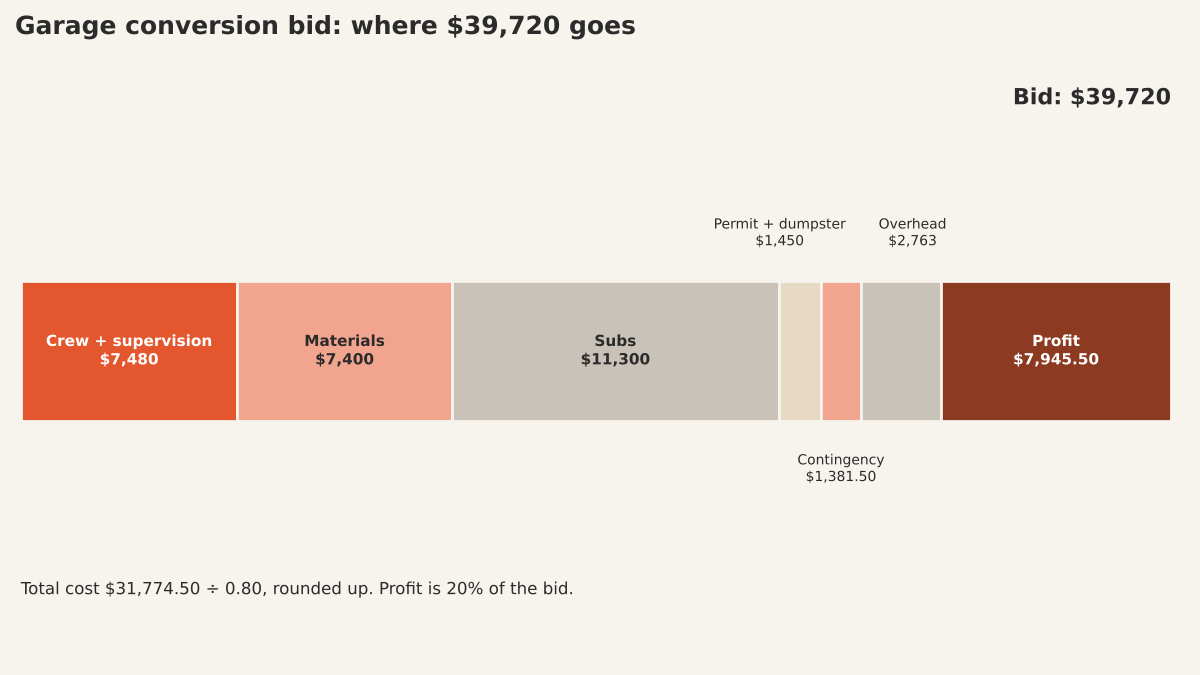
$39,720 minus $31,774.50 leaves $7,945.50 of profit, which is 20% of the price. Price it with a 20% markup instead and you'd send $38,129.40, keeping only 16.7%. The profit margin calculator converts between the two.
Notice overhead is a percentage of direct costs here, not a rate per labor hour. On a sub-heavy job your own hours undercount the time you spend managing it. Pick one method and use it on every bid so your numbers compare.
7. Write the bid so it can't be misread
The bid is the estimate turned into an offer: what you'll do, for how much, under what terms, until when. Group the lines the way the customer thinks about the job, then spell out the rest.
- Scope and inclusions: what's in the price, room by room or trade by trade.
- Exclusions: hidden damage, a panel upgrade if the service can't carry the mini-split, landscaping, anything your subs excluded.
- Allowances: fixed amounts for items the customer hasn't picked yet, and what happens if they go over.
- Alternates: priced options. In the example, upgrading the flooring adds $900 to the sub quote. With the same 5% contingency, 10% overhead and 20% margin, that's $1,035 ÷ 0.80 = $1,293.75, so the alternate is +$1,295.
- Schedule: start window and duration, and what pushes them.
- Payment terms: deposit, progress payments, final payment. See contractor payment terms for what to ask for and your state's deposit limits.
- Expiry date: 30 days is a sensible default on residential work, because material prices move.
Anything the customer adds after you sign gets priced as a change order before the work, not argued about at the final invoice.
8. What does bidding cost you, and how many should you win?
Bidding time is overhead, and it adds up faster than you think. Track how many hours each bid takes and how many you win.
Say each bid takes 10 hours of walking, takeoff, sub calls and write-up, and your time costs $70 an hour. That's $700 per bid.
Win 1 in 4 and every job you win carries $2,800 of bidding time, about the whole $2,763 overhead line on the garage bid. Win 1 in 8 and it's $5,600 per win.
So if your win rate drops, don't just cut your price to win more. First check whether you're bidding jobs that don't fit, against too many bidders, for customers who shop on price alone. Fewer, better bids usually beat more bids at a thinner margin.
9. Public jobs: bid bonds and payment bonds
Public work adds paperwork you have to price. On federal jobs, construction contracts over $150,000 require performance and payment bonds under the Miller Act (FAR 28.102-1). When a bid guarantee is required, it must be at least 20% of the bid price, capped at $3 million (FAR 28.101-2).
State and local jobs set their own bond thresholds, so read the bid documents and check with the agency. Bond premiums are a job cost: get a quote from your surety and put it in the estimate, not in your margin.
On sealed public bids, follow the bid form to the letter: every blank filled, every addendum acknowledged, every signature in place. A bid that doesn't follow the instructions can be rejected no matter how well you priced it.
10. Follow up, and learn from every bid
Follow up a few days after you submit: confirm they got it, answer questions, offer a walk-through of the numbers. On private work, the contractor who answers fastest and explains the scope clearly often wins without being the cheapest.
When you lose, ask the winning number if you can get it.
Being 30% high on a job you know well means your costs or your market changed. Being 2% high means you were close. Write it down next to the bid either way.
Common questions about bidding construction jobs
How do you bid a construction job for the first time?
Start with a small job in your own trade from someone who already knows you. Walk the site, estimate every line, get sub quotes in writing, add contingency, overhead and a margin, then write the scope, exclusions, payment terms and an expiry date. Learn the process on a job you can afford to get wrong.
What percentage should you add to a construction bid?
Decide your margin first, then divide total cost by one minus that margin. The example adds 5% contingency and 10% overhead to direct costs, then prices at a 20% margin. A 20% margin needs a 25% markup on cost. There's no single right number; it depends on your overhead and the job's risk.
What's the difference between a bid and an estimate?
An estimate is your calculation of what the job will cost and what you'll charge. A bid is the formal offer you submit for a defined scope, often against other contractors and by a deadline. You estimate first, then turn the estimate into a bid with the scope, exclusions and terms in writing.
How do you win more construction bids?
Bid fewer jobs that fit your crew, know who you're bidding against, answer questions fast and make the scope easy to compare. Clear exclusions and priced alternates help the customer choose you without guessing. Track your win rate and why you lost, so you change what's actually costing you jobs.
What to do on your next bid
Qualify the job, read every document, walk the site, price every line, add contingency, overhead and margin, then write the scope, exclusions, alternates, terms and expiry date. Submit it on time and follow up. In WinPal you can build the estimate from a photo and a voice note and send it from your phone.
Already sent a bid this month? Upload it to the estimate checker and see if it's priced too low.