Plumbing Business Profit Margin: Averages and the Math
Plumbing shops net about 5% after owner pay, per IRS data. Here's what's normal, why the IRS gross margin looks low, and a worked $450,000 year split by type of work.

A typical plumbing business profit margin is about 5% to 7% net, with the owner's pay counted as an expense. In IRS data for tax year 2022, plumbing, heating and air-conditioning contractor corporations kept 4.8% of their receipts as net income. The ones that made money kept 6.8%.
Gross margin is a different number, and it swings with your work mix. Drain, leak and fixture calls carry far more margin than bid rough-in work.
Gross margin = (revenue − job costs) ÷ revenue. Net margin = (gross profit − overhead) ÷ revenue.
On a hypothetical $450,000 plumbing year: $212,500 gross profit (47.2%), $185,000 overhead including the owner's pay, $27,500 net (6.1%).
That 6% is what pays for the slow week, the callback you eat, and the next van. One sloppy pricing habit can cut it in half.
Scope: US residential plumbing shops doing service, replacements and some new work. Benchmarks dated below, worked example hypothetical. For pricing a single job, see how to estimate a plumbing job; this page is about what the whole business keeps.
1. What is a good profit margin for a plumbing business?
Treat 5% to 7% net as normal and 10% or more as strong, with owner pay already taken out. Under 5% net, one bad month or a slab leak you priced wrong can wipe out the year.
| Benchmark, tax year 2022 | Figure | What it measures |
|---|---|---|
| Plumbing, heating and AC contractor corporations (85,508 returns) | 4.8% net | Net income less deficit ÷ total receipts |
| The 59,971 of them that reported net income | 6.8% net | Net income ÷ total receipts |
| Corporations with no net income for the year | 29.9% | Share of returns |
| Cost of goods sold | 66.1% of business receipts | Leaves about 34% before overhead |
| Officers' pay | 3.3% of total receipts | Owner and officer salaries, deducted before net income |
Source: IRS Statistics of Income, Corporation Complete Report, Tables 5.1 and 5.2, tax year 2022 (Publication 16, September 2025), row "Plumbing, heating, and air-conditioning contractors". Figures are IRS sample estimates.
Two things to know before you compare yourself. The IRS lumps plumbing in with HVAC under one industry code. And these are corporations, which average about $2.7 million in business receipts, so a one-van shop will look different line by line.
2. Why the IRS gross margin looks so low
About 34% gross sounds thin for anyone who bills service by the hour. The reason is what goes into cost of goods sold on a corporate return.
On IRS Form 1125-A, cost of goods sold includes the cost of labor. So for many shops the field crew's wages sit inside that 66.1%, next to the pipe, fixtures and water heaters. And the industry total mixes service shops with new-construction and commercial contractors, so it isn't a service-shop number.
The useful takeaway: the net number travels better than the gross one. Your gross margin depends on how you book labor and what work you take. Net is net.
Because corporations deduct officers' pay before net income, that 4.8% is closer to a real business profit than a sole proprietor's Schedule C, which mixes your wage and your profit together. The HVAC profit margin guide walks through that Schedule C trap with IRS numbers.
3. Gross margin by type of plumbing work
Price each type of work to its own target gross margin. A plumbing shop usually runs three kinds of work, and they behave nothing alike:
- Service and repair. Drains, leaks, fixture swaps, diagnostics. Mostly labor and drive time with small parts, so gross margin is high.
- Replacements. Water heaters, repipes, sewer lines. Big-ticket materials in the price, so the percentage drops even when the dollars grow.
- New construction and remodel rough-in. Bid against other plumbers, often for a builder who compares every number. Thinnest margin of the three.
Use price = cost ÷ (1 − margin) for each line. Hypothetical 50-gallon gas water heater swap: tank $750 (assumed supplier price), $180 for fittings, venting, haul-away and permit, 4 hours of labor at $44 an hour, and $30 for the truck. Cost is $1,136.
The $44 is the O*NET median wage for plumbers, $30.67 an hour (2025), plus an assumed 43% for payroll taxes and benefits, rounded.
At a 50% gross margin, price = $1,136 ÷ 0.50 = $2,272. At 40%, it's $1,893. A 50% margin is a 100% markup, which is exactly where people who say "markup" and mean "margin" lose money.
Running flat rate? Your plumbing flat rate price book is where these target margins live, task by task, so every tech quotes the same number.
4. Worked example: a $450,000 plumbing year
Take a hypothetical two-van residential shop: $200,000 in service and repair at a 60% gross margin, $150,000 in replacements at 45%, and $100,000 in rough-in work at 25%. Overhead, including a fair salary for the owner, is $185,000.
| Work type | Revenue | Gross margin | Gross profit | Share of revenue | Share of gross profit |
|---|---|---|---|---|---|
| Service and repair | $200,000 | 60% | $120,000 | 44.4% | 56.5% |
| Replacements | $150,000 | 45% | $67,500 | 33.3% | 31.8% |
| Rough-in | $100,000 | 25% | $25,000 | 22.2% | 11.8% |
| Total | $450,000 | 47.2% | $212,500 | 100% | 100% |
Subtract $185,000 of overhead and the year nets $27,500, or 6.1%. Right in the IRS band.
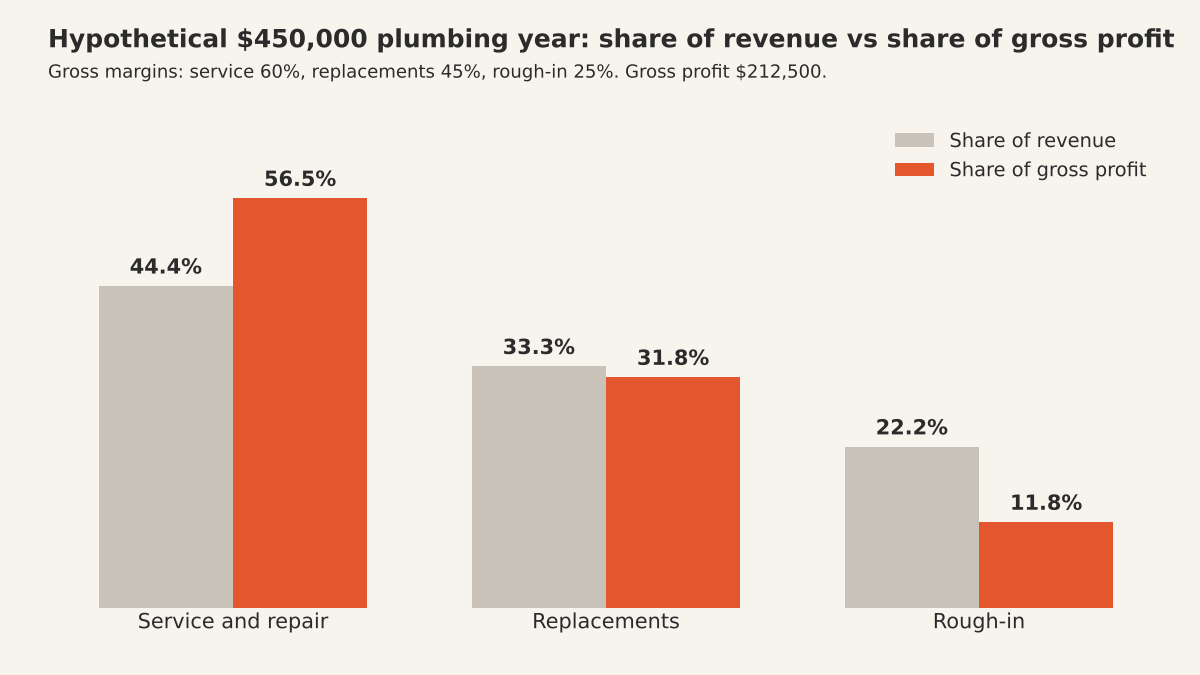
Rough-in still pays its way here: it adds $25,000 of gross profit toward overhead. It just pays a lot less per dollar of work, and it ties up your best plumbers on someone else's schedule.
5. What moves your net margin
Hold overhead at $185,000 and change one thing at a time. Small moves on the service side swing the year hard.
| Scenario | Gross profit | Net profit | Net margin | Change vs base |
|---|---|---|---|---|
| Base | $212,500 | $27,500 | 6.1% | |
| Service margin slips from 60% to 55% | $202,500 | $17,500 | 3.9% | −36.4% |
| Service margin rises from 60% to 65% | $222,500 | $37,500 | 8.3% | +36.4% |
| $50,000 moves from rough-in to service, same total revenue | $230,000 | $45,000 | 10.0% | +63.6% |
Unbilled time. Five points of service margin is easy to lose: the second trip for a part, the callback you don't charge for, the 20 minutes of "while you're here". That cost the example shop $10,000, more than a third of its profit.
Service pricing. The same five points in the other direction added $10,000. Charge the trip, price parts from a current list, and quote the job before you start.
Mix. Moving $50,000 of capacity from rough-in to service calls took net from 6.1% to 10.0% without a dollar of new revenue. Only if the service demand is really there, of course.
6. How to check your own plumbing margins
- Split last year's revenue into service and repair, replacements, and rough-in or new work.
- Add up job costs for each: materials, fixtures, permits, dump fees, and field labor including your own field hours at a real wage.
- Gross margin for each bucket = (revenue − job costs) ÷ revenue.
- Add up overhead: shop, vans, insurance, licensing, software, marketing, office help and your salary.
- Net margin = (total gross profit − overhead) ÷ total revenue.
- Compare each bucket's real gross margin with the margin you meant to price in. The gap is money that leaked: extra hours, free add-ons, parts that never hit the invoice.
The profit margin calculator handles the per-job math, and the hourly rate calculator builds overhead into your labor rate.
Doing bigger remodel or new-construction subs? The general contractor profit margin numbers show what the GC above you is working with. Wiring work on the same jobs runs similar math in electrical contractor profit margins.
Common plumbing profit margin questions
What is the average profit margin for a plumbing business?
About 5% net. In IRS data for tax year 2022, plumbing, heating and AC contractor corporations reported net income of 4.8% of total receipts, and 6.8% for those that made a profit. That's after officers' pay. Service-heavy shops can do better; shops living on bid work often do worse.
What is a good gross profit margin for plumbing service work?
There's no official standard, so set it from your overhead. Service and repair should carry a much higher gross margin than replacements or rough-in, because labor and drive time are most of the cost. In the hypothetical shop above, 60% on service, 45% on replacements and 25% on rough-in produced 6.1% net.
Is plumbing a profitable business?
It can be, but not automatically. In IRS data for tax year 2022, 29.9% of plumbing, heating and AC contractor corporations reported no net income. The profitable ones price service to a target margin, charge for every trip and watch how much bid work they take on.
How do I calculate profit margin on a plumbing job?
Subtract the job's costs from the price, then divide by the price. A $2,272 water heater swap with $1,136 in costs has a 50% gross margin: ($2,272 − $1,136) ÷ $2,272. To set a price from a target margin, use price = cost ÷ (1 − margin).
What to do on your next plumbing quote
Pick a target gross margin for each type of work, price every line with cost ÷ (1 − margin), and put the trip on the invoice.
Already sent one? Upload it to the estimate checker and see if it's priced too low.