Electrical Contractor Profit Margin: Averages and the Math
Electrical contractors net about 5% after owner pay, per IRS data. Here's what's normal, how a 30.8% jump in copper wire prices hits a bid, and a worked $700,000 year.

A typical electrical contractor profit margin is about 5% to 7% net, with the owner's pay counted as an expense. In IRS data for tax year 2022, electrical contractor corporations kept 5.0% of their receipts as net income. The ones that made money kept 7.3%.
Gross margin depends on your work mix, and on what copper does between the day you bid and the day you buy wire. Service calls hold margin. Bid work feels every price move.
Gross margin = (revenue − job costs) ÷ revenue. Net margin = (gross profit − overhead) ÷ revenue.
On a hypothetical $700,000 electrical year: $290,150 gross profit (41.5%), $250,000 overhead including the owner's pay, $40,150 net (5.7%).
That 5.7% covers the slow month, the inspection that fails on a Friday, and the next van. It doesn't take much to erase it.
Scope: US electrical contractors doing residential service, upgrades and some new construction. Benchmarks dated below, worked example hypothetical. For pricing one job, see how to price electrical jobs; this page is about what the whole business keeps.
1. What is a good profit margin for an electrical contractor?
Treat 5% to 7% net as normal and 10% or more as strong, with owner pay already taken out. Below 5% net, one underbid job can take the whole year's profit with it.
| Benchmark, tax year 2022 | Figure | What it measures |
|---|---|---|
| Electrical contractor corporations (65,801 returns) | 5.0% net | Net income less deficit ÷ total receipts |
| The 47,103 of them that reported net income | 7.3% net | Net income ÷ total receipts |
| Corporations with no net income for the year | 28.4% | Share of returns |
| Cost of goods sold | 68.1% of business receipts | Leaves about 32% before overhead |
| Officers' pay | 2.9% of total receipts | Owner and officer salaries, deducted before net income |
Source: IRS Statistics of Income, Corporation Complete Report, Tables 5.1 and 5.2, tax year 2022 (Publication 16, September 2025), row "Electrical contractors". Figures are IRS sample estimates.
These are corporations, averaging about $3.1 million in business receipts, so a two-van shop won't match line by line. The net figure is the one to compare against. Gross margin on a tax return depends on how labor is booked: on IRS Form 1125-A, cost of goods sold includes the cost of labor, so field wages often sit inside that 68.1%.
Corporations also deduct officers' pay before net income, which makes 5.0% closer to a true business profit than the bottom line of a sole proprietor's Schedule C.
2. Copper can eat a bid's margin before you buy the wire
Wire is the material line that moves. The Producer Price Index for copper wire and cable rose 30.8% from September 2025 to September 2026, from 464.522 to 607.705, per BLS data on FRED (series WPU10260314).
Here's what that does to a hypothetical $40,000 new-construction bid with $8,000 of wire and a 15% planned profit ($6,000). If your wire cost moved with the index between bid and purchase, it went up $2,466.
Profit drops to $3,534, or 8.8%. You did nothing wrong on site and lost 41% of the job's profit.
Ways to keep that money:
- Short quote validity. Put a date on the estimate, such as 15 or 30 days, and requote after it.
- A material price clause. On longer jobs, say in writing that wire and gear are priced as of the bid date and adjust with supplier invoices. Have your contract reviewed for your state.
- Buy at award. Lock the wire price when the job is signed, not when rough-in starts.
Service work barely notices. A troubleshooting call uses a few feet of wire, so the margin there is mostly about your labor rate.
3. Gross margin by type of electrical work
Give each type of work its own target gross margin. Most residential electrical shops run three:
- Service and repair. Troubleshooting, dead circuits, device swaps, small adds. Mostly labor and drive time, so gross margin is high.
- Upgrades and remodel. Panel changes, service upgrades, kitchen and basement circuits. More material, mid margin.
- New construction. Bid to builders who compare every line, with copper exposure. Thinnest margin.
Price each line with price = cost ÷ (1 − margin). Hypothetical 200-amp panel change: panel and breakers $900 (assumed supplier price), $250 of wire, connectors and fittings, a $150 permit (assumed), 8 hours of labor at $43 an hour, and $40 for the truck. Cost is $1,684.
The $43 is the O*NET median wage for electricians, $30.38 an hour (2025), plus an assumed 43% for payroll taxes and benefits, rounded.
At a 50% gross margin, price = $1,684 ÷ 0.50 = $3,368. At 45%, it's $3,062. Remember a 50% margin is a 100% markup; mixing those two words is how a panel job ends up priced like a favor.
Pricing service by the task? An electrical flat rate price book is where these target margins get locked in, so every tech quotes the same number.
4. Worked example: a $700,000 electrical year
Take a hypothetical three-van shop: $210,000 in service and repair at a 60% gross margin, $245,000 in upgrades and remodel at 45%, and $245,000 in new construction at 22%. Overhead, including a fair salary for the owner, is $250,000.
| Work type | Revenue | Gross margin | Gross profit |
|---|---|---|---|
| Service and repair | $210,000 | 60% | $126,000 |
| Upgrades and remodel | $245,000 | 45% | $110,250 |
| New construction | $245,000 | 22% | $53,900 |
| Total gross profit | $700,000 | 41.5% | $290,150 |
| Overhead, including owner pay | $250,000 | ||
| Net profit | 5.7% | $40,150 |
Service is 30% of revenue but 43% of gross profit. New construction is 35% of revenue and 19% of gross profit.
5. What moves your net margin
Hold overhead at $250,000 and change one thing at a time.
| Scenario | Gross profit | Net profit | Net margin | Change vs base |
|---|---|---|---|---|
| Base | $290,150 | $40,150 | 5.7% | |
| New construction margin drops from 22% to 17% | $277,900 | $27,900 | 4.0% | −30.5% |
| Service margin rises from 60% to 65% | $300,650 | $50,650 | 7.2% | +26.2% |
| $70,000 moves from new construction to service, same total revenue | $316,750 | $66,750 | 9.5% | +66.3% |
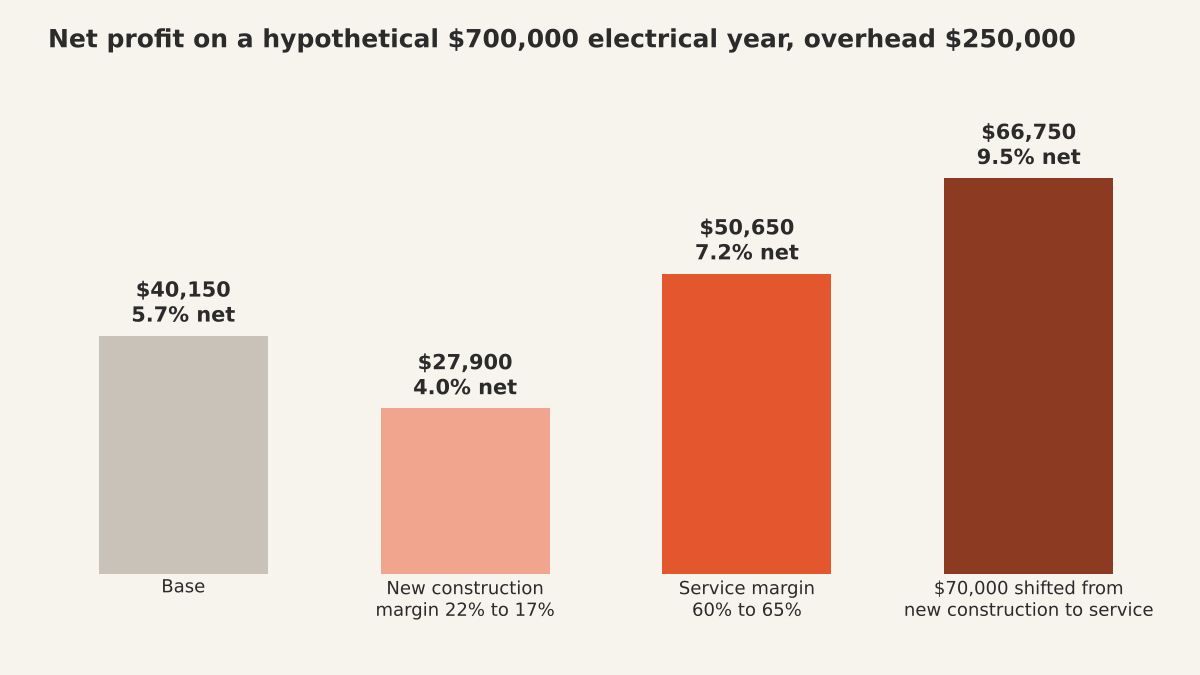
New construction squeeze. Five points off the bid work, from a copper jump or a builder who beat you down, cost $12,250. That's 30.5% of net.
Service pricing. Five points more on service added $10,500. Charge the trip, price parts from a current list, and quote before you open the panel.
Mix. Moving $70,000 of capacity from new construction to service took net from 5.7% to 9.5% without new revenue. That only works if the service calls are really out there to answer.
6. How to check your own electrical margins
- Split last year's revenue into service, upgrades and remodel, and new construction.
- Add up job costs for each: wire, gear, devices, permits, lifts and rentals, and field labor including your own hours at a real wage.
- Gross margin for each bucket = (revenue − job costs) ÷ revenue.
- Add up overhead: shop, vans, insurance, licensing and CE, software, marketing, office help and your salary.
- Net margin = (total gross profit − overhead) ÷ total revenue.
- Compare each bucket's real gross margin with the margin in your bids. On new construction, check whether the gap came from labor overruns or material price moves.
The profit margin calculator does the per-job math, and the hourly rate calculator builds overhead into your labor rate.
If you sub to a GC, the general contractor profit margin numbers show what they're working with. Plumbers on the same jobs face similar math in plumbing business profit margins.
Common electrical contractor profit margin questions
What is the average profit margin for an electrical contractor?
About 5% net. In IRS data for tax year 2022, electrical contractor corporations reported net income of 5.0% of total receipts, and 7.3% for those that turned a profit. That's after officers' pay. Service-heavy shops tend to sit higher than shops living on new-construction bids.
What is a good gross profit margin for electrical service work?
There's no official standard, so set it from your overhead. Service and repair should carry a much higher gross margin than new construction, because labor and drive time are most of the cost. In the hypothetical shop above, 60% on service, 45% on upgrades and 22% on new construction produced 5.7% net.
Is an electrical contracting business profitable?
Often, but not always. In IRS data for tax year 2022, 28.4% of electrical contractor corporations reported no net income. The ones that make money price service to a target margin, protect bids from material price swings and keep overhead in line with volume.
How do I calculate the profit margin on an electrical job?
Subtract the job's costs from the price, then divide by the price. A $3,368 panel change with $1,684 in costs has a 50% gross margin: ($3,368 − $1,684) ÷ $3,368. To set a price from a target, use price = cost ÷ (1 − margin).
What to do on your next electrical bid
Set a target gross margin for each type of work, price every line with cost ÷ (1 − margin), and put an expiration date on any bid with real wire in it.
Already sent one? Upload it to the estimate checker and see if it's priced too low.