General Conditions in Construction: What They Cover and How to Price Them
Supervision, the dumpster, the permit, the final clean: the job costs no drawing shows. What to include and how to price them by the week, with a worked kitchen remodel.
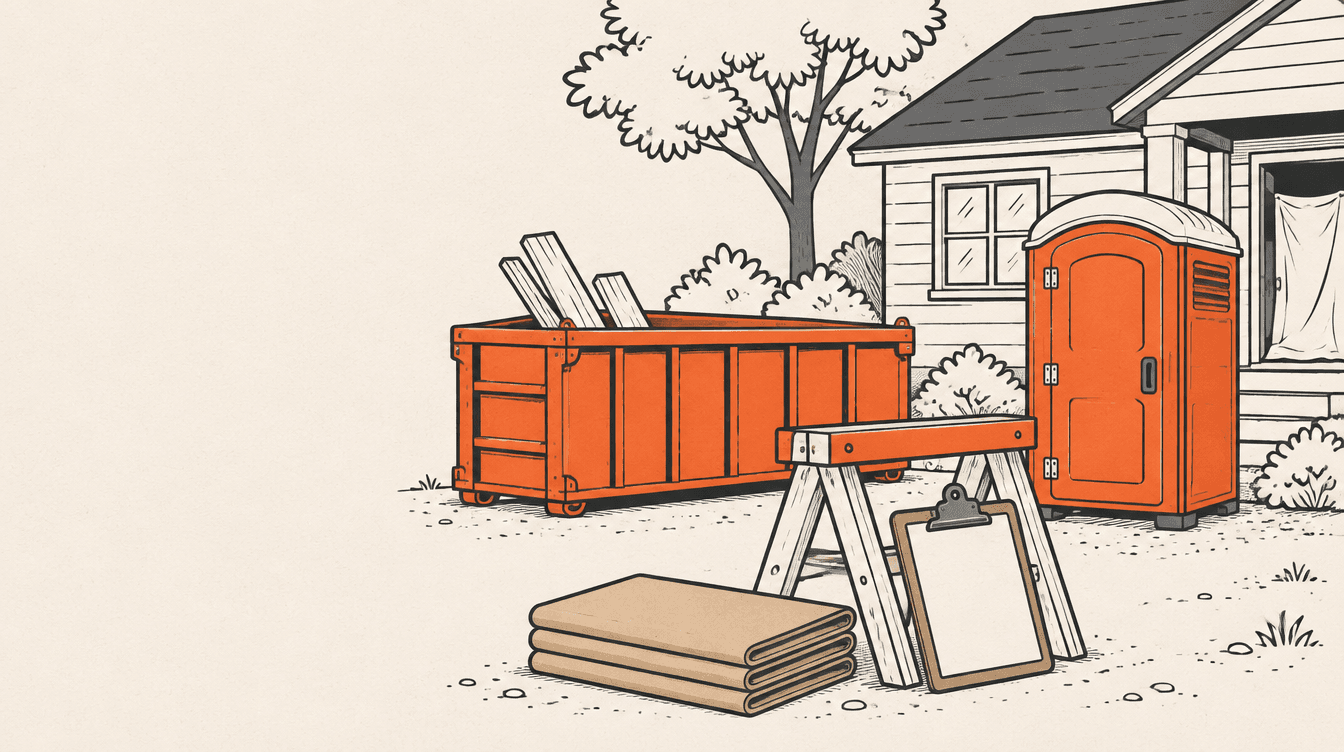
General conditions are the costs of running the job site that don't belong to any one task: supervision, the dumpster, the porta-john, the permit, floor protection, final cleanup. They're real job costs, and they go in your estimate as their own lines. Price them from how long the job runs, not from a percentage you picked once.
General conditions = (weekly site costs × weeks on site) + one-time site costs.
A six-week kitchen remodel with $42,000 in direct costs carries $5,330 of general conditions, about 12.7%. Hypothetical, worked below.
Leave them out and every one still gets paid, just out of your margin. Bury them in a vague "misc" line and you can't tell what the job really cost when it's over.
Scope: US remodelers and small contractors pricing residential and light commercial work. US dollars, hypothetical numbers. The full estimate, from takeoff to margin, is in how to estimate construction costs.
1. What are general conditions in construction?
They're the indirect costs of carrying out one specific project. Procore defines them as operations, procedures and indirect costs "not directly linked to construction, but are still essential for successfully executing the project," and says general contractors include them in the estimates they give owners (Procore).
Think of it as the stuff the job needs that no drawing shows. Nobody draws the dumpster. You still pay for it.
The term has a second meaning you'll run into on bigger jobs: the "general conditions of the contract," the legal terms section of a construction contract. Procore notes that in common usage most people mean the cost side. So does this guide.
2. General conditions vs overhead
This is where most small contractors lose money. General conditions are job overhead. Your office, insurance, truck payment and bookkeeping are company overhead. Different buckets.
| Bucket | Examples | Where it goes |
|---|---|---|
| General conditions (job overhead) | Site supervision, dumpster, porta-john, permit, temporary protection, final clean | A line in this job's direct cost |
| Company overhead | Office, insurance, vehicles, phone, software, advertising | Your overhead rate, spread across all jobs |
| Profit | What you keep | Your margin |
The test: would you still pay it if this job got cancelled tomorrow? If no, it's a general condition and it goes on this job. If yes, it's company overhead. The full split, with an overhead budget, is in construction overhead.
Count it twice and you lose bids. Count it zero times and you lose money. Pick one bucket per cost and stick with it.
3. What's included in general conditions
A checklist beats memory. Here's one built for residential and small commercial jobs. Not every item shows up on every job.
- Supervision: your or your lead's time on site that isn't already in task hours: walk-throughs, coordinating subs, inspections, customer meetings.
- Temporary facilities: portable toilet, storage container, temporary power or water if the house supply is off.
- Waste: dumpster rental, hauls and swaps, dump fees.
- Protection: floor paper, dust walls, zip doors, door and stair covers.
- Permits and inspections: permit fees, plan review, re-inspection fees.
- Cleaning: daily broom clean and the final clean before handover.
- Safety: fall protection, signage, fire extinguisher, fencing on open sites.
- Job-specific insurance or bonds: only if this job requires coverage beyond your normal policy.
Crewcost's guide to general conditions uses a similar checklist: staffing, protection and safety, temporary facilities and utilities, cleaning and dumpsters, insurance and bonding, permits and fees (crewcost).
4. How to price general conditions
Split the list into two kinds of cost, because they behave differently when the job runs long.
- Time-based: you pay by the week or month. Supervision, porta-john, storage, temporary power. Price = weekly cost × weeks on site.
- One-time: you pay once no matter how long it takes. Permit, final clean, protection materials, each dumpster haul.
Procore describes the same approach from the GC side: start from your standard set of general conditions, adjust for this project's site and schedule, and check against job costing from past projects. It says the job goes "beyond applying a standard percentage to direct construction costs" (Procore).
So the schedule drives the number. If you don't know how many weeks the job runs, you don't know your general conditions yet.
5. Worked example: a six-week kitchen remodel
The job (hypothetical): full kitchen remodel. Direct costs for labor, materials and subs are $42,000. You expect six weeks on site.
| Item | Type | Math | Cost |
|---|---|---|---|
| Supervision (8 h a week at $55 loaded) | Time-based | $440 × 6 weeks | $2,640 |
| Portable toilet | Time-based | $45 × 6 weeks | $270 |
| Dumpster, two hauls | One-time | 2 × $525 | $1,050 |
| Permit and inspections | One-time | $650 | |
| Floor and dust protection | One-time | $320 | |
| Final clean | One-time | $400 | |
| Total | $5,330 |
All rates are assumptions. Use your own supplier quotes and your own loaded labor rate; labor burden shows how to get that number.
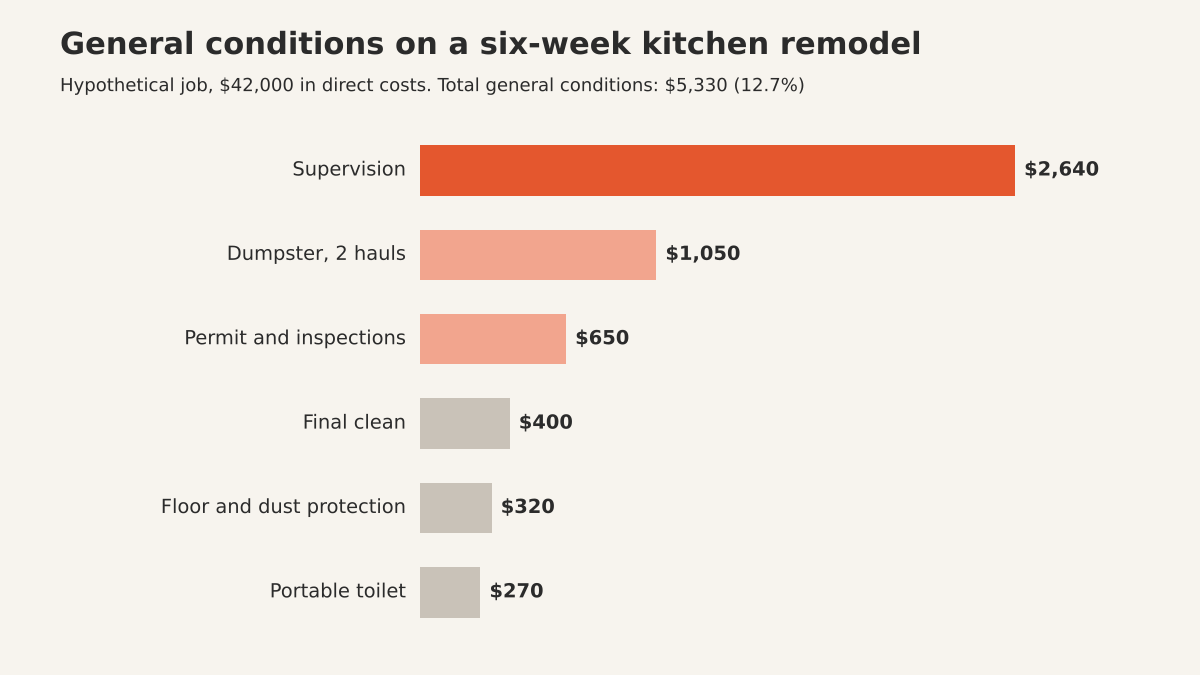
$5,330 is 12.7% of the $42,000 in direct costs. Crewcost says general conditions usually run 5 to 10% of a job's total cost. Small jobs land higher because the permit, the dumpster and the final clean don't shrink with the job.
Now price it. Company overhead is 10% of direct costs ($4,200), and you want a 25% margin.
- Total cost: $42,000 + $5,330 + $4,200 = $51,530.
- Price: $51,530 ÷ (1 − 0.25) = $68,706.67, so $68,710.
- Profit: $68,710 − $51,530 = $17,180, which is 25%.
Here's what happens when general conditions get forgotten, or the job runs long.
| Scenario | Price | Profit | Margin |
|---|---|---|---|
| General conditions left out, still paid | $61,600 | $10,070 | 16.3% |
| Priced in, job runs six weeks | $68,710 | $17,180 | 25.0% |
| Priced in, job runs eight weeks | $68,710 | $16,210 | 23.6% |
The left-out price is $46,200 ÷ 0.75 = $61,600. You still pay the $5,330, so profit drops to $10,070. Two extra weeks cost $485 a week in time-based items, $970 in all. That's why the schedule belongs in the estimate.
6. Show them on the estimate, or not?
On a fixed-price residential job, most customers see one total or a few trade lines. General conditions can sit inside the price. Keep them as separate lines in your own estimate so you can check them after the job.
On cost-plus or open-book jobs, the customer sees your costs, so list general conditions as their own section. Write down what's included and the weekly rate for time-based items. If the owner adds two weeks of scope, that rate makes the change order easy to price.
Either way, don't put general conditions inside your contingency. Contingency is for things that might happen; the dumpster is going to happen. The difference is in construction contingency.
7. Check the number after the job
When the job closes, compare general conditions priced with general conditions paid, line by line. Three things to look for:
- Supervision hours over plan? Your weekly hours are too low, or the job ran long.
- An extra dumpster haul on every remodel? Price two hauls minimum next time.
- Same item missing from every estimate? Add it to your standard list. That list is the most valuable thing this exercise produces.
Common general conditions questions
What are general conditions in construction?
General conditions are the costs of running a specific job site that aren't tied to one task: supervision, temporary facilities, waste removal, permits, protection and final cleaning. They're priced as their own section of the estimate, usually from the number of weeks on site plus one-time items. The legal terms section of a contract shares the name but is a different thing.
What percentage are general conditions?
Crewcost says general conditions usually account for 5 to 10% of a job's total cost. Treat that as a check, not a rule. Small residential jobs often run higher because permits, dumpsters and cleanup don't shrink with the job. In the kitchen example, $5,330 is 12.7% of direct costs.
Are general conditions overhead?
They're job overhead, not company overhead. General conditions exist only because this job exists, so they go in the job's cost. Office, insurance, vehicles and advertising are company overhead and belong in your overhead rate. Putting the same cost in both places overprices the job.
What is the difference between general conditions and general requirements?
Procore puts it as what versus how. General requirements, usually in Division 1 of the specifications, say what the owner wants the contractor to provide. General conditions describe how the contractor will provide it and what it costs. Many people use the terms interchangeably.
What to do on your next estimate
Write your standard general conditions list once. On every estimate, set the weeks on site, multiply the time-based items, add the one-time items and put the total on its own line. Then add overhead and margin with price = cost ÷ (1 − margin).
Already sent one with no general conditions line? Upload it to the estimate checker and see if it's priced too low. To turn cost into price at the margin you want, use the profit margin calculator.
Working a job paid by a construction loan? How the bank releases money in stages is in construction draw schedule.