Construction Draw Schedule: How Draws Work and How to Get Paid on Time
How loan draws work, what to put in a draw request, and how much of your own cash you float between draws, with a worked $160,000 build.
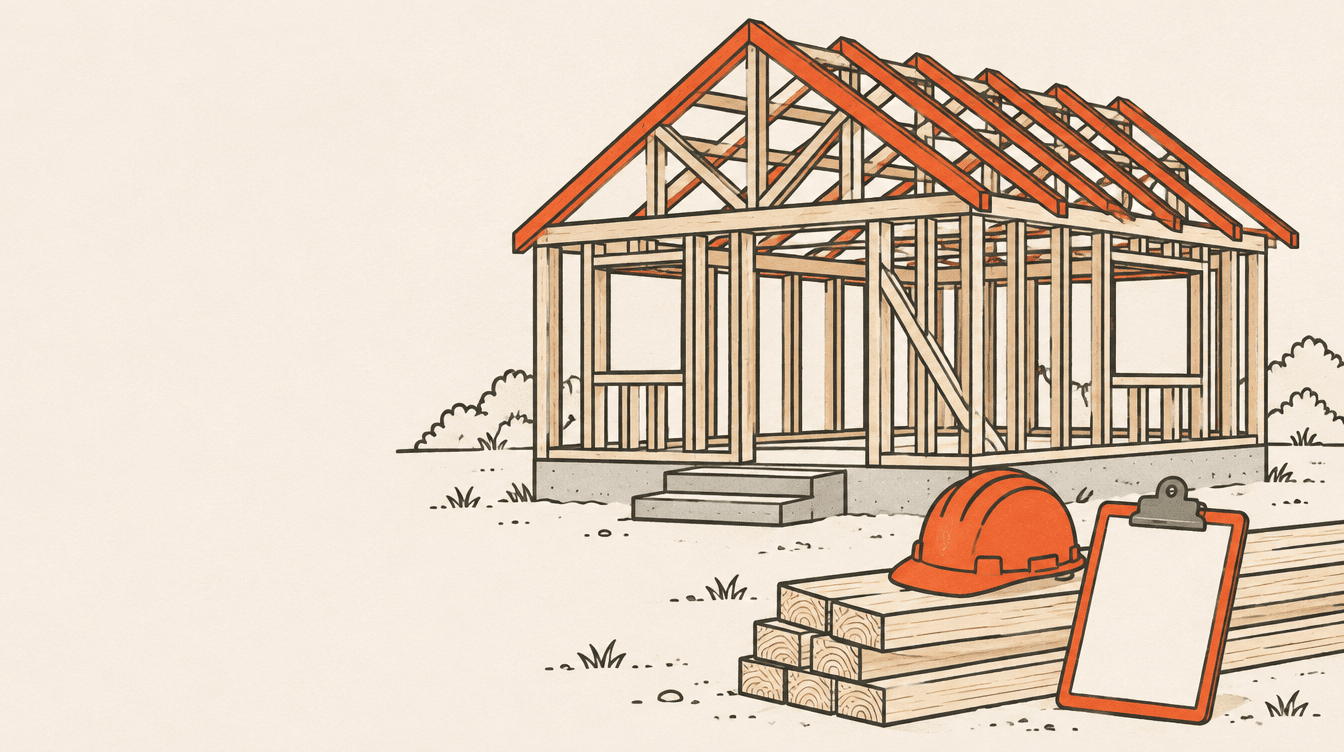
A construction draw schedule is the plan for when you get paid on a job funded in stages, usually by a construction loan. You finish a milestone, send a draw request, the lender or owner checks the work, and money comes out. Get the milestones and the paperwork right before you start and you get paid on time. Get them vague and you float the job yourself.
Each draw = contract price × that stage's share − retainage, paid after the work is verified.
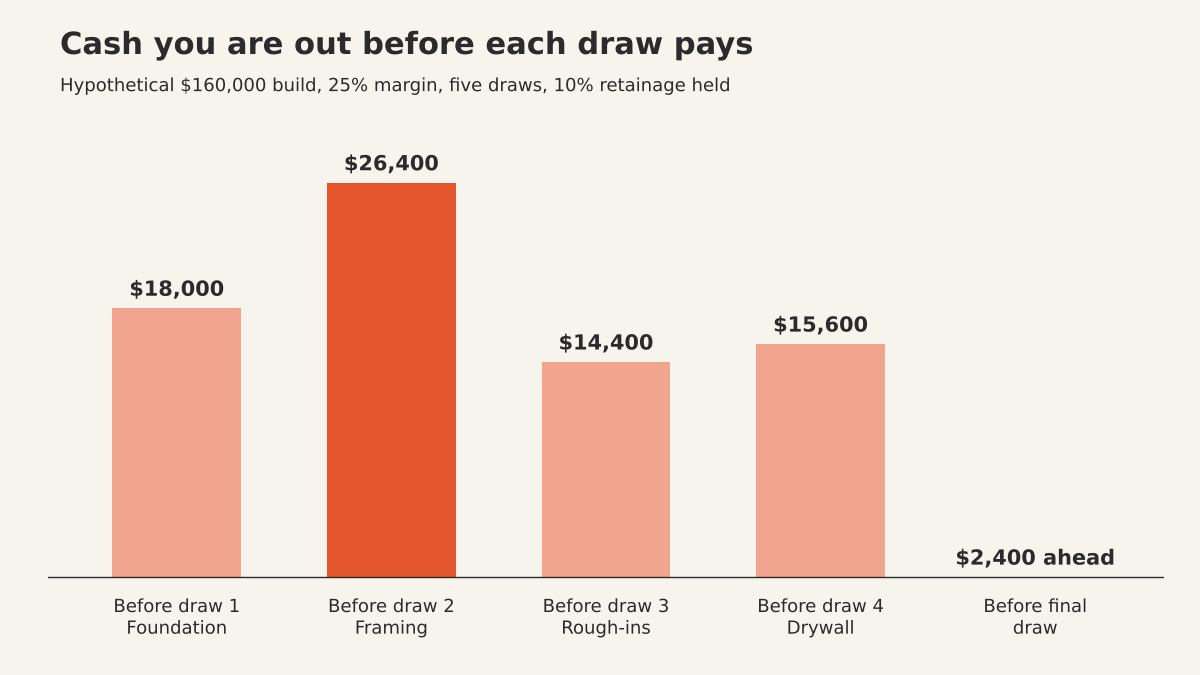
On a $160,000 build with five draws and 10% retainage, you're out up to $26,400 of your own cash before the framing draw clears. Hypothetical, worked below.
The draw schedule decides your cash flow more than your price does. A good price with a bad draw schedule still leaves you short on payroll in week five.
Scope: US builders and remodelers on loan-funded or milestone-paid residential work. US dollars, hypothetical numbers. How to split the contract into billable lines first is in schedule of values.
1. What is a draw schedule in construction?
It's a payment plan tied to milestones instead of calendar dates. Procore describes it as a plan for when a project's funds will be requested over the course of the project, often based on percentage of completion, and notes that contractors use one to bill owners while owners use one to get cash from the bank (Procore).
On a construction loan, the lender doesn't hand over the money at closing. The Federal Savings Bank explains that construction loans "typically provide money in a series of advances as construction progresses," and that draws are usually tied to milestones, not fixed dates (The Federal Savings Bank).
So your customer may love you, but the bank is the one writing the check. Build the schedule for the bank's process.
2. Draw schedule vs schedule of values vs progress billing
Three documents that get mixed up. They work together.
| Document | Answers | Example |
|---|---|---|
| Schedule of values | How much of the contract belongs to each part of the work | Framing $28,000 of a $160,000 contract |
| Draw schedule | When you can ask for money, and what has to be done first | Draw 2 after framing and dry-in pass inspection |
| Draw request (your invoice) | How much you're asking for this time, with proof | Draw 2: $36,000, photos and lien waivers attached |
ClockShark puts it this way: payment timing belongs in the draw schedule, cost allocation belongs in the schedule of values (ClockShark). If you bill monthly by percent complete instead of by milestone, that's progress billing.
3. A typical residential draw schedule
There's no standard percentage table. Each lender sets its own. But most residential schedules follow the order of the build. ClockShark lists stages for site preparation, foundation, framing, rough-ins, drywall, finishes and final completion.
| Draw | Milestone | Done means |
|---|---|---|
| 1 | Foundation | Footings and foundation poured, inspection passed |
| 2 | Framing and dry-in | Framed, roof on, windows and exterior doors in |
| 3 | Rough-ins | Plumbing, electrical and HVAC rough-ins inspected |
| 4 | Drywall and trim | Drywall finished, interior doors and trim installed |
| 5 | Final | Final inspection, punch list done, keys handed over |
Write the "done means" column into the contract. "Framing complete" sounds clear until the inspector says the sheathing isn't nailed off and the draw waits a week.
4. Worked example: five draws on a $160,000 build
The job (hypothetical): a $160,000 detached garage apartment on a construction loan. You priced it at a 25% margin, so your cost is $120,000 and your profit is $40,000. The contract holds 10% retainage on each draw until the end.
| Draw | Share | Amount | Retainage held | Paid to you |
|---|---|---|---|---|
| 1. Foundation | 15% | $24,000 | $2,400 | $21,600 |
| 2. Framing and dry-in | 25% | $40,000 | $4,000 | $36,000 |
| 3. Rough-ins | 20% | $32,000 | $3,200 | $28,800 |
| 4. Drywall and trim | 25% | $40,000 | $4,000 | $36,000 |
| 5. Final | 15% | $24,000 | $2,400 | $21,600 |
| Total | 100% | $160,000 | $16,000 | $144,000 |
Now the part that matters: cash. Say each stage costs you 75% of its draw amount, and you pay your crew, suppliers and subs before the draw for that stage comes in. That's a simplification, but it's close to how it feels.
- Before draw 1 pays: you've spent $18,000 and received nothing. You're out $18,000.
- Before draw 2 pays: spent $18,000 + $30,000 = $48,000, received $21,600. You're out $26,400.
- Before draw 3 pays: spent $72,000, received $57,600. Out $14,400.
- Before draw 4 pays: spent $102,000, received $86,400. Out $15,600.
- Before the final draw pays: spent $120,000, received $122,400. You're $2,400 ahead.
And the retainage: $16,000 held until the end is 40% of your $40,000 profit. You don't see most of your profit until the keys are handed over and the final paperwork clears. If the project closeout drags, so does your pay. Retainage covers how to negotiate and collect it.
Two ways to shrink the hole: ask for a deposit or mobilization payment at signing, and put a heavier share on early draws where your costs are heaviest, as long as the lender accepts it and each draw still matches work in place.
5. What to put in a draw request
A draw request is an invoice with proof attached. ClockShark lists what a clean request includes: the draw number, milestone, amount requested, a summary of completed work, invoices, lien waivers if required, photos, change-order references and the remaining balance.
- Photos: taken the day the milestone is done, from the same spots every time.
- Inspection results: the permit card or inspection report for that stage.
- Lien waivers: from your subs and suppliers for the previous draw, if the lender asks for them. Collect them as you pay, not the night before.
- Change orders: any approved changes, with their amounts, so the numbers reconcile. Unapproved ones don't belong in a draw.
- Running totals: contract amount, paid to date, retainage held, this request, balance left.
Missing one item usually means the request comes back, and the clock starts over.
6. Why draws get delayed, and how to avoid it
The Federal Savings Bank lists the usual culprits: inspections not completed, missing documentation, and changes to the plans or budget that need review before more money goes out. Its point: the schedule follows verified progress first.
- Vague milestones. Define each one by what an inspector can see.
- Change orders the lender doesn't know about. Get them approved by the owner and sent to the lender before you bill them. The process is in construction change orders.
- Inspection timing. Ask who orders the draw inspection and how long it takes, before the job starts.
- Front-loading. Asking for more than the work in place gets the whole draw cut back. Bill what's built.
Put your payment timing, deposit and late-payment terms in the contract too. Examples are in contractor payment terms.
Common construction draw schedule questions
How does a construction draw schedule work?
The contract or loan is split into milestones, each with a share of the price. When you finish one, you send a draw request with photos and paperwork. The lender or owner verifies the work, often with an inspection, then releases that draw minus any retainage. The schedule follows verified progress, not the calendar.
How many draws are in a construction loan?
It depends on the lender, the loan and the project. A small addition might have three or four draws; a new house often has five or more, following the build from foundation to final. Ask the lender for their standard schedule before you price the job, because it decides how much cash you need to float.
Who creates the draw schedule?
Procore notes both sides use one: contractors to bill owners, owners to draw from the bank. In practice the lender sets the rules, and the builder proposes milestones and amounts that fit them. Agree on it before work starts and put it in the contract.
What is a draw request in construction?
It's your invoice for one milestone. It lists the draw number, the work completed, the amount requested and the running totals, with photos, inspection results and lien waivers attached as required. Think of it as a progress invoice plus the proof the lender needs to release money.
What to do on your next loan-funded job
Get the lender's draw rules before you price. Set milestones an inspector can verify, run the cash math for the gap before each draw, and ask for a deposit to cover the first one. Then send each draw request the day the milestone is done.
Need a clean invoice to send with each draw? Start from the contractor invoice template, or invoice from your phone in WinPal and let the client pay online. See what a plan costs on the pricing page.
Pricing the job before you set the draws? Supervision, dumpsters and permits have to be in the number, and general conditions in construction shows how to price them.