Schedule of Values: How to Build One From Your Estimate (With Example)
What a schedule of values is, when you need one, and how to build it from your estimate, with a worked $42,000 bathroom remodel and the first pay request.

A schedule of values is a line-by-line breakdown of your contract price, with a dollar value on each part of the work, that adds up exactly to the contract sum. Every progress bill you send is measured against it, so the way you build it decides how fast you get paid.
Line value = line cost × (contract price ÷ total job cost). Every line carries its share of overhead and profit, and the lines add up to the contract.
On a $42,000 bathroom remodel with $31,500 of job cost, every $1 of cost becomes $1.33 on the schedule. Hypothetical, worked below.
Get it right and each pay request is a five-minute walk-through. Get it wrong and you spend the job arguing about what "60% done" means, or carrying costs the schedule never lets you bill.
Scope: small contractors, remodelers and subs in the US. Amounts are in US dollars, the example is hypothetical, and the rules quoted are examples to check against your own state and contract. Once the schedule exists, progress billing covers how to bill against it each month.
1. What is a schedule of values in construction?
It's the contractor's list of the parts of the job and what each part is worth. The owner, GC or lender uses it to check every payment request against the work actually in place.
On commercial jobs it lives on the AIA continuation sheet. AIA describes its G703 as the form that "breaks the contract sum into portions of the work in accordance with a schedule of values prepared by the contractor," and notes that AIA "does not publish a standard schedule of values form" (AIA Contract Documents). You write it. Nobody hands you one.
Federal jobs ask for the same thing in other words: each progress payment request must include "an itemization of the amounts requested, related to the various elements of work required by the contract" (FAR 52.232-5).
On a homeowner job, a one-page table does the work. You'll hear it called an SOV, a cost breakdown or, in California home improvement contracts, a schedule of progress payments.
2. When do you need one?
Any time you'll be paid in more than two or three pieces. That covers:
- Sub work for a GC. Most subcontracts ask for a schedule of values with your first pay application.
- Commercial and public work billed on AIA forms or a lender's draw schedule.
- Remodels and additions that run more than a few weeks.
- California home improvement contracts with progress payments. The schedule must state each payment in dollars and cents, tied to the work and materials it covers, and the contract must say "IT IS AGAINST THE LAW FOR A CONTRACTOR TO COLLECT PAYMENT FOR WORK NOT YET COMPLETED, OR FOR MATERIALS NOT YET DELIVERED" (Business and Professions Code § 7159).
A two-day job with a deposit and a final invoice doesn't need one. Your payment terms are enough.
3. How to build a schedule of values from your estimate
Start from the estimate you priced the job with, not from a blank form. Five steps:
- Group your estimate into lines you can measure. Use the phases you actually work in and that someone can see on a walk-through: demo, rough-in, drywall, tile, fixtures. Six to fifteen lines on a residential job.
- Put the job cost on each line. Labor, materials, subs and equipment for that phase, plus that phase's share of overhead. If you're unsure what belongs in job cost, start with how to estimate construction costs.
- Price the job. Contract price = total job cost ÷ (1 − margin). Margin, not markup.
- Spread overhead and profit across every line with one factor: contract price ÷ total job cost. Multiply each line's cost by it.
- Round, then make it add up to the penny. Fix any rounding difference on the biggest line. A schedule that's $3 off the contract gets sent back.
Two lines worth adding on almost every job: mobilization (permits, protection, setup) so the first pay request has something real to bill, and punch list and closeout so the last bit of money is tied to a defined finish, not to the owner's mood. More on that in our guide to the construction punch list.
4. Worked example: a $42,000 bathroom remodel
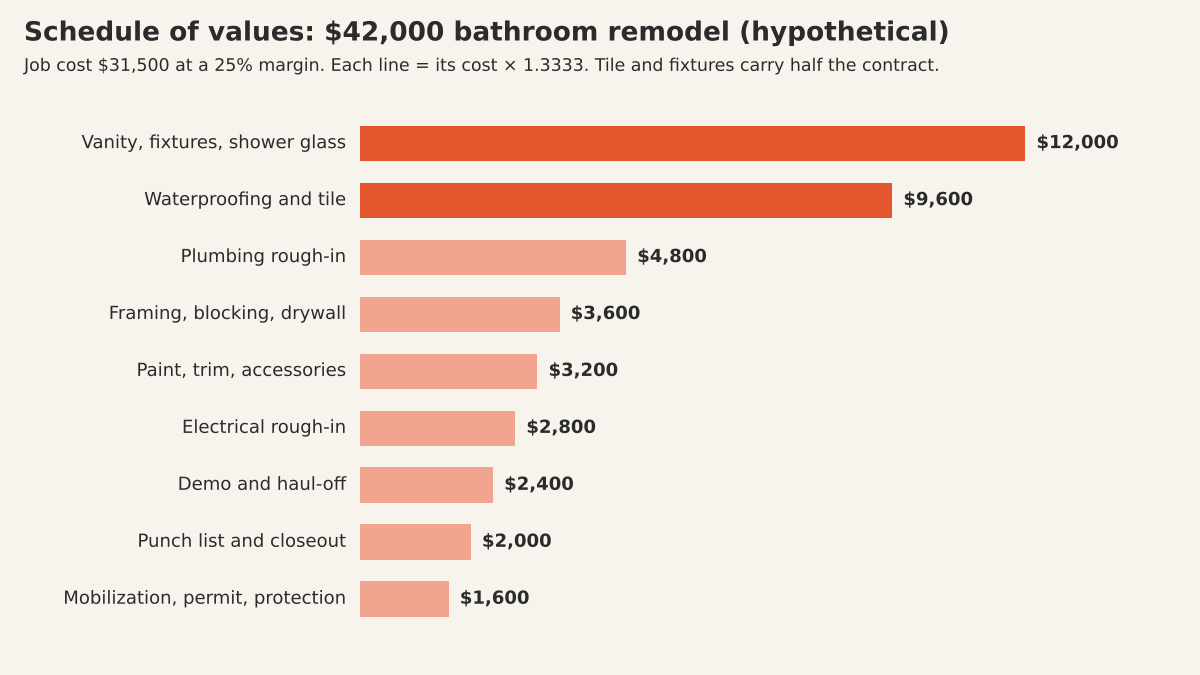
The job (hypothetical): a full primary bathroom remodel. The estimate comes to $31,500 of job cost, including overhead. Target margin: 25%.
Contract price = $31,500 ÷ (1 − 0.25) = $31,500 ÷ 0.75 = $42,000.
Spread factor = $42,000 ÷ $31,500 = 1.3333. Every line's cost × 1.3333 = its scheduled value.
| # | Line | Job cost | Scheduled value | % of contract |
|---|---|---|---|---|
| 1 | Mobilization, permit, protection | $1,200 | $1,600 | 3.8% |
| 2 | Demo and haul-off | $1,800 | $2,400 | 5.7% |
| 3 | Plumbing rough-in | $3,600 | $4,800 | 11.4% |
| 4 | Electrical rough-in | $2,100 | $2,800 | 6.7% |
| 5 | Framing, blocking, drywall | $2,700 | $3,600 | 8.6% |
| 6 | Waterproofing and tile | $7,200 | $9,600 | 22.9% |
| 7 | Vanity, fixtures, shower glass | $9,000 | $12,000 | 28.6% |
| 8 | Paint, trim, accessories | $2,400 | $3,200 | 7.6% |
| 9 | Punch list and closeout | $1,500 | $2,000 | 4.8% |
| Total | $31,500 | $42,000 | 100% |
Percentages are rounded, so they add to 100.1%. The dollars add up exactly, and the dollars are what you bill.
5. What the first pay request looks like
End of week three (hypothetical): mobilization and demo are done, plumbing rough-in is half done, and the vanity and fixtures, worth $4,500 at their scheduled value, are delivered and locked in the garage.
- Line 1: $1,600 × 100% = $1,600
- Line 2: $2,400 × 100% = $2,400
- Line 3: $4,800 × 50% = $2,400
- Materials stored on site (line 7): $4,500
- Total completed and stored: $10,900. Balance to finish: $42,000 − $10,900 = $31,100.
Stored materials only count if your contract allows them. Federal contracts let the contracting officer consider "material delivered on the site" (FAR 52.232-5). A California home improvement contract can't collect for materials not yet delivered, so the fixtures count only once they're on site. If there's no clause, ask before you bill for them.
If your contract has retainage, subtract it from the total. Our retainage guide shows the math and how to get it back.
6. Front-loading: why it backfires
Front-loading means putting extra value on the early lines so you get paid sooner. Move $2,000 from fixtures to demo and line 2 becomes $4,400, more than 10% of the contract for two days with a sledgehammer.
Owners, GCs and lenders know what demo costs. A front-loaded schedule gets rejected, or worse, approved and then checked line by line on every pay request after that. And if the job stops halfway, you've been paid for work that isn't there.
The opposite mistake costs you too: burying overhead and profit in the last lines. You carry the job on your own cash and only see your margin at the end, which is also when the owner has the most reasons to hold money back. One spread factor across every line avoids both.
7. Change orders on the schedule
Each approved change order gets its own new line, with its own value, and the contract sum goes up by that amount. Never fold it into an existing line.
Say the owner adds a heated floor for $1,800. Line 10 reads "CO #1: heated floor, $1,800" and the contract becomes $43,800. You bill it by percent complete like any other line. How to price and write the change itself is in construction change orders.
Job funded by a construction loan? The bank releases money on its own milestone plan. How that works, and how much cash you float between draws, is in construction draw schedule.
Common schedule of values questions
Who prepares the schedule of values?
The contractor. The GC writes it for the owner, and each sub writes its own for the GC. The owner, architect or lender then reviews and approves it before the first payment. Submit it with the contract or the first pay application, and don't bill against it until it's approved in writing.
What's the difference between a schedule of values and an estimate?
Your estimate is how you priced the job: costs, quantities, overhead and margin, for your eyes. The schedule of values is what you show the customer: the contract price broken into billable parts, with overhead and profit already spread across each line. Build the schedule from the estimate, never the other way around.
How detailed should a schedule of values be?
Detailed enough that someone walking the job can tell how far along each line is, and no more. Six to fifteen lines fits most residential jobs. Commercial jobs often go by trade or spec section. Lines that are too big are hard to measure; lines that are too small turn every pay request into an audit.
Is a schedule of values the same as a pay application?
No. The schedule of values is set once, at the start, and only changes with approved change orders. A pay application is the monthly request that reports progress against it: work done this period, work done to date, stored materials, retainage and the amount due now.
What to do on your next contract
Group your estimate into measurable lines, price the job with cost ÷ (1 − margin), spread overhead and profit with one factor, add mobilization and closeout lines, and get the schedule approved before your first bill. Want to check the margin first? Run it through the profit margin calculator.
Already sent the estimate? Upload it to the estimate checker and see if it's priced too low.