Punch List in Construction: How to Run One and Get Your Final Payment
What a punch list is, when it happens, how to write items nobody can argue with, and how much of the final payment a customer should hold for open items.
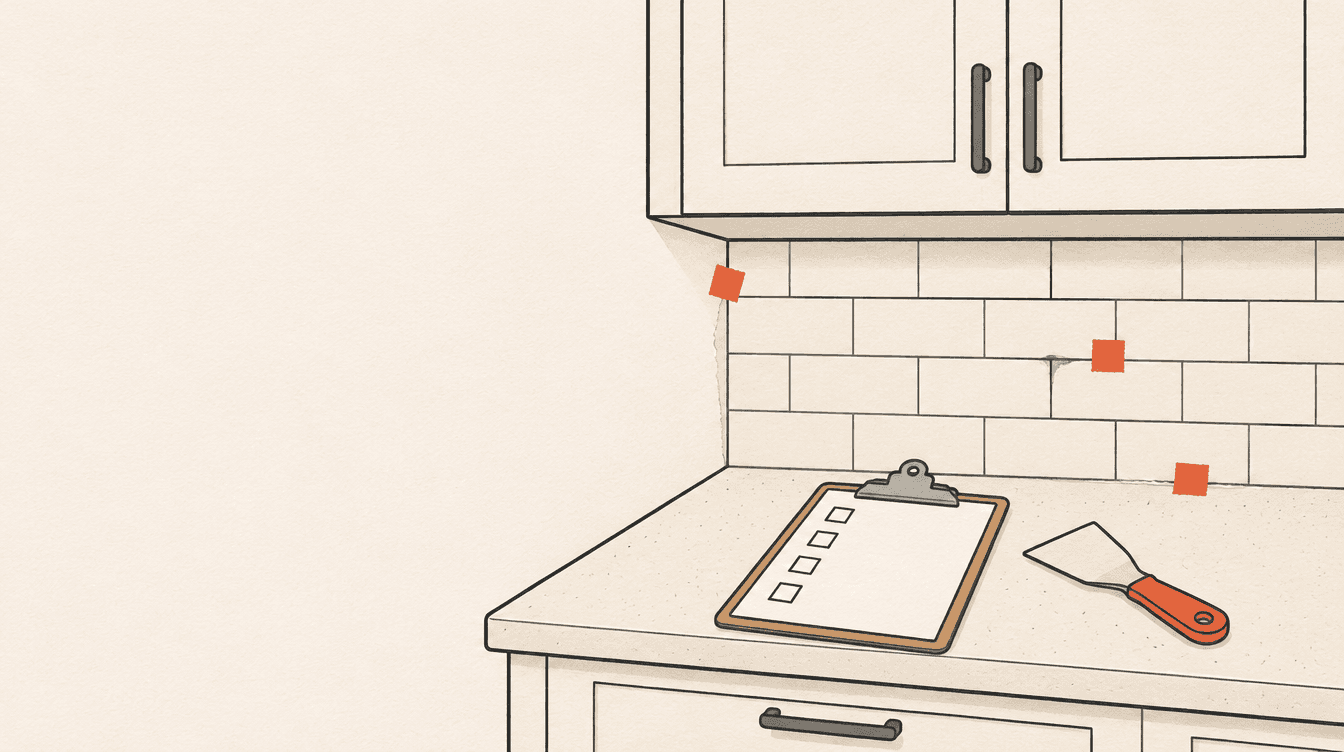
A punch list is the list of small items left to fix or finish at the end of a construction job: the touch-ups, adjustments and missing pieces found on a final walk-through. Once every item is done and signed off, the job is closed and the last payment is due.
Fair holdback = value of the open punch items × 1.5, not the whole final payment.
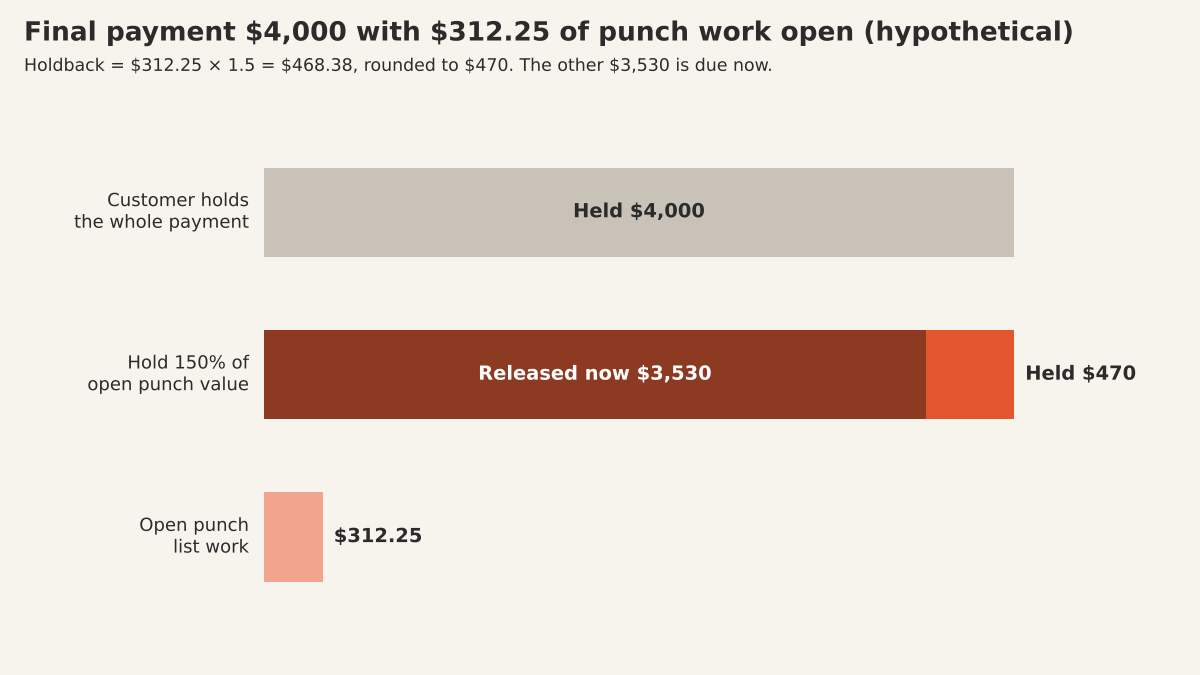
On a $4,000 final payment with $312.25 of open punch work, that's about $470 held and $3,530 released now. Hypothetical, worked below.
The punch list is where small jobs lose money quietly. Seven little items, a second trip, and a customer sitting on your final check until the last outlet cover is swapped.
Scope: small contractors, remodelers and subs in the US. Amounts are in US dollars, the example is hypothetical, and the laws quoted are examples to check against your own state and contract. For how the last payment shows up on a pay request, see progress billing.
1. What is a punch list in construction?
It's a written list of everything that still doesn't match the contract when the job is basically done: a chipped tile, a door that rubs, a missing drawer pull, a paint skip. Each item gets a location, a fix and a sign-off.
On commercial jobs, the contractor often submits the list and the architect inspects the work against it. On a remodel, it's usually you and the homeowner with a roll of blue tape.
A punch list is not a to-do list for unfinished scope. If the backsplash isn't installed yet, the job isn't at the punch stage. Punch items are small and quick, and they don't stop the owner from using the space.
2. When does the punch list happen?
At substantial completion: the work is done enough that the owner can use it for what it was built for. That's when you schedule the walk-through.
The law cares about this moment too, because it starts the clock on final money. The federal payment clause says that when work is substantially complete, the contracting officer keeps only what's adequate to protect the government "and shall release to the Contractor all the remaining withheld funds" (FAR 52.232-5). In California, completion for lien and payment purposes happens on actual completion, or when the owner moves in and work stops, among other events (Civil Code § 8180).
Your contract should say what counts as complete and how the punch list works. If it doesn't, the customer decides, and they'll decide on the day they feel like paying.
3. How to run a punch list walk-through
- Do your own walk first. Go through the job a day or two before the customer does and fix what you find. Every item you catch is one they don't.
- Walk it together, once. Bring the contract, the scope of work and the change orders, plus tape and your phone.
- Write each item so nobody can argue about it later: where, what's wrong, what the fix is, who does it. "Kitchen, upper cabinet left of hood, door rubs, adjust hinge" beats "cabinet issue".
- Check each item against the contract. A real defect goes on the list. A new idea ("can we add a pendant?") goes on a change order, with a price.
- Get the list signed by the customer as complete. Nothing added after the signature without a new walk.
- Fix everything in one trip, photograph each fix, and get a second signature that the list is closed.
The signed list is your best friend at closeout. "These seven items, signed on the 14th" ends the conversation that starts with "there were a few other things".
4. What a good punch list item looks like
| Location | Item | Fix | By | Done |
|---|---|---|---|---|
| Hallway | Paint skip next to outlet | Touch up, two coats | Paint | Photo + initials |
| Kitchen, upper left of hood | Door rubs frame | Adjust hinge | Carpentry | Photo + initials |
| Island | Cracked outlet cover | Replace cover | Electrical | Photo + initials |
If you have subs, put the trade on every line and send each sub its own items the same day. A punch list that sits in your truck for a week is a week of the customer holding your money.
5. Worked example: the punch list and the final payment
The job (hypothetical): a $40,000 kitchen remodel. The contract holds the last $4,000 until completion. The walk-through turns up seven items. Price each one at your cost to fix it, with labor at an assumed loaded cost of $55 an hour (what goes into a loaded rate is in labor burden).
| Item | Hours | Labor at $55/h | Material | Cost |
|---|---|---|---|---|
| Paint touch-up at hallway outlet | 0.5 | $27.50 | $0 | $27.50 |
| Adjust cabinet door hinge | 0.25 | $13.75 | $0 | $13.75 |
| Replace cracked outlet cover | 0.25 | $13.75 | $4 | $17.75 |
| Caulk gap at backsplash | 0.5 | $27.50 | $8 | $35.50 |
| Replace scratched shoe molding | 1 | $55.00 | $18 | $73.00 |
| Re-grout two floor tiles | 1 | $55.00 | $12 | $67.00 |
| Install missing drawer pull | 0.25 | $13.75 | $9 | $22.75 |
| Return trip (drive and setup) | 1 | $55.00 | $0 | $55.00 |
| Total | 4.75 | $261.25 | $51 | $312.25 |
The customer's first move: "We'll pay the $4,000 when it's all done." That's $4,000 held over $312.25 of work, almost 13 times the value.
A fairer split: hold 150% of the open punch value and release the rest now.
- Holdback: $312.25 × 1.5 = $468.38, call it $470.
- Released now: $4,000 − $470 = $3,530.
Where does 1.5 come from? Borrow it from California's rule for disputed retention: the owner "may withhold from final payment an amount not in excess of 150 percent of the disputed amount" (Civil Code § 8812). That statute is about retention, not punch lists, so don't quote it at a homeowner as if it covers them. Write the same idea into your own contract instead.
6. Put the punch list in your contract and your price
Three lines in the contract save most closeout fights:
- One walk-through, one list. Items found after the signed list are warranty work, handled on the warranty terms, not a reason to hold the final payment.
- Holdback limit. The customer can hold no more than 150% of the value of open punch items. The rest of the final payment is due at substantial completion.
- A deadline. You finish the list within a set number of days, and the holdback is due when the list is signed off.
Then price the punch into the job. Most jobs have one, so treat it as a line you know is coming: a few hours, a trip and some caulk. On a schedule of values, give it its own line, like the punch list and closeout line in our schedule of values example. Your payment terms should match.
7. Close it out and send the final invoice
The day the list is signed off, send the final invoice. Don't wait for the end of the month.
- Show the contract sum, approved change orders, payments received and the amount due now.
- Attach the signed punch list with photos of each fix.
- Include any closeout paperwork the contract asks for: warranties, manuals, lien waivers.
- Write a due date, not just "due on receipt", and make it easy to pay online.
If there's retainage on the job, a signed punch list is usually what releases it, so send a separate retainage invoice the same day. In WinPal you can send the invoice from your phone at the walk-through and let the customer pay online. The basics of a clean invoice are in how to invoice as a contractor.
Common punch list questions
What is the difference between a punch list and a checklist?
A checklist is planned in advance: the steps or inspections you run on every job. A punch list is found at the end: the specific items on this job that don't yet match the contract. You use a checklist to prevent punch items, and a punch list to clean up the ones that got through.
Who creates the punch list?
On commercial jobs, the contractor often submits the list and the architect or owner's rep inspects against it and adds to it. On residential jobs, usually the contractor and the homeowner together. Either way, the contractor should walk the job first and fix what they find, so the official list is short.
Can a homeowner refuse to pay until the punch list is done?
Depends on your contract. If it ties the final payment to completion with no limit, the customer can hold all of it. Write a holdback limit, such as 150% of the value of open items, and a deadline into the contract. If payment stalls after the list is signed, see your options for non-payment.
Should you charge for punch list work?
Not separately for real defects in your own work; that's part of the contract price, so price it in from the start. New requests that come up at the walk-through are different. Anything outside the contract goes on a change order with a price before you do it.
What to do on your next closeout
Walk the job yourself first, do one signed walk-through, price the open items, hold back 150% of their value instead of the whole payment, and send the final invoice the day the list is signed.
Want the final invoice to go out from the job site? Get started with WinPal.