Construction Bookkeeping: A Weekly Routine for Contractors
Construction bookkeeping is regular bookkeeping plus job costs, deposits, retainage and subs. A 30-minute weekly routine, the monthly check, and why a profitable month can still drain your bank account.
Construction bookkeeping is regular bookkeeping plus four things most small businesses don't deal with: costs tracked by job, money held back as retainage, deposits and progress invoices that arrive before the work is done, and subcontractors you have to report to the IRS. Get those four right with a 30-minute weekly routine and a monthly check, and tax season stops being a shoebox problem.
Collected − paid out = this month's cash. Invoiced − costs = this month's profit. They're not the same number.
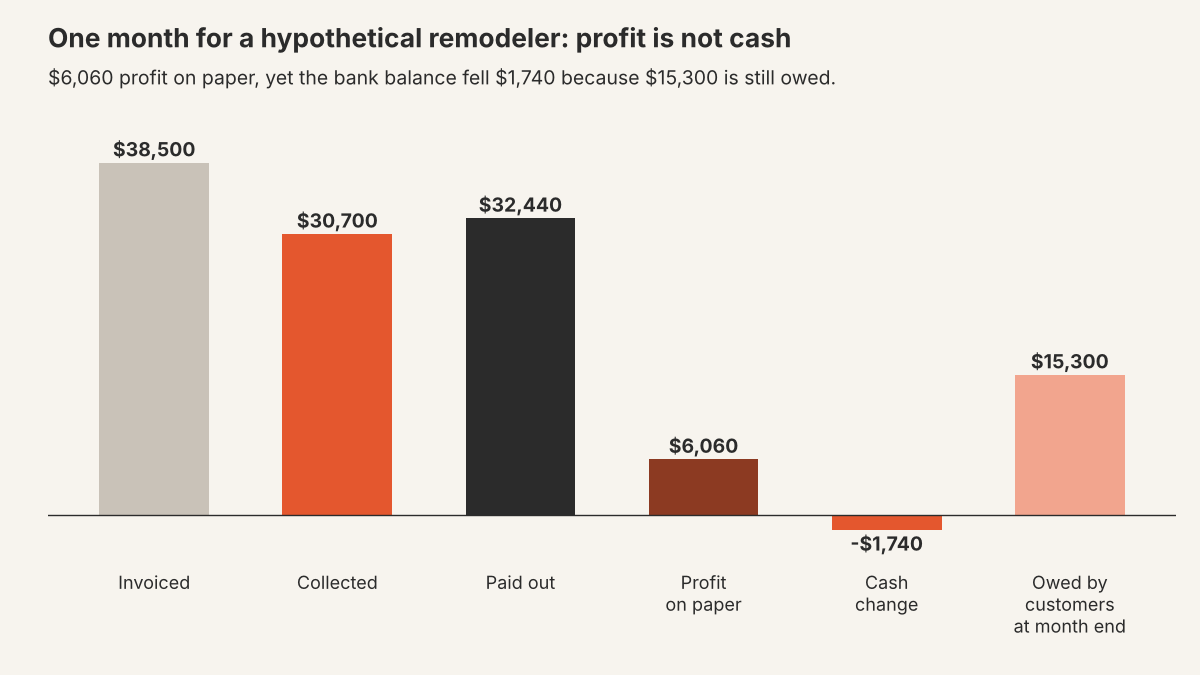
Hypothetical: a remodeler invoices $38,500, makes $6,060 on paper, and still ends the month $1,740 short on cash. Worked below.
Why it matters: a busy contractor can still run out of cash between invoices. Bookkeeping is how you see that coming.
Scope: US residential contractors and small crews. This is the paperwork side, not tax advice. Your accountant or bookkeeper decides how things get booked and filed. All dollar figures are hypothetical unless a source is named.
1. What's different about construction bookkeeping
A coffee shop sells a latte and gets paid on the spot. You sign a job, take a deposit, buy materials, pay subs, bill in stages and wait on the last 5 or 10%. That's what makes it different.
| Construction wrinkle | What it means for your books |
|---|---|
| Costs by job | Every receipt, hour and sub invoice gets tagged to a job, not just a category |
| Deposits and progress billing | Money comes in before the work is finished; track it against the job |
| Retainage | Part of each invoice is held back; it's owed to you but not in the bank yet |
| Subcontractors | W-9 on file, payments tracked per sub, 1099-NEC at year end |
| Change orders | Extra revenue and extra cost on the same job, kept separate from the original scope |
If you bill in stages, progress billing and retainage cover the invoicing side. This page is about keeping the books straight once the money moves.
2. Set it up once
- A separate business bank account and card. Mixed personal and business spending turns every receipt into a question. Separate accounts make every other step faster.
- Accounting software or a bookkeeper. Your books live in accounting software. Field apps feed it; they don't replace it.
- Simple expense categories. Materials, subcontractors, payroll, equipment and rentals, vehicle, insurance, office and software. Your accountant can refine them.
- Job tags. One tag or class per job, so the same receipt counts as "materials" and as "Smith bathroom." That's what makes construction job costing possible later.
- A W-9 from every sub before the first payment. Chasing tax IDs in January is miserable.
3. The weekly routine (about 30 minutes)
Pick a slot, say Friday after the last job, and do the same five things every week.
- Receipts. Every receipt from the week, tagged to a job. Better yet, snap them the day you buy. In WinPal you can scan a receipt with your phone and it saves the details as an expense.
- Invoices out. Bill every finished job and every stage that's due. Unbilled work is a loan you gave the customer for free. WinPal lets you invoice from your phone and let clients pay online.
- Money in. Match payments to invoices. Note any partial payments and retainage still held.
- Bills out. Check sub and supplier invoices against their quotes, then schedule payment.
- Who's late. List anything past due and send a reminder. The contractor invoicing guide has follow-up wording that works.
4. The monthly check
Once a month, reconcile your bank and card accounts with your books so every transaction is categorized and nothing is counted twice. Then look at three numbers: cash collected, money paid out, and what customers still owe you.
That third number, accounts receivable, is where contractors get surprised. Retainage and slow final payments pile up quietly.
5. Worked example: profitable on paper, short on cash
Hypothetical two-person remodeler, one month. Retainage is 5% on the progress invoices. For simplicity, all costs below belong to the work invoiced this month.
| Line | Amount |
|---|---|
| Owed by customers at the start of the month | $7,500 |
| Invoiced this month | $38,500 |
| Collected this month | $30,700 |
| Owed by customers at month end ($7,500 + $38,500 − $30,700) | $15,300 |
| of which retainage held (5% of $38,500) | $1,925 |
| Materials | $11,640 |
| Subcontractors | $8,900 |
| Payroll, including employer taxes | $7,800 |
| Overhead (truck, insurance, phone, software) | $4,100 |
| Total paid out | $32,440 |
Profit on paper: $38,500 invoiced − $32,440 in costs = $6,060, a 15.7% margin. Not bad.
Cash in the bank: $30,700 collected − $32,440 paid = −$1,740. The month made money and the account still went down.
The gap is the $7,800 growth in what customers owe you (from $7,500 to $15,300). That's your money, sitting in someone else's account. The bookkeeping didn't cause it. It just made it visible before payroll bounced.
Fixes that show up in the books within a month: bigger deposits on material-heavy jobs, billing each stage the day it's done, and following up the day an invoice goes past due. The contractor payment terms guide has the wording.
6. Subcontractors and 1099-NEC
If you pay a sub who isn't your employee, you'll usually owe them a Form 1099-NEC after year end. The threshold changed. For tax years beginning after 2025, the IRS raised the minimum reporting threshold to $2,000, and its instructions say to enter nonemployee compensation "of $2,000 or more" (IRS Instructions for Forms 1099-MISC and 1099-NEC).
So in 2026, a painter you paid $8,900 gets a 1099-NEC, and a one-off helper you paid $1,800 generally doesn't. Payments to corporations and other exceptions have their own rules, so confirm each sub with your accountant. The bookkeeping job is simple: a W-9 on file and a running total per sub, so January is a report, not a hunt.
7. How long to keep the paperwork
The IRS says to keep records that support your tax return until the period of limitations runs out. For most returns that's 3 years, and it adds: "Keep employment tax records for at least 4 years" (IRS, How long should I keep records?). Some situations call for longer, and your insurer or lender may want more.
Digital copies make this easy. A photo of a receipt tagged to a job is easier to find in three years than the paper version faded in a glovebox.
Common construction bookkeeping questions
Can I do my own construction bookkeeping?
Yes, at small volume. A separate bank account, accounting software and a 30-minute weekly routine cover most solo and two-person shops. Hire a bookkeeper when the weekly routine keeps slipping, when you add employees and payroll, or when you're juggling progress billing and retainage on several jobs. Either way, an accountant for taxes is money well spent.
How is construction bookkeeping different from regular bookkeeping?
Costs and income are tracked by job, not just by category. Money arrives in stages through deposits and progress invoices, part of it can be held back as retainage, and subcontractor payments have to be tracked for 1099 reporting. Regular small-business bookkeeping usually has none of that, which is why generic setups feel like a bad fit.
Is a customer deposit income?
Treat it as money tied to a specific job, not as free cash. Track it against that job so you know what's already been paid when you send the next invoice. How it's recorded for taxes depends on your accounting method, so that's a question for your accountant. Just don't spend a deposit before the job's materials are bought.
Does WinPal replace accounting software?
No. WinPal handles the paperwork around jobs: estimates, invoices, payments, receipts and expenses. It's where the information starts, on your phone at the job. Your books still live in accounting software or with your bookkeeper. Capturing receipts and invoices on the day they happen is what makes the books easy to keep.
What to do this week
Open a separate business account if you don't have one, tag this week's receipts to their jobs, and send every invoice that's due. Then check what customers owe you right now. That number tells you more about next month than your profit does.
Want to see what your jobs are really clearing? Run them through the profit margin calculator, or start from the contractor invoice template for your next bill.