Retainage in Construction: What It Is and How to Get Paid
What retainage is, what it really costs a sub, the release deadlines in California and Texas, and a step-by-step way to get it paid.
Retainage is the part of each payment an owner or general contractor holds back until the job is finished, often 5% to 10%. You still bill the full value of the work. The held amount sits as money owed to you until the contract says it's released.
Retainage held = retainage rate × work billed to date.
On a hypothetical $80,000 subcontract at 10%: $8,000 held by the last pay app. At an 8% net margin, the profit on that job is $6,400. The money held is bigger than the profit.
That's the whole problem in one line. Until retainage comes back, the job hasn't made you a dime.
Scope: US contractors and subs billing in progress payments. Amounts are in US dollars, the example is hypothetical, and the laws quoted are examples from California, Texas and federal contracts. Check your own state and your contract. For how retainage shows up on a pay application, see progress billing.
1. What is retainage in construction?
Retainage, also called retention, is a percentage withheld from each progress payment as security that the work gets finished and fixed. The owner holds it from the general contractor, and the GC often holds the same percentage from each sub.
It shows up mostly on commercial work, multi-family, public jobs and anything with a GC and subs. Most small residential jobs paid by a homeowner don't have it, and some laws exclude them on purpose.
The rate depends on the contract and the law. Three examples:
| Where | Rule | Source |
|---|---|---|
| California, private works, contracts from Jan 1, 2026 | Max 5% of any payment and 5% of the contract price; subs can't be held at a higher rate than the prime contract. Does not apply to residential projects that aren't mixed-use and are four stories or fewer. | Civil Code § 8811 |
| Texas, jobs with mechanic's lien rights | Owner must reserve 10% of the contract price or of the work's value during the job and for 30 days after completion | Property Code § 53.101 |
| Federal fixed-price construction | Up to 10% of a payment only if progress isn't satisfactory; remaining funds released at substantial completion | FAR 52.232-5(e) |
Sources: California Civil Code § 8811; Texas Property Code § 53.101; FAR 52.232-5.
2. What retainage costs you
Retainage isn't lost money, but it's late money, and late money has two costs: the cash you're short while you wait, and the risk you never see it.
Take a hypothetical four-month, $80,000 subcontract billed $20,000 a month with 10% retainage. Each pay app holds back $2,000. By month 4 you're carrying $8,000, and it stays there until the release.
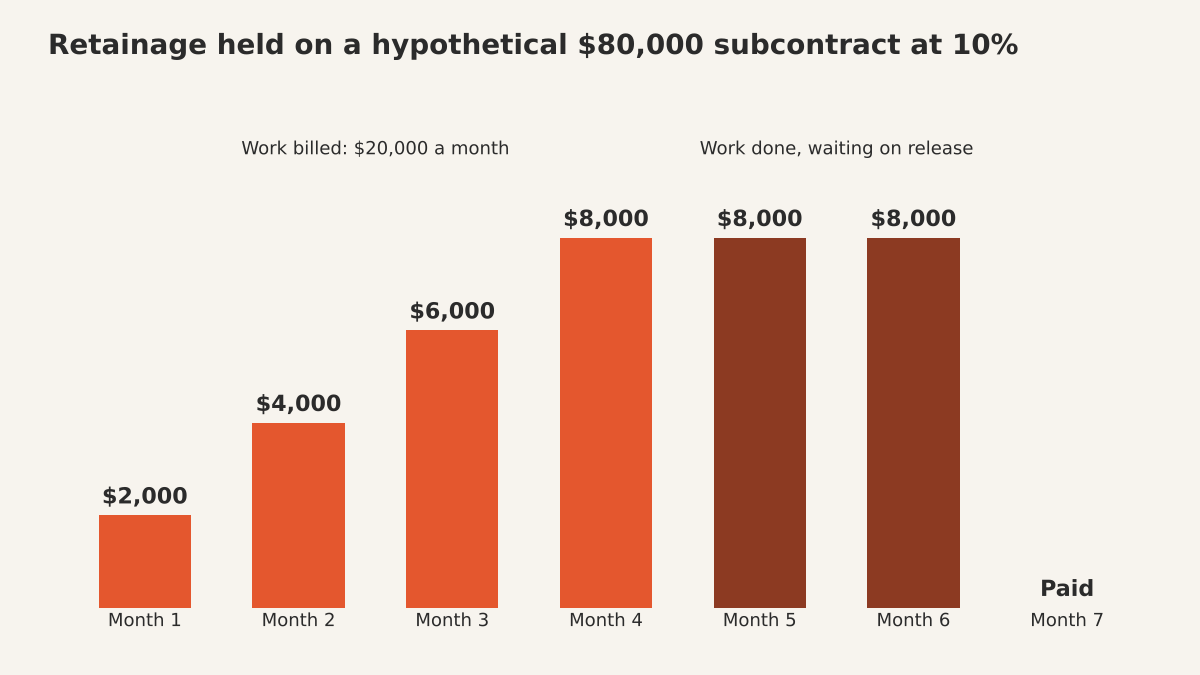
The cash cost. Add up the month-end balances: $2,000 + $4,000 + $6,000 + $8,000 + $8,000 + $8,000 = $36,000 of month-dollars. If you cover the gap on a credit line at an assumed 10% a year, that's $36,000 × 10% ÷ 12 = $300.
The risk cost. $300 is small. The real hit is the $8,000 itself. At an 8% net margin the job's profit is $6,400, so if the GC slow-pays, disputes the punch list or goes under, you did the job at a loss. See what a normal contractor profit margin looks like: most jobs don't have 10% to spare.
3. Read the retainage clause before you sign
The time to deal with retainage is the bid, not month seven. Look for four things in the contract or subcontract:
- The rate. 5% and 10% are both common. In California private work, the sub's rate can't be higher than the owner's rate on the prime contract.
- What triggers release. Completion of your scope, completion of the whole project, or final acceptance by the owner. A sitework sub who finishes in month 2 of an 18-month build can wait over a year if release is tied to the project.
- Pay-when-paid language. If the GC only pays you after the owner pays them, your retainage depends on someone else's job.
- Reductions. Ask whether retainage can drop to 5% or zero once the job is half done. If the clause says nothing, it won't.
Things worth asking for, in this order: a lower rate, release when your own scope is done and accepted, a reduction at 50% complete, and a written date for release. Get it in the contract, not in a phone call.
4. Price retainage into the bid
If you know 10% will sit for months, the carrying cost is a real job cost. Put it in, then price the job with price = cost ÷ (1 − margin).
Hypothetical: job costs of $73,300 plus the $300 carrying cost is $73,600. At an 8% target margin, price = $73,600 ÷ 0.92 = $80,000. Leave the $300 out and you're working for 7.6% on a job you meant to price at 8%.
Price is only half of it. Your payment terms should say when retainage is billed and when it's due, so nobody has to guess at closeout.
5. When retainage has to be paid
Many states set deadlines for releasing retainage, and some add penalties for holding it too long. California is a good example of how the chain works on private jobs:
- The owner pays the direct contractor's retention within 45 days after completion of the work of improvement (Civil Code § 8812).
- The direct contractor pays each sub its share within 10 days after receiving it (§ 8814).
- Miss those deadlines and the penalty is 2% a month on the amount wrongfully withheld, plus attorney's fees for the winner of a collection suit (§ 8818).
- With a good faith dispute, the payer can withhold up to 150% of the disputed amount.
In Texas, a sub whose contract provides for retainage must send a notice of claim for unpaid retainage to the owner and the original contractor by the 30th day after the sub's contract is completed, terminated or abandoned, or after the original contract is terminated or abandoned, whichever is earlier, to keep a lien on it (Property Code § 53.057). Miss that window and you lose the lien on that money.
Other states have their own deadlines and exceptions. This is general information, not legal advice. If a big retainage is stuck, talk to a construction attorney in your state before a deadline passes.
6. How to get your retainage paid
- Track it from the first pay app. Keep a running total of retainage held per job and per customer. It's money owed to you, so treat it like any other open invoice.
- Put the release date on your calendar the day the job ends. Count from whatever triggers release in your contract.
- Finish the closeout paperwork fast. Signed punch list, warranties, manuals, as-builts, lien waivers. Missing paperwork is an easy excuse to keep holding your money.
- Send a separate retainage invoice. One line: retainage released on contract X, amount, due date. Attach the closeout documents.
- Follow up on a schedule, in writing, and keep lien and notice deadlines in view. If it goes past due, the steps in suing for non-payment apply here too.
Changes that happened during the job affect retainage too. Approved change orders raise the contract value, and the retainage on them should come back with the rest.
Not every trade deals with this. A residential HVAC shop's profit margin mostly depends on how service and replacements are priced, but the same shop doing commercial sub work will see retainage on every pay app.
A signed punch list is usually what releases the last money on a job. Here's how to run a punch list so a few small items don't hold up your whole final payment.
Common retainage questions
What does retainage mean?
Retainage means money held back from each progress payment on a construction contract until the work is complete, usually 5% to 10%. It protects the owner or general contractor if work is unfinished or defective. The contractor still earns it and gets it at the release point the contract or state law sets.
Is retainage the same as retention?
Yes. Retainage, retention and retention payment all describe the same holdback. California's statute says "retention"; many contracts and pay applications say "retainage". The amount, release trigger and deadlines come from the contract and the state's law, whatever the word.
What is a typical retainage percentage?
5% to 10% of each payment. Some laws cap it: California limits most private works contracts entered on or after January 1, 2026 to 5%, and federal fixed-price contracts allow up to 10% only when progress isn't satisfactory. Small residential jobs often have none.
Can you put a lien on unpaid retainage?
Often yes, but the notices and deadlines are strict and differ by state. In Texas, a sub must send a notice of claim for unpaid retainage by the 30th day after its contract is completed, terminated or abandoned, or after the original contract is terminated or abandoned, whichever is earlier, to keep lien rights on it. Check your state's deadlines the day the job ends.
What to do on your next bid
Read the retainage clause, ask for a lower rate or an earlier release, price the carrying cost into the job, and calendar the release date the day you finish.
Already priced it? Upload the estimate to the estimate checker and see if it's priced too low.