Construction Cash Flow: Stop Running Out of Money Mid-Job
Why a profitable job can still empty your account, how to forecast cash week by week, and the deposit and billing moves that close the gap.

Construction cash flow is the timing of money coming in and going out on your jobs. You pay for labor, materials and subs before the customer pays you, so a profitable job can still leave your account empty for weeks. Managing cash flow means shrinking that gap: get paid earlier, spend later, and see the low point coming.
Cash position each week = starting cash + money in − money out.
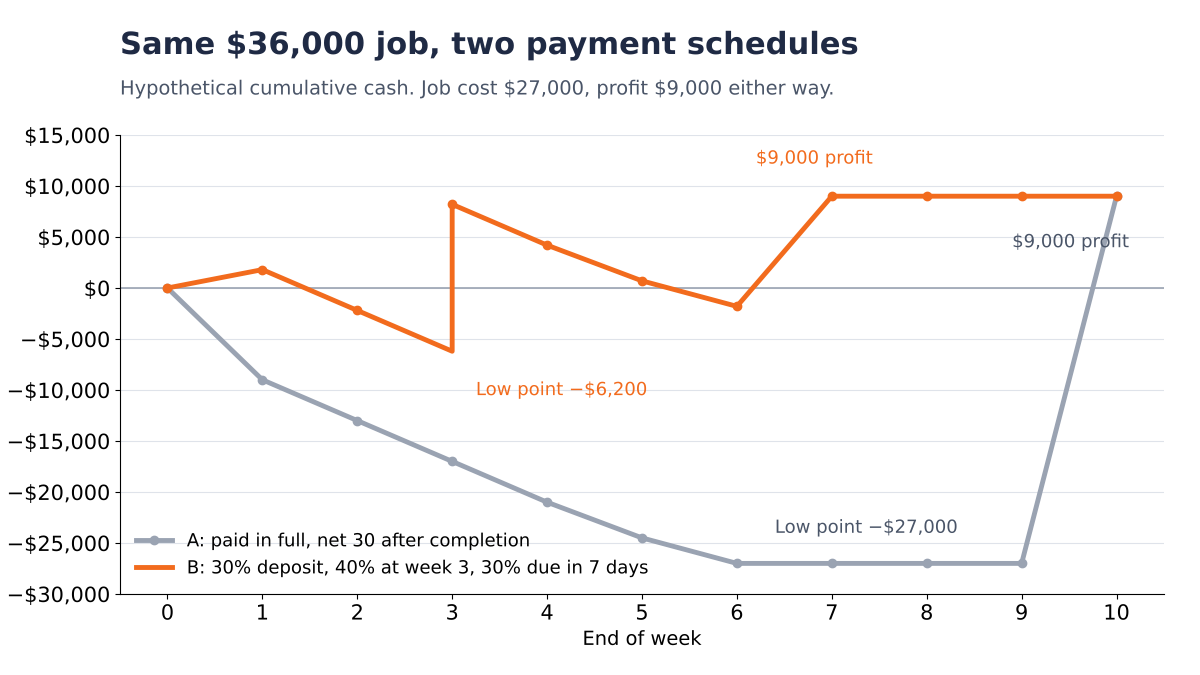
Hypothetical: the same $36,000 job with the same $9,000 profit. Paid in full on net 30 after completion, you're $27,000 in the hole at the worst point. With a deposit and a progress payment, the worst point is $6,200. Worked below.
Why it matters: most cash crunches aren't a pricing problem. They're a timing problem. The fix is in your payment terms and your invoicing habits, and you set both before the job starts.
Scope: US contractors and remodelers running small crews. All dollar figures are hypothetical. For the paperwork side of the books, see construction bookkeeping.
1. Profit isn't cash
Procore puts it plainly: "Cash flow in construction refers to the movement of funds into and out of a construction project over a specific period" (Procore). Profit is how much is left at the end. Cash flow is whether you can make payroll in week three.
A job priced right on paper can still hurt you if the money arrives late. The cabinets, the crew and the dumpster all get paid on their schedule, not your customer's.
A construction budget tells you how much each part of the job should cost. Cash flow tells you when that money leaves your account, and when the customer's money arrives to replace it.
2. Why construction cash flow problems happen
- You pay first. Materials and labor go out in week one. The customer's money comes later.
- You invoice late. The job finished Friday, the invoice went out two weeks later. That's two weeks of float you gave away.
- Long payment terms. Net 30 after completion means the money for week-one materials can show up two months later.
- Retainage. On commercial work, a share of every bill can be held until closeout. Retainage covers how it works.
- Unbilled change orders. Extra work done in week two, billed with the final invoice.
- Growth. More jobs at once means more money floating at once. Busy seasons can be the tightest ones.
3. Worked example: same job, two payment schedules
Hypothetical six-week remodel. Job cost $27,000, priced at a 25% margin with price = cost ÷ (1 − margin): $27,000 ÷ 0.75 = $36,000. Costs go out each week: $9,000 in week 1 (materials and demo), $4,000 a week in weeks 2 to 4, $3,500 in week 5 and $2,500 in week 6.
Schedule A: paid in full on net 30 after completion. The $36,000 arrives in week 10. Schedule B: 30% deposit at signing ($10,800), 40% at the end of week 3 when rough-in is done ($14,400), and the final 30% ($10,800) due 7 days after completion, so week 7.
A 30% deposit isn't allowed everywhere. Some states cap home improvement deposits much lower, so check yours before you copy this schedule.
| End of week | Money out | A: cash position | B: money in | B: cash position |
|---|---|---|---|---|
| 1 | $9,000 | −$9,000 | $10,800 | $1,800 |
| 2 | $4,000 | −$13,000 | $0 | −$2,200 |
| 3 | $4,000 | −$17,000 | $14,400 | $8,200 |
| 4 | $4,000 | −$21,000 | $0 | $4,200 |
| 5 | $3,500 | −$24,500 | $0 | $700 |
| 6 | $2,500 | −$27,000 | $0 | −$1,800 |
| 7 | $0 | −$27,000 | $10,800 | $9,000 |
| 10 | $0 | $9,000 | $0 | $9,000 |
Same job, same $9,000 profit. Under A, you float up to $27,000 of your own money for about a month. Under B, the deepest point is $6,200 in week 3, just before the progress payment lands, and you have your profit three weeks sooner.
4. Build a simple cash flow forecast
You don't need software for this. A sheet with one row per week for the next eight weeks does it. For every job, list the payments you expect and when, and every bill you'll pay and when.
- Money in: deposits, progress payments and finals, on the date you realistically expect them, not the due date.
- Money out: payroll, material orders, sub payments, equipment, and your fixed bills like insurance and the truck.
- Running balance: start with what's in the bank and roll it forward.
- A floor: pick a minimum you never want to go below, for example one payroll plus a month of fixed bills. Any week under the floor is a week to fix now.
| Week | Money in | Money out | Ending balance |
|---|---|---|---|
| Start | $8,000 | ||
| 1 | $10,800 | $9,500 | $9,300 |
| 2 | $0 | $6,000 | $3,300 |
| 3 | $14,400 | $7,500 | $10,200 |
| 4 | $2,500 | $5,000 | $7,700 |
In this hypothetical, week 2 is the tight one. You'd see it a week ahead, and you could move a material order, ask the supply house for terms, or bill something sooner. Update the sheet every Monday. It takes ten minutes once it's set up.
5. Billing moves that fix it
- Take a deposit. Enough to cover the first materials order, within your state's limit. Some states cap home improvement deposits; contractor payment terms has the details.
- Bill by milestone. Tie payments to finished stages, not the calendar. Progress billing and a construction draw schedule show how to set them up.
- Invoice the day the milestone is done. Not at the weekend, not next month. In WinPal you can invoice from your phone and let clients pay online, so it can go out before you leave the driveway.
- Short due dates. 7 days, written on the estimate and the contract before the job starts.
- Make paying easy. Cards and online payment take "the check's in the mail" off the table. See how to accept credit card payments as a contractor.
- Bill change orders as you go. Signed and priced before the work, billed with the next progress payment, per construction change orders.
Need a clean invoice to send? Start from the contractor invoice template.
6. Spending moves that help
- Open an account at the supply house. Paying on 30-day terms instead of at the counter moves your biggest early cost closer to your first progress payment.
- Order by phase. Buy what the next stage needs, not the whole job in week one, unless prices or lead times make it worth it.
- Line up sub payments with your draws. Agree in writing when subs get paid. Pay-when-paid and pay-if-paid clauses are treated differently from state to state, so have a lawyer look at the wording before you rely on one.
- Keep a reserve. The floor from your forecast, sitting in its own account, so one slow payer doesn't stop payroll.
7. When a customer pays late
Your forecast assumed a date. When it slips, find out why the same day: a missing lien waiver, a question about a line, or a customer who's stalling. Fix the paperwork ones fast and follow up in writing.
If it turns into real non-payment, can a contractor sue for non-payment without a contract covers your options. The best protection is still upfront: a deposit, milestone billing and short due dates.
Common construction cash flow questions
What causes cash flow problems in construction?
Mostly timing. You pay for labor, materials and subs before the customer pays you, and the gap grows with long payment terms, late invoices, retainage and change orders billed at the end. Growth makes it worse, because more jobs at once means more of your money tied up at once, even when every job is profitable.
How do you manage cash flow in construction?
Get paid earlier and spend later. Take a deposit, bill by milestone, invoice the day work is done and use short due dates. On the spending side, use supplier terms, order by phase and agree sub payment timing in writing. Then keep a weekly forecast so you see a tight week coming instead of finding out at payroll.
What is a construction cash flow forecast?
It's a week-by-week list of the money you expect to come in and go out across all your jobs, with a running bank balance. Eight weeks ahead is enough for a small crew. It shows which week dips below the minimum you want to keep, early enough to move an order, chase a payment or bill sooner.
Is profit the same as cash flow?
No. Profit is what's left after all the job's costs are paid. Cash flow is when the money actually moves. A job can make $9,000 of profit and still leave you $27,000 short for a month if you pay costs every week and get paid in one lump at the end on net 30 terms.
Should I pay my subs before the customer pays me?
It's a business decision, but agree it in writing before the job starts. Many contractors tie sub payments to their own draws so cash goes out after it comes in. Pay-when-paid and pay-if-paid clauses are enforced differently by state, so get the wording checked by a lawyer before you depend on one.
What to do this week
Open a sheet, list the next eight weeks, and put in every payment you expect and every bill you'll pay. Find the lowest week. Then change the payment terms on your next estimate: deposit, milestones, 7-day due date.
Already sent the estimate for your next job? Upload it to the estimate checker and see if it's priced too low before the payment schedule gets locked in.