Labor Burden: What It Is and How to Calculate It (Worked Example)
A $25-an-hour employee doesn't cost $25 an hour. What labor burden includes, how to calculate your burden rate and fully burdened labor rate, and how to price with it.

Labor burden is everything an employee costs you on top of their wage: payroll taxes, unemployment insurance, workers' comp, benefits and the hours you pay for but can't bill. Add it up for a year, divide by wages, and you have your burden rate. Divide wages plus burden by billable hours, and you have the real cost of an hour of labor.
Labor burden rate = annual burden costs ÷ annual wages. Fully burdened labor rate = (wages + burden) ÷ billable hours.
Hypothetical $25-an-hour employee: $12,240 of burden on $52,000 of wages is a 23.5% burden rate, and the fully burdened cost is $40.15 per billable hour. Worked below.
That gap is where crews quietly lose money. If you bill a $25 tech at $45 because "that's almost double," you're about $5 an hour above what that hour costs you, before the truck, the insurance on the truck, or any profit.
Scope: US contractors with W-2 employees, federal payroll tax rates as published by the IRS for 2026, and a hypothetical example. Working alone? See section 7, or run the hourly rate calculator.
1. What counts as labor burden
Labor burden is any cost that rises and falls with the people on your payroll. The usual lines:
- Social Security and Medicare. The employer pays 6.2% Social Security and 1.45% Medicare on wages, 7.65% together, and Social Security stops at a $184,500 wage base for 2026 (IRS Topic 751).
- Federal unemployment (FUTA). 6.0% on the first $7,000 of each employee's wages, cut to 0.6% if you get the full 5.4% credit for paying state unemployment on time (IRS Topic 759). That's $42 per employee per year.
- State unemployment (SUTA). Your state sets the rate and the wage base. New businesses usually get an assigned rate; check your state notice.
- Workers' comp. Priced per $100 of payroll by class code and state. Roofers and carpenters don't pay what a painter pays. Your policy has the real number.
- Benefits. Your share of health insurance, retirement match, and anything else you pay per employee.
- Paid time that isn't billable. Holidays, vacation, sick days, and the shop time, supply runs and drive time you pay for but can't put on an invoice.
Some shops also load uniforms, phones and small tools per employee. Fine, as long as you don't count them again in overhead.
2. What labor burden is not
Burden belongs to the person. Overhead belongs to the business. Keep them apart or you'll charge for the same thing twice, or not at all.
| Cost | Where it goes |
|---|---|
| Payroll taxes, workers' comp, benefits, paid time off | Labor burden |
| Truck, fuel, office, software, your own liability policy | Overhead |
| Lumber, fixtures, paint, dump fees | Job costs and materials |
| What's left for the business | Profit |
And burden isn't markup. Markup is what you add on top of cost. Burden is part of the cost. If you're fuzzy on the difference between markup and margin, read contractor markup first.
3. How to calculate labor burden in five steps
- Annual wages. Hourly wage × paid hours. A full-time year is 2,080 paid hours, including paid holidays and vacation.
- Annual burden. Add every line from section 1 for the year. Use your real policies and state notices, not guesses.
- Burden rate. Burden ÷ wages. This is the percentage people mean when they say "our burden is 25%."
- Billable hours. Paid hours minus paid time off, then times the share of worked hours you can actually bill. This is the number that hurts.
- Fully burdened rate. (Wages + burden) ÷ billable hours. That's the cost you price against.
Do it on a full year, not one paycheck. FUTA and most state unemployment stop once wages pass their wage bases, so a January paycheck carries more burden than a November one.
4. Worked example: a $25-an-hour employee
Hypothetical: one full-time carpenter at $25 an hour, 2,080 paid hours, 80 of them paid holidays and vacation. The federal rates are the IRS figures above. The state unemployment rate, workers' comp rate and health insurance cost are assumptions for the example.
| Line | Math | Per year |
|---|---|---|
| Wages | $25 × 2,080 paid hours | $52,000 |
| Social Security | 6.2% × $52,000 | $3,224 |
| Medicare | 1.45% × $52,000 | $754 |
| FUTA | 0.6% × $7,000 | $42 |
| State unemployment (hypothetical) | 3.0% × $10,000 state wage base | $300 |
| Workers' comp (hypothetical) | $6.00 per $100 × $52,000 | $3,120 |
| Health insurance, employer share (hypothetical) | $400 × 12 months | $4,800 |
| Total labor burden | $12,240 | |
| Burden rate | $12,240 ÷ $52,000 | 23.5% |
Now spread it over the hours you can bill:
| Step | Math | Result |
|---|---|---|
| Wages plus burden | $52,000 + $12,240 | $64,240 |
| Cost per paid hour | $64,240 ÷ 2,080 | $30.88 |
| Hours worked | 2,080 − 80 paid time off | 2,000 |
| Billable hours (hypothetical 80% of worked hours) | 2,000 × 80% | 1,600 |
| Fully burdened cost per billable hour | $64,240 ÷ 1,600 | $40.15 |
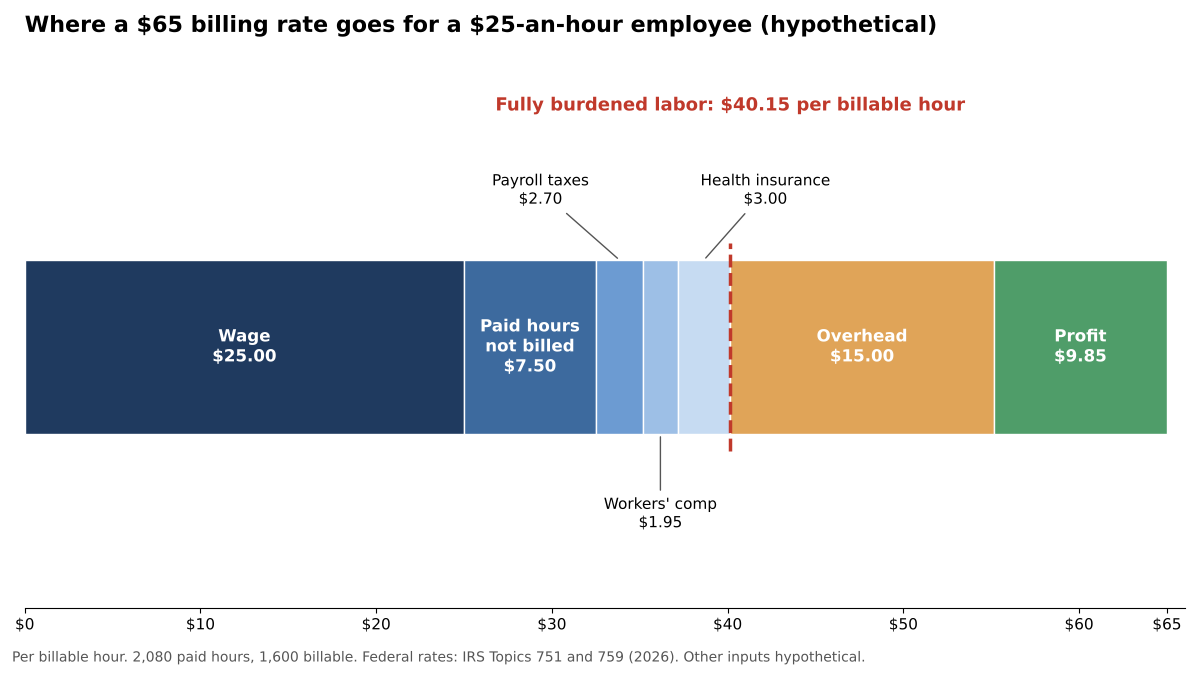
So the $25 carpenter costs you $40.15 for every hour you can put on an invoice. Taxes and insurance are only part of it. The biggest single jump is the $7.50 an hour of paid time that never gets billed: holidays, vacation, the supply run, the morning at the shop.
5. Turn the burdened rate into a price
The burdened rate is a cost, not a price. Add overhead per billable hour, then divide by one minus your margin. Don't multiply by 1.15; that gives you a smaller margin than you think.
| Step | Math | Result |
|---|---|---|
| Fully burdened labor | from section 4 | $40.15 |
| Overhead (hypothetical) | per billable hour | $15.00 |
| Cost per billable hour | $40.15 + $15.00 | $55.15 |
| Price at 15% margin | $55.15 ÷ 0.85 = $64.88 | $65 rounded up |
At $65 you keep $9.85 an hour, a 15.2% margin. A 12-hour job for this carpenter is $780 of labor on the estimate. Bill him at $45 and the same 12 hours lose you about $122 against cost, with overhead in.
Your overhead number comes from last year's books, not this example. The overhead and profit guide shows how to split it per hour.
6. Mistakes that hide labor burden
- Dividing by 2,080. Nobody bills 2,080 hours. Use the hours you actually invoice, or your rate is short by exactly the hours you forgot.
- Using one paycheck. Unemployment taxes front-load the year. Annual numbers only.
- One burden rate for everyone. A roofer's comp rate and a helper with no health plan don't share a rate. Calculate by role if the gap is big.
- Forgetting overtime. Overtime pays 1.5 times the wage and carries taxes and comp on top. If a job needs Saturdays, price them.
- Never updating it. Raises, new comp rates and a new health plan all move it. Recheck every renewal.
7. Working alone? Your burden looks different
If it's just you, there's no W-2 payroll tax or FUTA on your pay. You pay self-employment tax instead, plus your own health insurance and your own unpaid hours. Same idea, different lines. The hourly rate calculator builds that rate for an owner-operator and has a loaded labor rate mode for your first hire.
Common labor burden questions
What is labor burden?
Labor burden is the cost of an employee beyond the wage: employer Social Security and Medicare, federal and state unemployment tax, workers' comp, benefits and paid time that isn't billed. Contractors add it to the wage so every estimate covers the full cost of the hour, not just the paycheck.
How do you calculate the labor burden rate?
Add up a year of burden costs for the employee and divide by their annual wages. In the hypothetical example here, $12,240 of taxes, comp and health insurance on $52,000 of wages is a 23.5% burden rate. Use real policy and state rates, not averages.
What is a fully burdened labor rate?
It's wages plus burden divided by billable hours: the true cost of one hour you can invoice. A $25-an-hour employee in the example costs $40.15 per billable hour, because burden adds $12,240 a year and only 1,600 of 2,080 paid hours get billed.
Is labor burden the same as overhead?
No. Labor burden follows each employee: their taxes, comp, benefits and paid time off. Overhead runs the business whether anyone works or not: the truck, office, software and your own insurance. Price both, separately, so nothing gets counted twice or missed.
What to do before your next estimate
Pull last year's payroll reports, your workers' comp policy and your state unemployment notice. Fill in the table from section 4 for each person on the crew, then price labor at the burdened rate plus overhead, divided by one minus your margin. Next, check the quantities side of your estimates with how to do a construction takeoff.
Already sent an estimate at the old rate? Upload it to the estimate checker and see if it's priced too low.