What Is the Average Markup on Labor? Contractor Markup Benchmarks
The average remodeler kept a 29.9% gross margin in 2024, about a 43% markup on job costs. Here's the markup vs margin table, a bathroom remodel priced two ways, and how to find your own markup.

There's no official average markup on labor. The best public benchmark is NAHB's latest Remodelers' Cost of Doing Business Study: remodelers kept an average 29.9% gross profit margin in 2024, which works out to marking up job costs (labor, materials and subs) by about 43%. After overhead, the average net profit was 6.3%.
Price = job cost ÷ (1 − margin). Markup = margin ÷ (1 − margin).
A $17,382 bathroom remodel at a 30% margin: $17,382 ÷ 0.70 = $24,831, a 42.9% markup. Hypothetical, worked below.
That's why “just add 20%” doesn't hold up. A 20% markup is a 16.7% margin, and the average remodeler needed about 23.6 cents of every dollar just to run the business.
This guide is for small general contractors, remodelers and trade businesses who set their own prices: what the benchmark says, how markup on labor, materials and subs fits together, and how to get your own number from three figures you already have. US dollars, a hypothetical example, your numbers swapped in. To do the conversion for any job, use the profit margin calculator.
1. What is the average markup on labor?
The closest thing to an average is the gross margin of real companies, and for residential remodelers that was 29.9% in 2024, or about a 43% markup on job costs. NAHB reports it for the whole job, not per line, so treat it as the blended markup across your labor, materials and subs (NAHB, April 10, 2026).
Three numbers from the same study are worth knowing:
- Gross profit margin: 29.9% in 2024, up five points from the record low of 24.9% in 2021.
- Net profit margin: 6.3% in 2024, the highest since 1996, up from 3% in 2011.
- Trade contractor costs: 30% of revenue in 2024, down from 36% in 2021. Subs are a big slice of a remodeler's job cost.
The gap between 29.9% and 6.3% is 23.6 points. That's what overhead, office pay and the owner's salary ate before anyone saw a profit. Your markup has to cover that gap first.
One caveat: these are averages for remodelers who answered NAHB's survey. A solo handyman with a paid-off truck and no office can run leaner. A shop with an estimator, a project manager and a showroom can't.
2. Markup vs margin: the table that fixes most pricing
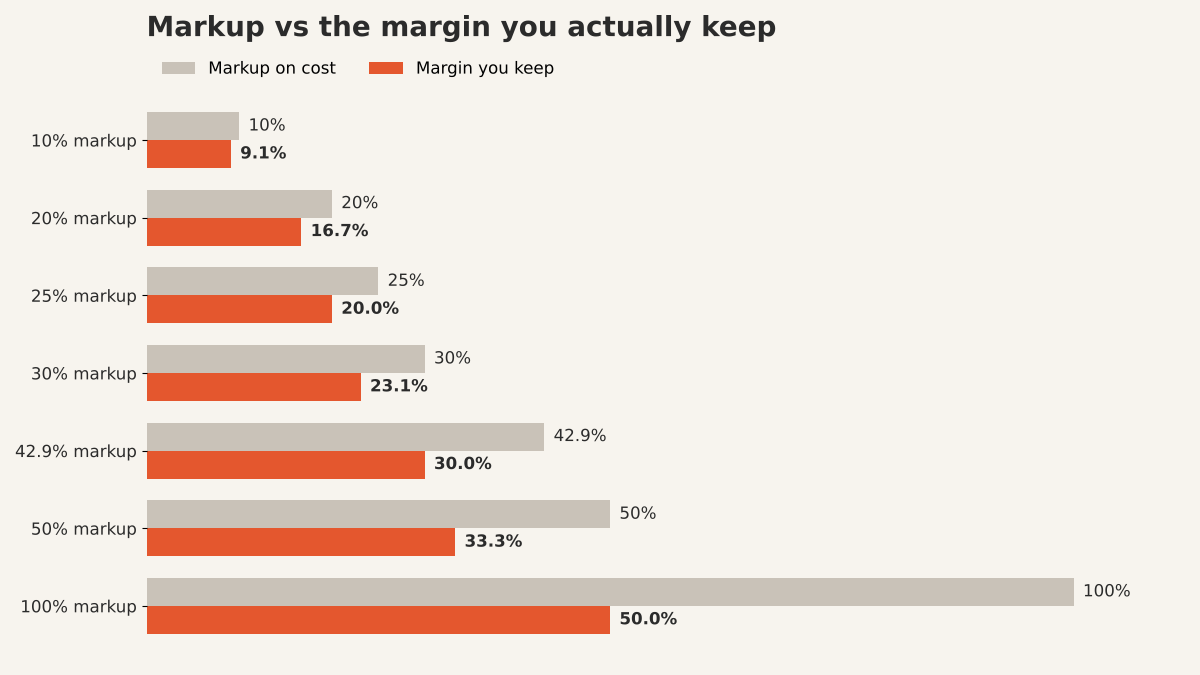
Markup is what you add to cost. Margin is what's left of the price. They use the same dollars but divide by different numbers, so a markup always looks bigger than the margin you keep.
| Markup on cost | Margin you keep | $10,000 job cost becomes |
|---|---|---|
| 10% | 9.1% | $11,000 |
| 15% | 13.0% | $11,500 |
| 20% | 16.7% | $12,000 |
| 25% | 20.0% | $12,500 |
| 30% | 23.1% | $13,000 |
| 40% | 28.6% | $14,000 |
| 42.9% | 30.0% | $14,290 |
| 50% | 33.3% | $15,000 |
| 100% | 50.0% | $20,000 |
If someone tells you their markup, ask which one they mean. Half the arguments about “normal markup” are two people using different words for the same number.
3. Markup on labor: load the wage first
Markup on labor only works if the labor cost is real. Start from the wage, add payroll taxes, workers' comp, insurance and paid time off, and mark up that loaded number, not the bare wage.
For a reference point, the national median wage for carpenters is $29.12 an hour (O*NET 47-2031, BLS 2025 wage data). The example below loads it by about 44% to $42 an hour, which is an assumption. The hourly rate calculator builds your own loaded rate.
- Bill your own hours too. If you swing a hammer on the job, your time is labor cost. Your salary for running the company is overhead.
- Count the non-swinging hours. Pickup runs, cleanup and the punch list visit are labor on this job.
- Labor is where you take risk. Materials come with a receipt. Hours run long. That's the usual argument for a higher markup on your own labor than on subs.
4. Markup on materials and subcontractors
You can mark up materials and subs less than labor, but only if the blended result still clears your overhead. Lower markups on big pass-through lines are fine. Lower markups on everything are how a busy year ends with no money.
Materials. Customers can price-check a vanity or a box of tile on their phone, so a big markup on a visible item invites an argument.
The time you spent choosing, ordering, picking up and returning it is still real. Charge for it in the materials markup or as labor, not neither.
Subcontractors. A sub's price already includes their overhead and profit. Yours doesn't.
You still schedule them, supervise them, fix their punch list and carry the warranty call. At NAHB's 30% of revenue, subs are often the single biggest line, so a thin markup there drags the whole job down.
Whatever split you use, check the blended margin on every bid. The worked example shows why.
5. Worked example: one margin vs a “normal” markup split
Hypothetical job. A small GC remodels a hall bathroom: own crew for demo, framing, drywall and trim, with a plumber, an electrician and a tile setter as subs. The company's overhead runs 23% of revenue (from section 6).
| Cost line | Qty | Rate | Cost |
|---|---|---|---|
| Own crew labor, loaded (assumption) | 96 hr | $42 | $4,032 |
| Materials: vanity, fixtures, board, trim (assumption) | 1 | $5,400 | $5,400 |
| Subs: plumber $2,800, electrician $1,600, tile $2,900 | 3 | $7,300 | |
| Permit and dumpster (assumption) | 1 | $650 | $650 |
| Total job cost | $17,382 |
Now price it two ways.
| Line | One 30% margin | Split: labor 50%, materials 25%, subs 15% |
|---|---|---|
| Price | $24,831 | $21,843 |
| Gross profit | $7,449 | $4,461 |
| Margin | 30.0% | 20.4% |
| Overhead at 23% of price | $5,711.13 | $5,023.89 |
| Net profit | $1,737.87 (7.0%) | −$562.89 (loss) |
The split looks reasonable line by line. A 50% markup on labor sounds high.
But labor is the smallest of the three big lines, and subs at 15% carry the most dollars, so the blend comes out to a 25.7% markup and a 20.4% margin. After overhead, the job loses $562.89.
The one-margin price is $2,988 higher and makes $1,737.87. Same job, same crew, same subs. The difference is which number you checked before you sent it.
Markup is set job by job. What the whole business keeps after overhead is a different number, and it's usually much smaller. See general contractor profit margin benchmarks for gross vs net.
6. Find your own markup from three numbers
Your markup comes from your overhead, not from what someone on a forum charges. You need last year's revenue, last year's overhead and the profit you want.
- Overhead share. Add up everything that isn't a job cost: truck, insurance, phone, software, office, marketing, accounting and your own salary for running the company. Divide by revenue. Example: $110,400 ÷ $480,000 = 23%.
- Add your profit target. 23% overhead + 7% profit = 30% margin needed.
- Convert to markup. 0.30 ÷ 0.70 = 42.9% markup on job cost.
Then price every job at that margin, or use different markups per line and check that the blended margin still hits 30%. If your overhead share is higher than the margin you've been charging, that's why the bank account doesn't match how busy you are.
On bigger jobs with several trades, the same check applies to the whole bid; how to estimate construction costs walks through the cost build and how to bid construction jobs covers contingency and the bid write-up. For a single-trade job priced the same way, see how to bid a siding job.
In WinPal you can snap a photo of the job, describe it out loud and get a first-draft estimate to fix up before you send it. Check the margin on it before it goes out.
Insurance work adds its own wrinkle: the adjuster's O&P line, often "10 and 10". Before you accept it, compare it with your real overhead rate. Overhead and profit in construction shows the math.
Common contractor markup questions
What is the average markup on labor?
There's no published average for labor alone. The best benchmark is the whole-job gross margin: NAHB found remodelers averaged 29.9% in 2024, about a 43% markup on job costs. You can mark up your own labor more than materials or subs, as long as the blended margin still covers overhead and profit.
What is a normal markup on materials?
Normal is whatever keeps your blended margin above your overhead plus profit. One way to do it: a lower markup on big, easy-to-price items and a higher one on small parts and specialty orders. Check the total: if materials are half the job and marked up 15%, the rest of the job has to carry a lot.
How much do general contractors mark up subcontractors?
There's no standard, and public data doesn't break it out. The sub's price covers their overhead, not yours: you still schedule, supervise and handle the warranty. Since trade contractors were 30% of remodelers' revenue in NAHB's 2024 data, a thin sub markup pulls the whole job's margin down. Price it, then check the blend.
Is a 30% markup normal for a contractor?
A 30% markup is a 23.1% margin. That's below the 29.9% average gross margin NAHB reported for remodelers in 2024, and roughly equal to the 23.6 points their overhead took. For most shops with an office and staff, 30% markup leaves almost no profit. A lean solo operator may be fine.
What to do on your next bid
Work out your overhead share, add your profit target, convert it to a markup, and check the blended margin on the bid before you send it.
Already sent one? Upload it to the estimate checker and see if it's priced too low.