How to Bid a Siding Job: Takeoff, Trim and a Worked Bid
Measure walls and gables, convert to squares, count trim by the linear foot and price labor by task. A two-story vinyl re-side comes to $21,530 at a 30% margin.
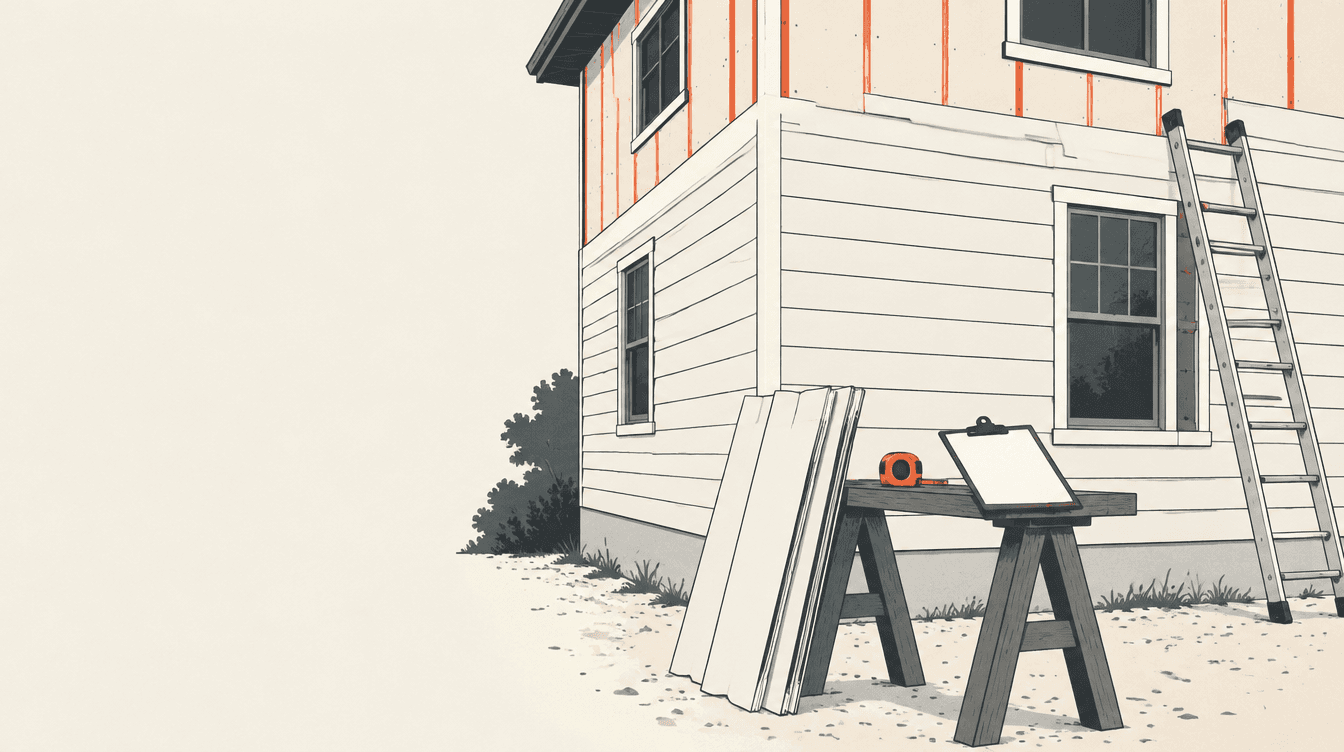
To bid a siding job, measure every wall and gable in square feet, add waste and convert to squares (100 sq ft each), then price tear-off, housewrap, siding and trim labor, add siding, trim pieces by the linear foot, disposal and overhead, and divide by one minus your margin. On a house built before 1978, check the lead rules before you price the tear-off.
Price = (labor + materials + disposal + overhead) ÷ (1 − margin).
A two-story 40 × 28 ft house, old siding off and new vinyl on: $15,068 in costs ÷ 0.70 = $21,530 at a 30% margin, about $718 a square. Hypothetical, worked below.
Siding bids rarely go wrong on the panels. They go wrong on the trim, the tear-off and the second-story setup: J-channel around every window, corner posts on every outside corner, and ladders or staging moved a dozen times.
This guide is for residential re-siding and new siding on small jobs: the takeoff, labor, materials, a full worked bid and what the bid should say. US dollars, a hypothetical example, your rates swapped in. For a job with other trades in it, see how to bid construction jobs.
1. Measure the walls and gables, then convert to squares
Siding is bought and usually priced by the square: 100 sq ft of wall. Measure each wall as width × height, each gable as a triangle, add them up, add waste and divide by 100.
- Walls: the perimeter times the wall height. A two-story house 40 × 28 ft with 18 ft walls is 136 ft × 18 ft = 2,448 sq ft.
- Gables: ½ × base × rise for each one. A 28 ft gable end with a 7 ft rise is 98 sq ft; two of them are 196 sq ft.
- Openings: this guide doesn't deduct windows and doors on a typical house. You cut around them and the offcuts rarely go back on the wall. Deduct a garage door or a wall of glass.
- Waste: 10% is the assumption here. Cut-up walls with lots of windows, dormers and bump-outs waste more. Track your own on the next few jobs.
- Squares: 2,644 sq ft × 1.10 ÷ 100 = 29.1, so order 30 squares.
While you measure, note what slows the crew down: the second story, a steep or soft yard for ladders, a deck or roof in the way, and how many windows each wall has.
2. Count the trim by the linear foot
Trim is where siding bids lose money, because it's counted in feet and pieces, not squares. Take it off the house wall by wall.
- Outside corners: one post per corner, full wall height. Four corners × 18 ft = 72 lf, so 8 posts at 10 ft each.
- J-channel: around every window and the sides and top of every door, plus the rakes on the gables. Sixteen 3 × 5 ft windows are 256 lf, two doors 34 lf, two gable rakes about 63 lf: 353 lf, or 29 pieces at 12.5 ft.
- Starter strip: the base of every wall, 136 lf, or 12 pieces at 12 ft.
- Soffit and fascia: price them on their own line if they're in scope. They change the labor more than the material.
Piece lengths vary by manufacturer. Check the product you're buying before you divide.
3. Price the labor: tear-off, wrap, siding and trim
Price labor by task, because tear-off, housewrap, siding and trim run at different speeds. Count hours from your own past jobs, then multiply by a loaded rate: wage plus payroll taxes, workers' comp, insurance and paid time off.
For a reference point, the national median wage for carpenters is $29.12 an hour (O*NET 47-2031, BLS 2025 wage data). The example loads it by about 44% to $42 an hour, an assumption. The hourly rate calculator builds your own rate.
- Tear-off: stripping, bagging and loading the old siding, plus pulling nails and fixing any soft sheathing you find (priced as a change, see section 6).
- Housewrap: wrap, tape and flashing around openings. Quick, but it's a full trip around the house.
- Siding: the panels, with the second story counted slower than the first.
- Trim: corners, J-channel and starter. On a house with lots of windows, this can take as long as the panels.
4. Worked example: re-siding a two-story house in vinyl
Hypothetical bid. A two-story house, 40 × 28 ft, 18 ft walls, two gable ends, sixteen windows and two doors.
Old siding off, new housewrap, new vinyl siding and trim. Soffit and fascia stay. Built after 1978.
| Cost line | Qty | Rate | Cost |
|---|---|---|---|
| Labor: tear-off 24 hr, wrap 10 hr, siding 90 hr, trim 24 hr (assumption) | 148 hr | $42 | $6,216 |
| Vinyl siding (assumption) | 30 squares | $165 | $4,950 |
| Housewrap and tape (assumption) | 3 rolls | $180 | $540 |
| Trim: 8 corner posts at $35, 29 J-channel at $12, 12 starter at $9, $150 nails and caulk (assumption) | 1 | $886 | $886 |
| Dumpster for tear-off (assumption) | 1 | $550 | $550 |
| Permit (assumption; check your town) | 1 | $150 | $150 |
| Overhead (assumption) | 148 hr | $12 | $1,776 |
| Total cost | $15,068 | ||
| Price at 30% margin ($15,068 ÷ 0.70 = $21,525.71, rounded up) | $21,530 |
That leaves $6,462 of profit after everyone's wages, including yours. The price works out to $717.67 per square ordered, or $8.14 per square foot of wall.
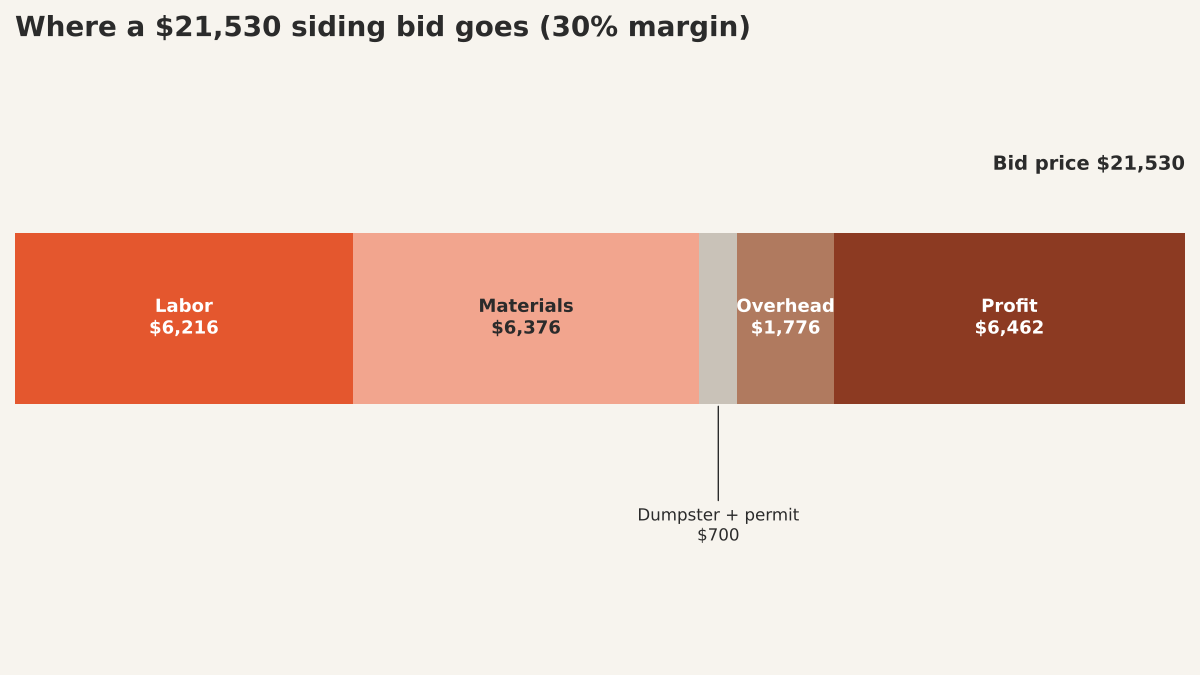
Watch the markup trap. A 30% markup on $15,068 is $19,588.40, which is only a 23.1% margin. The profit margin calculator shows both side by side, and contractor markup benchmarks shows why the gap matters.
5. Bid per square or by the job?
Bid by the job and use the per-square number as a check. A per-square price is quick to quote over the phone, but it only holds for a house like the one you built it from.
The example comes to $717.67 a square. Put the same number on a one-story ranch with eight windows and you're high.
Put it on a three-story Victorian with turrets and forty windows and you're losing money by lunch on day two. The trim count and the height change the hours, and the square count doesn't see either one.
6. When the siding bid changes
Three situations change the math enough to rebid, not just adjust.
- Pre-1978 houses with painted siding. Under EPA's Renovation, Repair and Painting rule, disturbing more than 20 sq ft of painted surface outside a pre-1978 home isn't a minor repair (40 CFR 745.83). The firm needs EPA certification and a certified renovator directing the work (40 CFR 745.81), and has to give the owner the Renovate Right pamphlet no more than 60 days before starting (40 CFR 745.84). In the example, 12 extra hours for containment and cleanup plus $250 of supplies adds $1,285 to the price.
- Rot under the old siding. Soft sheathing or a rotted sill shows up at tear-off, not at the walk. Put a per-sheet sheathing price in the bid and write it up before you fix it; construction change orders covers the paperwork.
- Fiber cement instead of vinyl. Heavier boards, more cutting, dust control and often painted trim. Don't reuse your vinyl hours; build the labor again from your fiber cement jobs.
7. What the siding bid should say
A siding bid should say what's coming off, what's going on, which product and color, and what's not yours. The arguments you want to avoid are about trim, rot and cleanup, not the price.
- Walls and gables included, with the square count.
- Product, profile and color, with trim and accessories listed.
- Tear-off and disposal, housewrap and flashing.
- What's excluded: soffit and fascia, gutters, painting, window replacement.
- Rot and sheathing repair priced per sheet, approved before the work.
- Price, deposit, payment schedule and due dates. The wording is in contractor payment terms.
In WinPal you can snap a photo of the house, describe the job out loud and get a first-draft estimate to fix up before you send it, then invoice from the same job when the last corner post is on.
Common siding bidding questions
How do you bid a siding job?
Measure the walls and gables, add waste and convert to squares. Count trim by the linear foot. Price tear-off, housewrap, siding and trim labor at a loaded rate, add materials, disposal and overhead, then divide by one minus your margin. The example two-story house comes to $21,530 at a 30% margin.
How much should I charge per square to install siding?
Build the job price first, then divide by the squares. The example works out to $717.67 a square for tear-off and new vinyl with trim, but only for a similar house. More windows, more height or a harder material push it up. A per-square number you didn't build from your own costs is a guess.
How many squares of siding do I need?
Add the wall area (perimeter times height) and the gables (½ × base × rise each), multiply by one plus your waste factor and divide by 100. The example house is 2,644 sq ft, so 29.1 squares with 10% waste, rounded up to 30.
How do you quote a siding job over the phone?
Give a range, not a number, and book the walk. You need the wall heights, window count, existing material and the build year before you can price trim, tear-off and lead rules. A phone quote that skips those is the one that loses money.
What to do on your next siding bid
Measure walls and gables, convert to squares, count trim by the foot, check the build year, price labor by task, add materials and overhead, and divide by one minus your margin.
Already sent a siding bid? Upload it to the estimate checker and see if it's priced too low.