Overhead and Profit (O&P) in Construction: What It Is and How to Price It
O&P is everything above direct job cost. Calculate your real overhead rate, price a job from it, and see why 10 and 10 can lose money.
Overhead and profit (O&P) is everything in your price above the direct cost of the job. Overhead pays for running the business: office, insurance, truck, phone, software and your time quoting. Profit is what's left after that. Price both as a share of the selling price, not as a percentage added to cost.
Price = direct job cost ÷ (1 − overhead % − profit %).
Hypothetical: $30,000 ÷ (1 − 0.21 − 0.08) = $42,254. Worked below.
Why it matters: if your O&P number is a habit instead of a calculation, you can be busy all year and still lose money on every job. And on insurance work, the adjuster's "10 and 10" may not be your number at all.
Scope: US contractors and remodelers pricing residential work, including insurance repairs. Dollar figures are hypothetical unless a source is named. For the markup side of the same math, see contractor markup.
1. What overhead and profit means in construction
Overhead is the cost of being in business that doesn't belong to one job. Profit is the return you keep for the risk and the work of running it.
Direct job costs are everything you can trace to one address: materials, crew labor and burden, subs, equipment rental, permits, the dumpster. Some pros call the job-site part of that "general conditions": supervision, temporary toilets, protection, cleanup. Those go in the job cost, not in overhead.
Overhead is what you'd still pay if you had no jobs this week. Profit isn't a cost at all. It's the reason you're doing this instead of working for someone else.
2. What counts as overhead
If it keeps the business running but you can't point to one job, it's overhead.
- Office and admin: rent, utilities, office staff, bookkeeping, software, phone.
- Insurance and licenses: general liability, the parts of insurance not charged to a job, license renewals, bonds.
- Vehicles and tools: truck payments, fuel between jobs, tool replacement, shop space.
- Selling: advertising, website, the hours you spend measuring and quoting jobs you don't win.
- You: your salary as the owner, if you're not charging all of your hours to jobs.
United Policyholders, a policyholder advocacy group, lists the same kind of items in its explainer: general and administrative expenses, office rent and utilities, office supplies, office salaries and benefits, depreciation on office equipment, licenses and advertising (United Policyholders, "What's UP with Overhead and Profit?").
Forgot to count the hours you spend quoting? Your margin noticed.
3. Calculate your overhead rate
Overhead rate = last year's overhead ÷ last year's revenue. Use revenue, not job costs, so the rate matches how you'll price.
Hypothetical remodeler: $900,000 in revenue and $189,000 of overhead, owner's salary included. $189,000 ÷ $900,000 = 21%. So 21 cents of every dollar you bill goes to keeping the doors open before any profit shows up.
For a reference point, NAHB's 2024 remodelers' study put the average gross profit margin at 29.9% and the average net profit margin at 6.3% (NAHB, April 10, 2026). The gap, 23.6 points, is roughly what operating expenses took. Put another way, the average remodeler's O&P was about 30% of the price, not 20.
Don't have clean books yet? The hourly rate calculator builds overhead into an hourly rate, which works for smaller service jobs.
Want the full overhead budget, your break-even month and three ways to express the rate? Read construction overhead.
4. Price a job with overhead and profit
Add your overhead rate and target profit, then divide the direct cost by what's left of a dollar.
Hypothetical job: a kitchen remodel with $30,000 of direct cost. Overhead rate 21%, target profit 8%.
| Line | Math | Amount |
|---|---|---|
| Direct job cost | materials, labor, subs, permits, dumpster | $30,000 |
| Price | $30,000 ÷ (1 − 0.21 − 0.08) = $30,000 ÷ 0.71 | $42,254 |
| Overhead covered | 21% × $42,254 | $8,873 |
| Profit left | $42,254 − $30,000 − $8,873 | $3,381 (8.0%) |
That's a 40.8% markup on cost to land an 8% net profit. If that sounds high, it's because overhead is real.
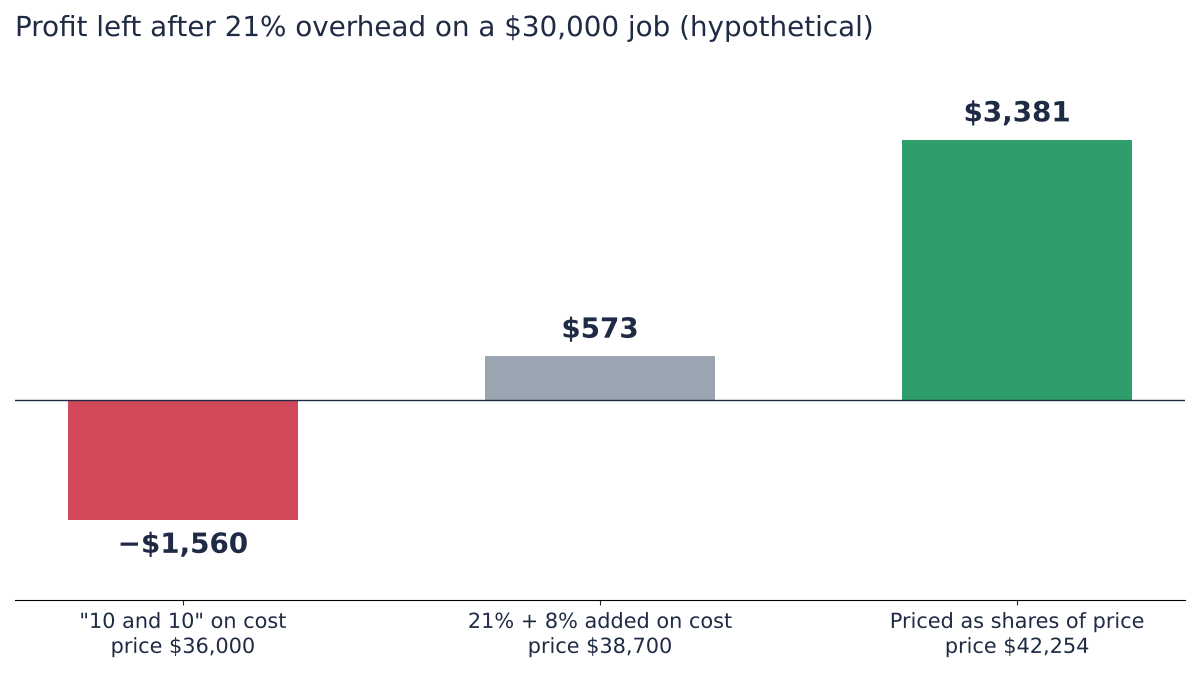
Here's the mistake to avoid: adding 21% and 8% on top of cost. $30,000 × 1.29 = $38,700. Overhead at 21% of that price is $8,127, which leaves $573. That's 1.5% profit, not 8%.
Check any price with the profit margin calculator before it goes out.
5. Overhead and profit on insurance claims
On insurance repairs, O&P is a line the adjuster adds to the estimate when a general contractor is needed to run the job. It's often written as two numbers, like "10 and 10": 10% overhead and 10% profit.
United Policyholders describes the rule of thumb most people work from: when a job needs three or more trades, a general contractor is entitled to be paid for supervising and coordinating them. It also says that at "10 and 10", O&P is charged as 20% on top of the total job estimate, and that rates like 5/10, 10/15 or 20/20 come up depending on the job.
That 20% on top of cost is 16.7% of the final price. Run the same $30,000 kitchen through it: $36,000, with $6,000 of O&P. Your overhead at 21% of $36,000 is $7,560. You're $1,560 in the hole before any profit.
What to do about it:
- Know your real rate from section 3, so you know whether "10 and 10" works for you before you take the job.
- Document the coordination. List every trade, the scheduling, the inspections and the supervision. That's the case for O&P being owed.
- Match the adjuster's format. Same line items, same order, O&P on its own line, supplements separate. The insurance claim invoice guide walks through it.
- Ask about O&P on the first payment. Whether O&P belongs in the actual cash value payment is one of the common disputes United Policyholders lists. Policy language and state rules differ, so check before you assume.
6. Show O&P on the estimate, or bake it in?
For retail homeowners, bake it into your line prices. A separate "overhead" line invites the customer to ask what it's for and whether they can skip it.
Show it as a line when the paperwork expects it: insurance estimates, some commercial bids, and cost-plus contracts where the fee is the deal.
Either way, use the same O&P on change orders. Extra work uses the same truck, the same office and the same you. And write the scope of work tight enough that the O&P you priced covers the job you actually do.
Want to see how your overall margin compares with other builders? General contractor profit margin has the benchmarks.
Common overhead and profit questions
What does O&P mean in construction?
O&P stands for overhead and profit. It's the part of a contractor's price above the direct cost of the job: overhead covers running the business (office, insurance, vehicles, admin, selling) and profit is what's left. On insurance estimates it often appears as its own line, such as "10 and 10".
What is typical overhead and profit for a contractor?
It depends on your books, which is why you calculate your own rate. For a benchmark, NAHB's 2024 remodelers' study showed a 29.9% average gross profit margin and a 6.3% average net profit margin, so overhead and profit together took about 30% of revenue. The insurance convention of "10 and 10" is lower.
Is 10 and 10 overhead and profit standard?
It's a common convention on insurance claims, not a rule. United Policyholders notes that O&P can be 5/10, 10/10, 10/15 or even 20/20 depending on the job. At "10 and 10" charged as 20% on top of cost, O&P is 16.7% of the price, which may not cover your overhead.
How do you calculate overhead and profit?
Divide last year's overhead by last year's revenue to get your overhead rate. Add your target profit. Then price each job as direct cost ÷ (1 − overhead % − profit %). With $30,000 of cost, 21% overhead and 8% profit, the price is $42,254.
What to do on your next estimate
Pull last year's overhead and revenue, get your real overhead rate, and price the next job from it. Then compare that number with what you'd have charged on habit.
Already sent one? Upload it to the estimate checker and see if it's priced too low. Pricing gutter jobs between the big ones? Here's how much to charge for gutter cleaning.