Scope of Work in Construction: What to Write, With a Real Example
What goes in a construction scope of work, how to write one step by step, and a priced deck rebuild example with the exclusions that protect your margin.

A scope of work in construction is the part of your estimate or contract that says exactly what you will build, with what materials, in what quantities, and what you will not do. Write it as a numbered list of tasks with quantities, then an exclusions list, then how changes get priced. On a typical residential job that fits on one page.
Scope = tasks + quantities + materials + exclusions + how changes are handled.
Price it with the same list: price = cost ÷ (1 − margin). Worked below on a hypothetical $8,573 deck rebuild.
Why bother? Because every line you leave vague becomes an argument later.
The customer remembers what they hoped for. You remember what you priced. The scope is the only thing both of you signed.
Scope: US residential jobs, hypothetical example, dollar figures as labeled assumptions. If you're still building the numbers behind the scope, start with how to estimate construction costs.
1. What is a scope of work in construction?
It's the written description of the work you're agreeing to do, detailed enough that a stranger could tell whether the job is finished. On small residential jobs it usually lives inside the estimate or contract, not in a separate document.
Big commercial projects split this into drawings, specifications and a separate scope document per trade. You probably don't need that. You need one clear list that matches your price line by line.
The quick test: if your customer and your helper each read it, would they picture the same finished job? If not, it's not a scope yet. It's a guess.
2. What goes in a construction scope of work
Six parts cover almost every residential job. Skip one and you'll feel it at the final walkthrough.
- Project summary. One or two sentences: what, where, why. "Replace decking, railing and stairs on the existing 12 × 16 ft rear deck at 14 Oak St."
- Tasks with quantities. Each task as its own line, with a unit you can count: square feet, linear feet, each, hours.
- Materials. Product type, size and grade, or an allowance in dollars when the customer still has to pick.
- Exclusions. What you are not doing, in plain words. This is the section that saves you money.
- Customer responsibilities. Access, power, water, moving furniture, HOA approval, decisions by a date.
- Changes, schedule and payment. How extra work gets priced and approved, the rough timeline, and the payment schedule.
The payment piece has its own rules of thumb. Our contractor payment terms guide covers deposits and progress payments.
3. How to write a scope of work, step by step
Walk the job, list every task in the order you'll do it, attach a quantity to each, then write what's excluded before you write the price.
- Walk the site with the customer. Ask what "done" looks like to them. Write their words down.
- Measure. Every task gets a number: 192 sq ft of decking, 44 linear ft of railing, 3 steps.
- List tasks in build order: demo, prep, rough work, finish work, cleanup.
- Name the materials, or set an allowance for anything the customer hasn't chosen.
- Write the exclusions. Think about what's hidden (rot, wiring, buried stuff) and what's nearby but not yours (the patio, the gutters, the paint).
- Write how changes work: in writing, priced before the work starts.
- Price every line, then read the scope once more as if you were the customer looking for loopholes.
In WinPal you can snap a photo of the job, describe it out loud, and get a first-draft estimate to fix up before sending. That's a fast way to get the task list down while you're still standing in the yard.
4. Worked example: residential construction scope of work for a deck rebuild
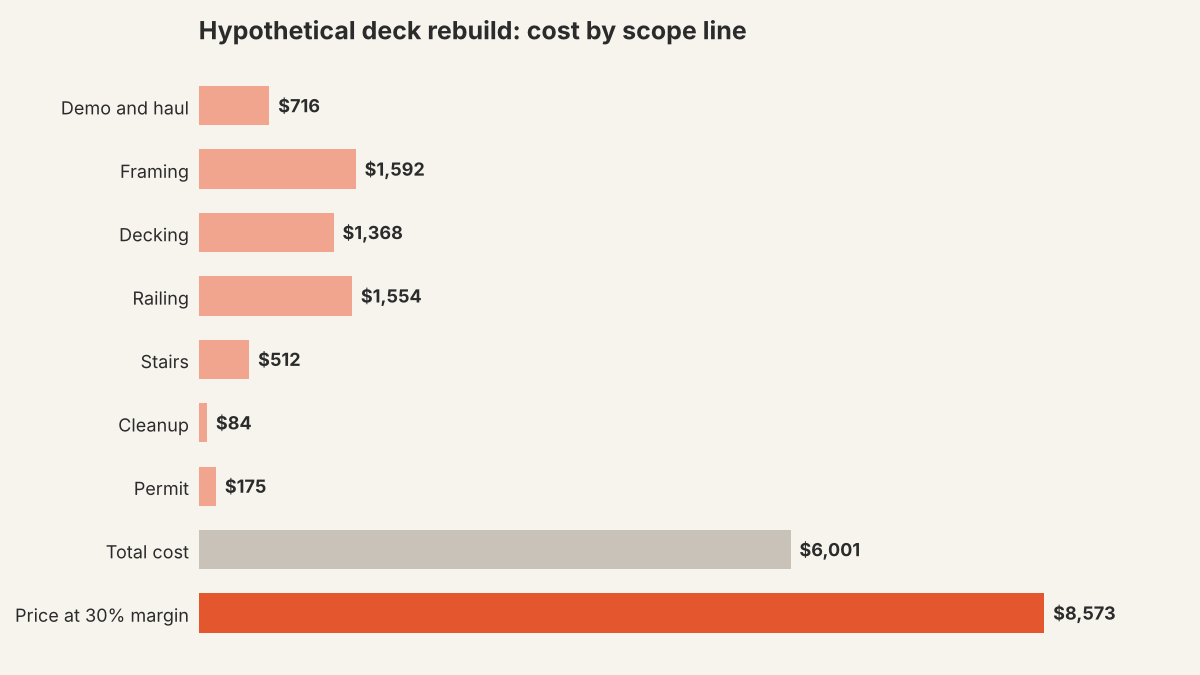
Here's a full scope for a hypothetical job: replace the decking, railing and stairs on a 12 × 16 ft (192 sq ft) deck, keeping the existing posts and beams. Labor is $42 an hour, an assumption built from the O*NET national median for carpenters ($29.12 an hour, BLS 2025 wage data) plus about 44% for payroll taxes, insurance and benefits. Material and fee figures are assumptions for illustration, not quotes.
Project summary: Remove and replace decking, framing above the beams, railing and stairs on the existing 12 × 16 ft rear deck. Existing footings, posts and beams stay.
| Scope line | Hours | Labor | Materials and fees | Line cost |
|---|---|---|---|---|
| Demo and haul off old decking and railing | 8 | $336 | $380 | $716 |
| Framing: joists, rim, hangers, ledger flashing | 16 | $672 | $920 | $1,592 |
| Decking: 192 sq ft of 5/4 × 6 pressure-treated boards | 14 | $588 | $780 | $1,368 |
| Railing: 44 linear ft | 12 | $504 | $1,050 | $1,554 |
| Stairs: 3 steps, 4 ft wide | 6 | $252 | $260 | $512 |
| Cleanup and final walkthrough | 2 | $84 | $0 | $84 |
| Permit (allowance) | $175 | $175 | ||
| Total cost | 58 | $2,436 | $3,565 | $6,001 |
At a 30% margin: $6,001 ÷ (1 − 0.30) = $8,572.86, rounded to $8,573. That leaves $2,572 to cover overhead and profit.
Not sure about the margin math? Run it through the profit margin calculator, and check your labor number with the hourly rate calculator.
Exclusions: footings, posts and beams; ledger board replacement (see below); electrical and lighting; staining or sealing; landscaping repair outside a 3 ft work zone; HOA approval.
Customer responsibilities: clear the deck and the area under it before day one; provide an outdoor outlet; pick railing style by the deposit date.
Changes: any work not listed above is priced in writing and signed before it starts.
5. Exclusions: the lines that protect your margin
Exclusions turn "I assumed you'd handle that" into a priced change order. Write them for anything hidden, anything nearby, and anything the customer might reasonably expect.
In the deck example, the ledger board stays if it's sound. Say you pull the old boards and it's soft. Replacing it takes about 5 hours and $140 in materials: $350 of cost, or $500 at the same 30% margin.
With the exclusion written down, that's a $500 change order the customer expected might happen. Without it, you eat $350, which is about 14% of the $2,572 the job was supposed to leave you. Your margin noticed.
Good exclusions are specific. "Unforeseen conditions" is weak. "Rotted framing or ledger found after demo, priced at $42 an hour plus materials" is strong.
6. Scope creep and change orders
Scope creep is the pile of small "while you're here" requests that never got priced. The fix is a rule in the scope itself: changes in writing, priced and signed before the work starts.
That rule is the law in some states. In California, a home improvement contract over $500 has to include a section headed "Description of the Project and Description of the Significant Materials to be Used and Equipment to be Installed," and a change order only becomes part of the contract if it's in writing and signed before the work starts (Business and Professions Code § 7159). Other states have their own home improvement rules, so check yours.
When the extra work does show up, write it up the same day. Here's how to write a construction change order that gets signed instead of argued about.
Unpriced extras don't just cost you on one job. They're one of the quiet reasons a year's general contractor profit margin comes in lower than the estimates said it would.
7. Scope of work vs estimate vs contract
The estimate is your price. The scope is what that price buys. The contract is the signed agreement that holds both, plus terms like payment and warranty.
On a small job, all three can be one document: an estimate with a detailed scope section that the customer signs. On bigger jobs the scope might be an attachment to a contract. Either way, the scope lines and the price lines should match one to one. If you're fuzzy on the price side, read quote vs estimate.
The scope says what you'll build. The contract type says how you get paid for it, and who pays if it runs over. Compare lump sum, cost plus and time and materials in types of construction contracts.
Common scope of work questions
What is an example of a scope of work in construction?
A deck rebuild scope reads like this: remove old decking and railing; replace joists and rim; install 192 sq ft of 5/4 × 6 pressure-treated decking; install 44 linear ft of railing; build 3 stairs; clean up. Then exclusions such as footings, staining and lighting, and a line that changes get priced in writing first.
Who writes the scope of work?
On residential jobs, you do. The contractor who prices the job writes the scope, because the scope has to match the price. On larger projects an architect or owner may write a project scope and each trade contractor writes the scope for its part. Either way, read the one you're signing line by line.
How detailed should a contractor scope of work be?
Detailed enough that someone who never saw the site could tell if the job is done. That means a quantity on every task, named materials or dollar allowances, and a written exclusions list. One page is normal for a deck, bathroom or roof repair. Longer is fine if every line earns its place.
What's the difference between scope of work and specifications?
The scope says what work gets done. Specifications say how and to what standard: product models, installation methods, tolerances. Small residential jobs usually fold the key specs into the scope lines, like "5/4 × 6 pressure-treated decking, 16 inches on center." Commercial jobs keep them in a separate spec book.
What to do on your next estimate
Write the scope first: tasks with quantities, materials, exclusions, how changes work. Then price each line and check the total against your margin.
Already sent one? Upload it to the estimate checker and see if it's priced too low.