Types of Construction Contracts and How Each Pays You
Lump sum, cost plus, GMP, time and materials and unit price contracts compared, with one hypothetical $40,000 job showing who eats a 10% overrun.

The main types of construction contracts are lump sum (fixed price), cost plus (with a percentage fee, a fixed fee or a guaranteed maximum price), time and materials, and unit price. They differ in one thing that matters to your margin: who pays when the job costs more than you estimated. On a lump sum, you do. On cost plus, the customer does, up to any cap.
Lump sum price = estimated cost ÷ (1 − margin). Cost plus price = actual cost + fee.
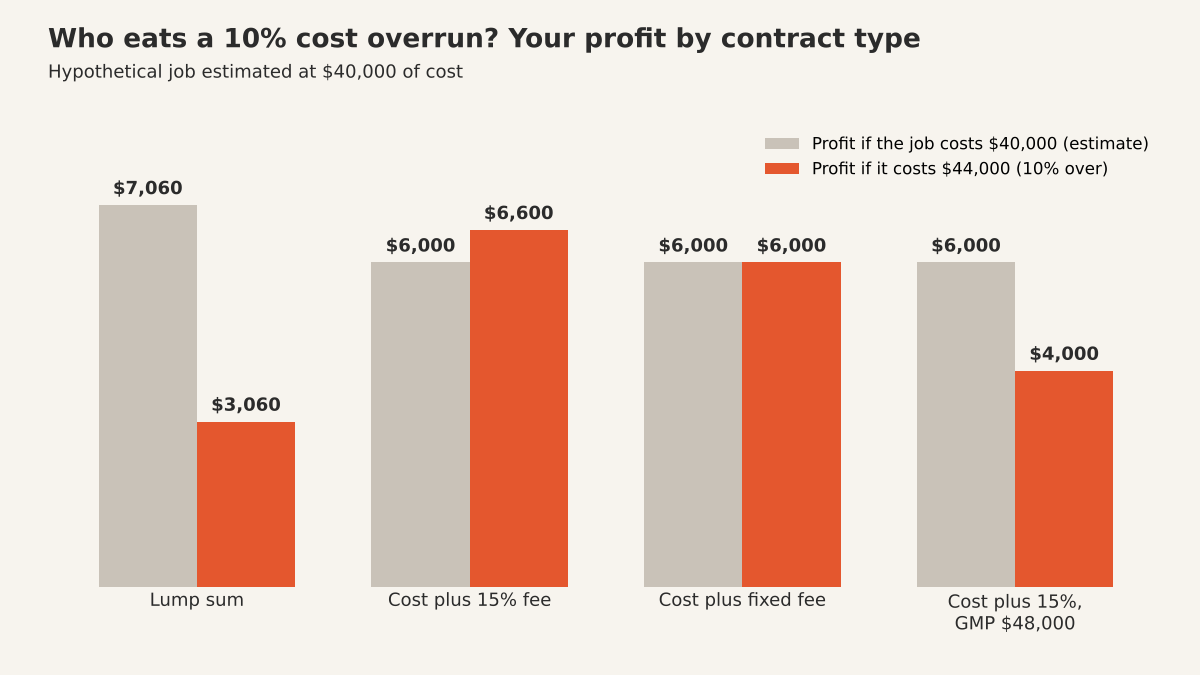
Hypothetical $40,000 job: a 15% margin lump sum is $47,060. A 10% overrun cuts that profit from $7,060 to $3,060. Worked below.
Pick the contract type before you finish the estimate, not after. It changes how you price, what you track on site and how you invoice.
Scope: US residential and light commercial contractors. Federal definitions come from the Federal Acquisition Regulation (FAR); private contracts and state law vary, so check yours. All job numbers are hypothetical. For the bid process itself, see how to bid construction jobs.
1. What are the main types of construction contracts?
Four families cover almost every job a small contractor signs. Each one answers the same question differently: who carries the cost risk.
| Contract type | What the customer pays | Who carries cost risk | Best fit |
|---|---|---|---|
| Lump sum (fixed price, stipulated sum) | One agreed price | You | Clear plans and scope |
| Cost plus percentage fee | Actual cost + a % of cost | Customer | Unclear scope, trusted customer |
| Cost plus fixed fee | Actual cost + a set dollar fee | Customer (your fee doesn't grow) | Unclear scope, customer wants a known fee |
| Cost plus with a GMP | Actual cost + fee, capped | Customer below the cap, you above it | Larger jobs with a budget ceiling |
| Time and materials | Hours × billing rate + materials | Customer | Repairs and service work you can't size |
| Unit price | Quantity × price per unit | Split: you on the unit cost, customer on quantity | Sitework, paving, drywall or tile by the square foot |
Whatever the type, the contract still needs a clear construction scope of work. The type decides how you get paid. The scope decides what you're getting paid for.
2. Lump sum: one price, all the risk is yours
A lump sum contract has one price for the whole job. If it costs you less, you keep the difference. If it costs more, that comes out of your pocket.
The federal definition says it plainly: a firm-fixed-price contract has a price "not subject to any adjustment on the basis of the contractor's cost experience" and puts on the contractor "maximum risk and full responsibility for all costs and resulting profit or loss" (FAR 16.202-1).
Most residential work is lump sum, because homeowners want to know the number. Price it like it'll run long: a real contingency line, an expiration date on material prices, and exclusions in writing. The only way the price moves after signing is a change order.
3. Cost plus: the customer pays actual cost plus your fee
On a cost plus contract, the customer reimburses your actual job costs and pays you a fee on top. It fits remodels where nobody knows what's behind the wall yet.
The fee comes in two shapes:
- Percentage of cost. Your fee grows with the cost. Customers worry that rewards you for spending. Federal agencies aren't allowed to use it at all: "The cost-plus-a-percentage-of-cost system of contracting shall not be used" (FAR 16.102(c)). Private jobs can.
- Fixed fee. A set dollar fee agreed up front. It "does not vary with actual cost" but can be adjusted when the work changes (FAR 16.306).
Watch the math on a percentage fee. A 15% fee on cost is a 13.0% margin on the price, not 15%. To net a 15% margin, the fee has to be 17.65% of cost (0.15 ÷ 0.85). Contractor markup explains why markup and margin drift apart.
Cost plus only works if you can prove the costs. Keep receipts, timesheets and sub invoices per job, and agree in writing which costs count: is your truck a job cost or part of your fee? Overhead and profit covers where that line usually sits.
4. Guaranteed maximum price: cost plus with a ceiling
A guaranteed maximum price (GMP) contract is cost plus with a cap. The customer pays actual cost plus fee up to the GMP. Anything over the cap is yours.
It looks like cost plus while the job behaves and like a lump sum when it doesn't. Set the GMP from a real estimate with contingency, and agree what happens to savings under the cap before you sign. Some contracts split them, some give them all back to the owner.
5. Time and materials: hours at a rate, plus materials
A time and materials (T&M) contract bills your hours at an agreed hourly rate plus materials. The rate has to carry everything: in the federal definition, fixed hourly rates "include wages, overhead, general and administrative expenses, and profit," and materials are billed at actual cost (FAR 16.601).
That's the trap. If your billing rate is just your wage plus a bit, you're working for free on overhead. Build it with the same formula: a hypothetical $45 loaded labor cost plus $20 of overhead per hour is $65, and $65 ÷ 0.85 is $76.47, so bill $77 an hour for a 15% margin.
The federal rule only allows T&M when it's "not possible at the time of placing the contract to estimate accurately the extent or duration of the work" (FAR 16.601). That's a good private-job test too. Many private T&M contracts also add a markup on materials; say so in the contract if yours does. Put a not-to-exceed amount on it so the customer isn't signing a blank check.
6. Unit price: a price per square foot, yard or item
A unit price contract sets a price per unit of work, like per square foot of tile or per cubic yard of fill, and the final bill is actual quantity times that price. You carry the risk on the unit cost. The customer carries the risk on quantity.
When quantities swing a lot, unit prices stop being fair. Federal fixed-price construction contracts with estimated quantities use a 15% band: if the actual quantity "varies more than 15 percent above or below the estimated quantity," either side can demand an equitable adjustment, based only on the part above 115% or below 85% (FAR 52.211-18). On a private job, write your own band into the contract.
7. Worked example: one $40,000 job, four contracts
Hypothetical: a basement finish estimated at $40,000 of cost (labor, materials, subs and job costs). Target margin 15%. Then the job runs 10% over, to $44,000. Here's your profit under each contract type.
| Contract | Price at $40,000 cost | Profit | Price at $44,000 cost | Profit | Margin after overrun |
|---|---|---|---|---|---|
| Lump sum, $40,000 ÷ 0.85, rounded | $47,060 | $7,060 | $47,060 | $3,060 | 6.5% |
| Cost plus 15% fee | $46,000 | $6,000 | $50,600 | $6,600 | 13.0% |
| Cost plus $6,000 fixed fee | $46,000 | $6,000 | $50,000 | $6,000 | 12.0% |
| Cost plus 15%, GMP $48,000 | $46,000 | $6,000 | $48,000 (capped) | $4,000 | 8.3% |
The lump sum pays best when your estimate is right and worst when it isn't. A $4,000 overrun took $4,000 straight out of your profit. On the GMP, the cap absorbed $2,600 of it ($50,600 of cost plus fee, billed at $48,000).
Run your own numbers with the profit margin calculator before you pick a fee.
8. How the contract type changes your estimate and invoices
The contract type tells you what the estimate has to prove and what every invoice has to show.
- Lump sum: the estimate carries your contingency, and invoices follow a payment schedule or progress billing by percent complete.
- Cost plus and GMP: the estimate is a budget, and every invoice needs backup: receipts, sub invoices and timesheets, with the fee shown as its own line.
- Time and materials: invoices list hours by day and materials by receipt, and stop at the not-to-exceed amount unless the customer signs off.
- Unit price: invoices show measured quantities times unit prices, so agree how you'll measure before you start.
Whichever you choose, put the payment schedule and deposit in the contract. Contractor payment terms has the details.
Common questions about construction contract types
What is the most common type of construction contract?
For small residential jobs, lump sum (fixed price) is the usual choice because homeowners want one number before work starts. Cost plus and time and materials show up on remodels and repairs where the scope can't be known until walls are open. Larger commercial jobs often use GMP or unit price contracts.
Is cost plus better than a fixed price for the contractor?
Cost plus protects you from overruns, but it usually pays a smaller fee and needs detailed cost records the customer can audit. A fixed price can earn more when you estimate well and costs behave. If you can't define the scope, cost plus or time and materials is safer than guessing.
What is a lump sum construction contract?
A lump sum construction contract sets one price for the complete scope of work. You keep any savings and absorb any overruns, and the price only changes through a signed change order. It works best when the plans and scope are clear enough to estimate with confidence.
What is a cost plus construction contract?
A cost plus construction contract pays the contractor's actual costs plus a fee, either a percentage of cost or a fixed dollar amount. It can include a guaranteed maximum price that caps the total. The contract should list which costs are reimbursable and how they'll be documented.
What to do on your next contract
Before you send the next estimate, decide which contract type fits the scope, then price it with the formula for that type and put the fee, cap or rate in writing.
Already sent a lump sum price? Upload it to the estimate checker and see if it's priced too low. Small jobs work the same way: a handyman services list prices each task as its own little fixed-price contract.