Construction Overhead: What It Includes and How to Calculate Your Rate
List your company overhead, turn it into a rate, find your break-even month and price jobs so every one carries its share.

Construction overhead is what it costs to run your company that you can't charge to one job: office, insurance, trucks, phone, software, advertising, bookkeeping and the owner pay you don't bill to jobs. To calculate your overhead rate, divide last year's overhead by last year's revenue. Then make every price carry that share.
Overhead rate = annual overhead ÷ annual revenue.
Hypothetical: $86,800 ÷ $480,000 = 18.1%. Worked below.
Why it matters: overhead doesn't stop when the work does. A slow February still has a truck payment, an insurance bill and a phone plan. If your prices don't carry them, your pocket does.
Scope: US contractors and remodelers, mostly small crews doing residential work. All dollar figures are hypothetical unless a source is named. If you want the pricing side of overhead and profit together, read overhead and profit after this one.
1. Job overhead vs company overhead
There are two kinds, and only one of them is "overhead" in your overhead rate.
| Type | Also called | Examples | Where it goes |
|---|---|---|---|
| Job overhead | General conditions, job-site overhead | Supervision on that job, dumpster, porta-john, temporary protection, permits, final cleanup | In the job's direct cost |
| Company overhead | Indirect costs, G&A, general and administrative | Office, insurance, trucks, phone, software, bookkeeping, advertising, owner pay not billed to jobs | In your overhead rate |
The test: would you still pay it if this job got cancelled tomorrow? If yes, it's company overhead. If no, it belongs on the job.
Your lead carpenter running one remodel all week? That's job cost. The hours you spend driving between three jobs to check on them? Overhead.
2. Build your overhead budget
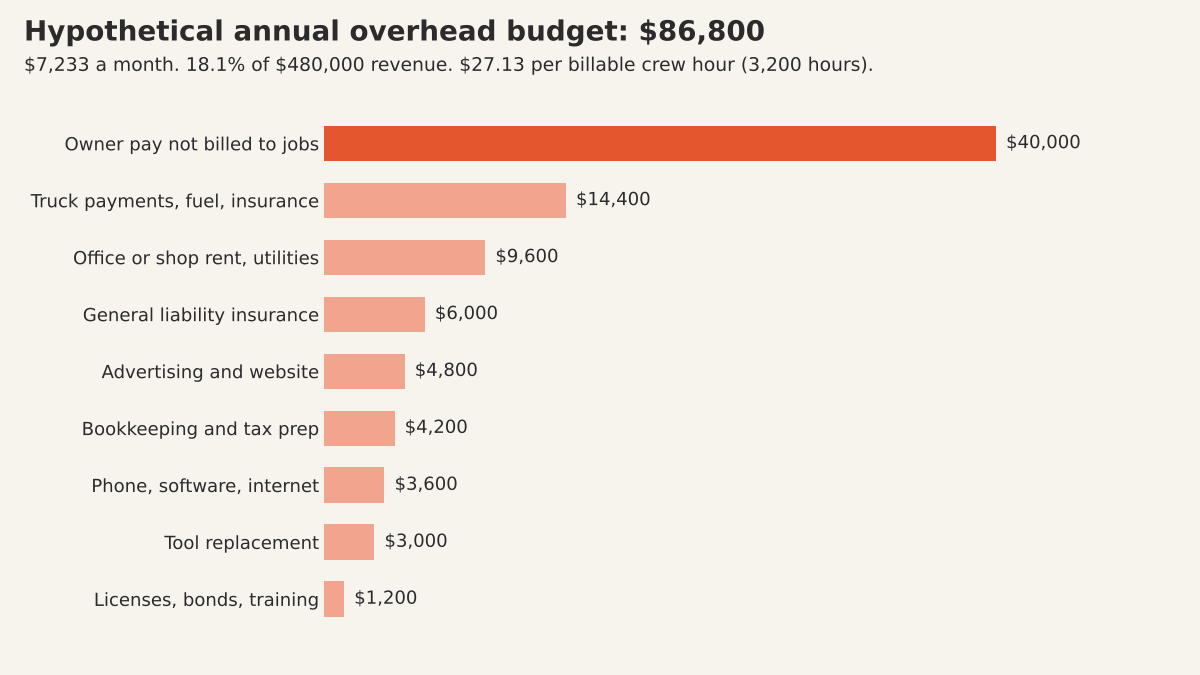
Pull last year's bank and card statements and sort every business expense into one of the lines below. Leave out materials, subs, crew wages and anything else you already price into jobs.
Here's a hypothetical small remodeler with two crews and $480,000 in revenue:
| Overhead line | Per year |
|---|---|
| Owner pay not billed to jobs | $40,000 |
| Truck payments, fuel between jobs, vehicle insurance | $14,400 |
| Office or shop rent, utilities | $9,600 |
| General liability insurance | $6,000 |
| Advertising and website | $4,800 |
| Bookkeeping and tax prep | $4,200 |
| Phone, software, internet | $3,600 |
| Tool replacement | $3,000 |
| Licenses, bonds, training | $1,200 |
| Total | $86,800 ($7,233 a month) |
The line people forget is the first one. If you spend half your week quoting, ordering and chasing invoices, that half of your pay is overhead. Leave it out and you're working those hours for free.
3. Three ways to express your overhead rate
Same $86,800, three yardsticks. Pick the one that matches how you price.
- Share of revenue: $86,800 ÷ $480,000 = 18.1%. Use it when you price jobs as cost ÷ (1 − overhead % − profit %).
- Share of direct cost: last year's direct job costs were $336,000, so $86,800 ÷ $336,000 = 25.8%. Use it only if you price by marking up cost.
- Per billable crew hour: 3,200 billable hours, so $86,800 ÷ 3,200 = $27.13 an hour. Use it for service and small repair work billed by the hour. The hourly rate calculator does this math for you.
The trap: taking the 18.1% revenue rate and adding it on top of cost. Those are different numbers.
Mix them up and every job comes in short. Section 5 shows by how much.
4. Your break-even revenue
Break-even revenue = annual overhead ÷ gross margin. It's the sales number where you've covered overhead and made zero profit.
Our hypothetical remodeler keeps 30% gross margin ($480,000 revenue minus $336,000 direct cost, divided by $480,000). So $86,800 ÷ 0.30 = $289,333 a year, or $24,111 a month.
That monthly number is worth knowing in a slow stretch. Bill less than about $24,000 of work in a month and that month loses money, no matter how good each job looked.
For a benchmark, NAHB's 2024 remodelers' study put the average gross profit margin at 29.9% and the average net profit margin at 6.3% (NAHB, April 10, 2026). The gap, 23.6 points of revenue, is roughly what overhead took for the average remodeler.
5. Put the overhead rate into a price
Price = direct job cost ÷ (1 − overhead rate − profit target).
Hypothetical bathroom: $12,000 of direct cost (materials, crew labor, the tile sub, the dumpster). Overhead rate 18%, profit target 10%.
| Line | Math | Amount |
|---|---|---|
| Direct job cost | materials, labor, subs, dumpster | $12,000 |
| Price | $12,000 ÷ (1 − 0.18 − 0.10) = $12,000 ÷ 0.72 | $16,667 |
| Overhead carried | 18% × $16,667 | $3,000 |
| Profit | $16,667 − $12,000 − $3,000 | $1,667 (10%) |
Now the trap from section 3. Add 18% on top of the $12,000 and the job carries $2,160 of overhead, not $3,000. That's $840 short on one bathroom.
Do that on 30 jobs a year and you've lost $25,200 before profit even comes up.
Run any price through the profit margin calculator before it goes out. And if you're wondering what markup that price implies, contractor markup walks through it.
6. When overhead goes up without spending more
Your overhead rate is a ratio. If revenue drops, the rate rises even though you didn't spend a dollar more.
Same $86,800 of overhead, but revenue comes in at $400,000 instead of $480,000: $86,800 ÷ $400,000 = 21.7%. Price next year at 18% and you're 3.6 points short on every job.
So check it every quarter. Use your trailing 12 months of overhead and revenue, and update the rate in your estimates when it moves more than a point.
7. How to cut overhead without cutting corners
- Quote faster. Unpaid quoting time is overhead. A template for your common jobs and estimates you can write on site cut it down.
- Shop your insurance every renewal and ask whether your class codes still match the work you do.
- Kill software you don't open. Check the card statement for subscriptions nobody logs into.
- Bill the job-site items to the job. Dumpsters, permits, protection and cleanup belong in the job cost. Leave them in overhead and the jobs that cause them get a free ride.
- Raise prices before you cut. If your overhead is lean and the rate is still high, you're short on revenue, not long on spending.
Writing estimates from the driveway is the whole point of an estimating app. In WinPal you can snap a photo of the job, describe it out loud, and get a first-draft estimate to fix up before you send it.
Overhead runs the business. The cost of each person on payroll, from payroll taxes to paid days off, is a separate line. See labor burden for how to calculate it.
General conditions are the job overhead from section 1, priced as their own lines on each estimate. The weekly method and a worked kitchen remodel are in general conditions in construction.
Your overhead budget is only as good as your books. If receipts live in the truck until April, start with a simple construction bookkeeping routine so this year's numbers are ready when you need them.
Common construction overhead questions
What is overhead in construction?
Overhead in construction is the cost of running the company that doesn't belong to one job: office, insurance, vehicles, phone, software, advertising, bookkeeping and owner pay not billed to jobs. Job-site costs like supervision on that job, dumpsters and permits are general conditions and go in the job's direct cost.
What is a typical overhead percentage for a contractor?
It depends on your books, so calculate your own. As a benchmark, NAHB's 2024 study showed remodelers averaging 29.9% gross margin and 6.3% net margin, which puts operating expenses near 23.6% of revenue. A lean solo operator can run lower; a company with office staff can run higher.
What does 20% overhead mean?
It usually means overhead takes 20 cents of every dollar of revenue. Some people mean 20% added on top of cost instead, which is a smaller share of the price: 20% on cost is 16.7% of the price. Ask which one before you compare numbers.
How do you calculate overhead for a construction company?
Add up a year of company expenses that aren't charged to jobs, owner pay included. Divide by the year's revenue to get your overhead rate. Then price each job as direct cost ÷ (1 − overhead rate − profit target). With $86,800 of overhead on $480,000 of revenue, the rate is 18.1%.
Is a superintendent overhead?
Not when they run one job. Time spent supervising a specific job is a job cost, usually listed under general conditions. Supervision split across every job, like an operations manager, is company overhead.
What to do this week
Pull last year's statements, fill in the nine overhead lines, and divide by revenue. Put that rate into your next estimate and see how far it is from what you'd have charged on habit.
Already sent one? Upload it to the estimate checker and see if it's priced too low. Pricing a framing package next? Here's how to price framing labor per square foot.