Framing Labor Cost per Square Foot: How to Price Your Crew
Set a framing labor price per square foot from your own crew cost and crew-days, not a going rate. Worked example and bid checklist.
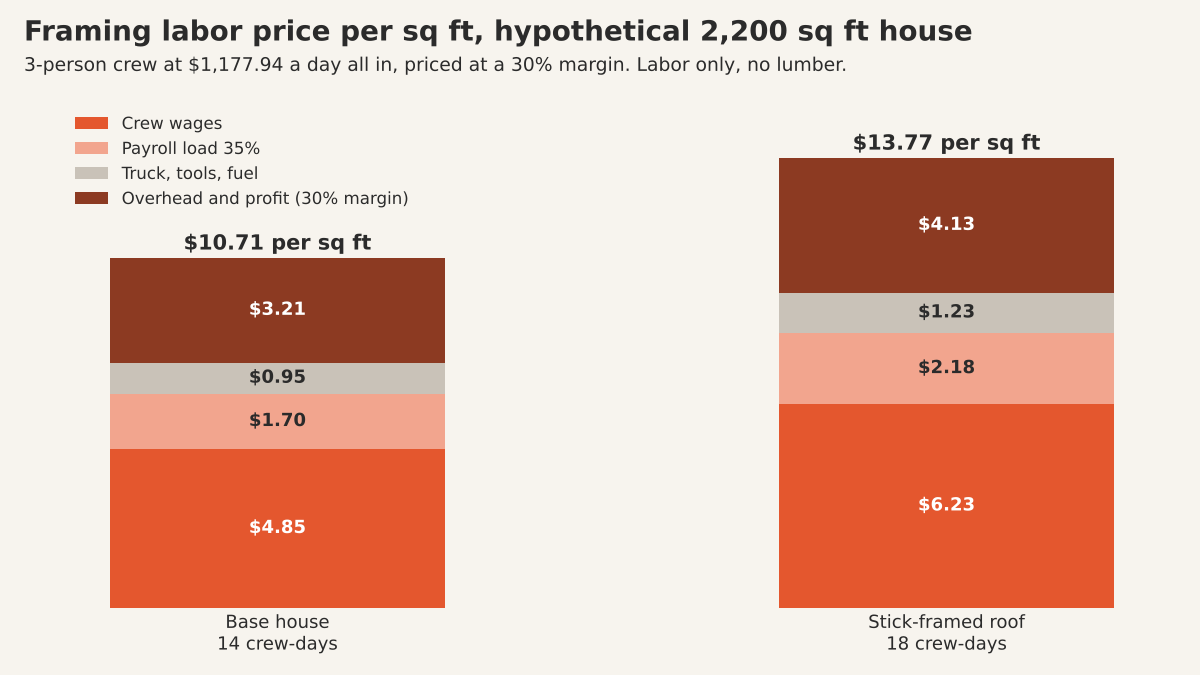
Framing labor is commonly quoted per square foot of the house, labor only, with the GC or owner buying the lumber. To set your number, take what your crew costs per day, multiply by the crew-days the frame will take, divide by the square footage, then divide by (1 − margin). The hypothetical crew below comes out at $10.71 per square foot.
Price per sq ft = (crew cost per day × crew-days ÷ sq ft) ÷ (1 − margin).
Hypothetical: ($1,177.94 × 14 ÷ 2,200) ÷ 0.70 = $10.71. Worked below.
Why it matters: a square-foot price you copied from a forum thread knows nothing about your crew, your wages or the roof on this set of plans. Your own crew-days do.
Scope: US framing subs and small builders pricing residential framing. Every rate below is a labeled assumption except the wage data, which is named. For bidding the whole job, see how to bid construction jobs.
1. What a square foot of framing includes
Before you price it, write down what you're measuring and what's in the number. Two framers can quote the same plans at very different prices and both be right, because they're pricing different scopes.
- Which square feet: conditioned living area, or everything under the roof including the garage and porches? Say which on the bid.
- What's framed: floor system, walls, roof (set trusses or stick-framed), wall and roof sheathing, stairs, blocking, backing.
- What's not: lumber and hardware (unless you supply them), crane or lift, dumpster, windows and doors, house wrap, and rework when the plans change.
The customer didn't ask about blocking, but the drywall crew will. Put it in scope or put it in the exclusions.
2. Your crew cost per day
Start with wages, then load them, then add what the crew burns through in a day.
For a wage reference, carpenters in the US earned a median of $29.12 an hour, with the top quarter at $36.94 or more (O*NET, Carpenters 47-2031, BLS 2025 wage data). Your local rates will differ, so use your own payroll.
Hypothetical 3-person crew: a lead at $36.94 and two carpenters at $29.12.
| Line | Math | Per day |
|---|---|---|
| Crew wages | ($36.94 + $29.12 + $29.12) × 8 hours | $761.44 |
| Payroll load (assumption 35%: payroll taxes, workers' comp, insurance) | $761.44 × 0.35 | $266.50 |
| Truck, fuel, nailers, compressor, blades (assumption) | flat | $150.00 |
| Crew cost per day | $1,177.94 |
Workers' comp for framing can be one of the bigger lines, and rates vary by state. Get your real rate from your policy and swap it in.
3. Count crew-days, not square feet
The square-foot price is the output, not the input. What you actually know is how long your crew takes to frame a house like this one.
Track it on every job: square feet framed ÷ crew-days. After five or six houses you'll have a real number for a simple one-story, a two-story and a cut roof.
Hypothetical: a 2,200 sq ft one-story with a truss roof takes this crew 14 days, floor to sheathing. Same footprint with a stick-framed roof and a vaulted great room: 18 days.
Price it like it'll run long. If the plans show a lot of corners, steel beams or a complicated roof, add the days now. You can't add them after you've signed.
4. Work out the price per square foot
Labor cost, then margin. Margin here has to cover your overhead and your profit.
| Line | Base house, 14 crew-days | Stick-framed roof, 18 crew-days |
|---|---|---|
| Labor cost | $1,177.94 × 14 = $16,491.22 | $1,177.94 × 18 = $21,202.99 |
| Cost per sq ft | $16,491.22 ÷ 2,200 = $7.50 | $21,202.99 ÷ 2,200 = $9.64 |
| Price at 30% margin | $16,491.22 ÷ 0.70 = $23,558.88 | $21,202.99 ÷ 0.70 = $30,289.99 |
| Price per sq ft | $10.71 | $13.77 |
Same house size, $3.06 a square foot apart. That's the roof. Quote both at one "going rate" and the cut-roof job eats the profit from the easy one.
Why 30%? It's an assumption for this example.
Your margin should come from your real overhead rate plus a profit target. Construction overhead shows how to get that rate, and the profit margin calculator checks the math.
5. Per square foot, per linear foot or day rate?
- Per square foot is the usual way to quote new houses. It's easy for a GC or owner to compare, and it's fine when your crew-day numbers are solid.
- Per linear foot of wall fits additions, basements and remodels, where floor area says little about the work.
- Day rate or hourly fits repairs, punch lists and plan changes. The hourly rate calculator builds overhead into the rate.
Whichever you pick for the contract, price changes the same way. Moved walls and added beams go on a change order before you cut anything.
6. What to put on the framing bid
- The plans and revision date you priced from.
- How square footage was measured, and the number.
- Price per square foot and the total.
- What's included: floor system, walls, roof, sheathing, stairs, blocking.
- Exclusions: lumber, hardware, crane, dumpster, windows, rework from plan changes.
- Payment schedule tied to stages, like floor deck, walls up, roof dried in.
- How changes are priced: day rate or a per-item list.
A tight scope of work is what keeps the square-foot price honest.
Common framing labor pricing questions
How much should I charge per square foot for framing?
Work it out from your own crew: crew cost per day × crew-days ÷ square feet, then divide by (1 − your margin). In this hypothetical, a 3-person crew at $1,177.94 a day framing 2,200 sq ft in 14 days, priced at a 30% margin, comes to $10.71 per square foot, labor only.
Does framing labor per square foot include materials?
Not unless the bid says so. A labor-only bid leaves lumber and hardware to the GC or owner, so spell that out. If you do supply materials, price them on their own line with your markup so the labor rate stays comparable from job to job.
Why do framing quotes vary so much per square foot?
Different scopes and different houses. One framer counts the garage and porches, another doesn't. A truss roof goes up faster than a stick-framed one, and corners, beams and vaulted ceilings all add crew-days. Compare quotes only after the scope and the measurement match.
How long does it take to frame a house?
It depends on the crew, the plans and the weather. Track your own: square feet framed per crew-day on every job. In the hypothetical above, 2,200 sq ft took 14 crew-days with trusses and 18 with a stick-framed roof.
What to do on your next framing bid
Pull your last few jobs, divide square feet by crew-days, and price the next set of plans from that number instead of the going rate.
Already sent one? Upload it to the estimate checker and see if it's priced too low.