How to Start a Cleaning Business: Setup, Costs and Your First Price
Start a house or commercial cleaning business the right way: registration, insurance and a bond, a first-year budget, and a per-clean price built from your own numbers.
To start a cleaning business, pick residential or commercial cleaning, check your city and state registration rules, register the business and get a free EIN, buy liability insurance and a bond, budget your supplies and overhead, and set your price from your own numbers. Then decide how you'll quote, invoice and get paid before the first booking.
Cost per billable hour = (your yearly pay + yearly overhead) ÷ billable hours.
Hypothetical: ($35,510 + $12,200) ÷ 1,344 hours = $35.50. A 3-hour house clean plus 20 minutes of driving then costs $118.33 and prices at about $158. Worked below.
Cleaning is cheap to start. A vacuum, a mop and a car will do it. That's also the trap: it's easy to start charging what the last cleaner charged and find out in March that the business pays you less than a job would.
Scope: US solo operators starting a house cleaning or commercial cleaning business. Budgets and rates below are hypothetical, and tax rules link to the official source. Already quoting homes? Try the house cleaning calculator.
1. Pick residential, commercial, or a niche
The two sides of cleaning run on different schedules, customers and pricing.
- Residential (house cleaning): daytime work, homeowners as customers, priced per visit. Repeat weekly or biweekly clients are your base, and one-time deep cleans and move-outs fill gaps.
- Commercial (janitorial): offices and small buildings, often evenings, priced per month under a contract. Fewer customers, bigger checks, longer sales cycle. The bidding math is in how to bid janitorial contracts.
- Niches: move-out cleans, vacation rentals, or post-construction cleaning for contractors and builders. Pricing that last one is in the post-construction cleaning price list.
Most solo cleaners start residential, because you can book your first client this week. Commercial pays off once you can cover evenings reliably or hire.
2. Register the business, get an EIN, and plan for taxes
If you work alone and don't form anything, you're a sole proprietor by default. An LLC is a state filing with fees and yearly paperwork; it can separate business and personal assets but doesn't replace insurance. Ask a local accountant which fits.
Check your city or county for a general business license, and register a business name if it isn't your own. Then get an EIN and open a separate bank account. The EIN is free: the IRS issues it online and says you never have to pay a fee for one (IRS, Get an EIN).
Self-employment tax is 15.3%, 12.4% for Social Security and 2.9% for Medicare, once your net earnings from self-employment reach $400 (IRS, Self-employment tax). That's on top of income tax. Move part of every payment into a tax account the day it clears.
3. Insure and bond the business
You'll be alone in people's homes with their stuff. Customers will ask if you're insured, and commercial clients will ask for a certificate before you start.
- General liability: damage to a customer's property and injuries to others. The knocked-over lamp, the bleach spot on the rug.
- A janitorial bond: sold by insurance agents and surety companies to protect clients against theft by someone working for you. Ask your agent what yours covers and how claims work.
- Commercial auto: driving between jobs with supplies may not be covered by a personal policy. Ask.
- Workers' comp: check your state's rules the day you hire your first cleaner.
4. Budget supplies and overhead for a full year
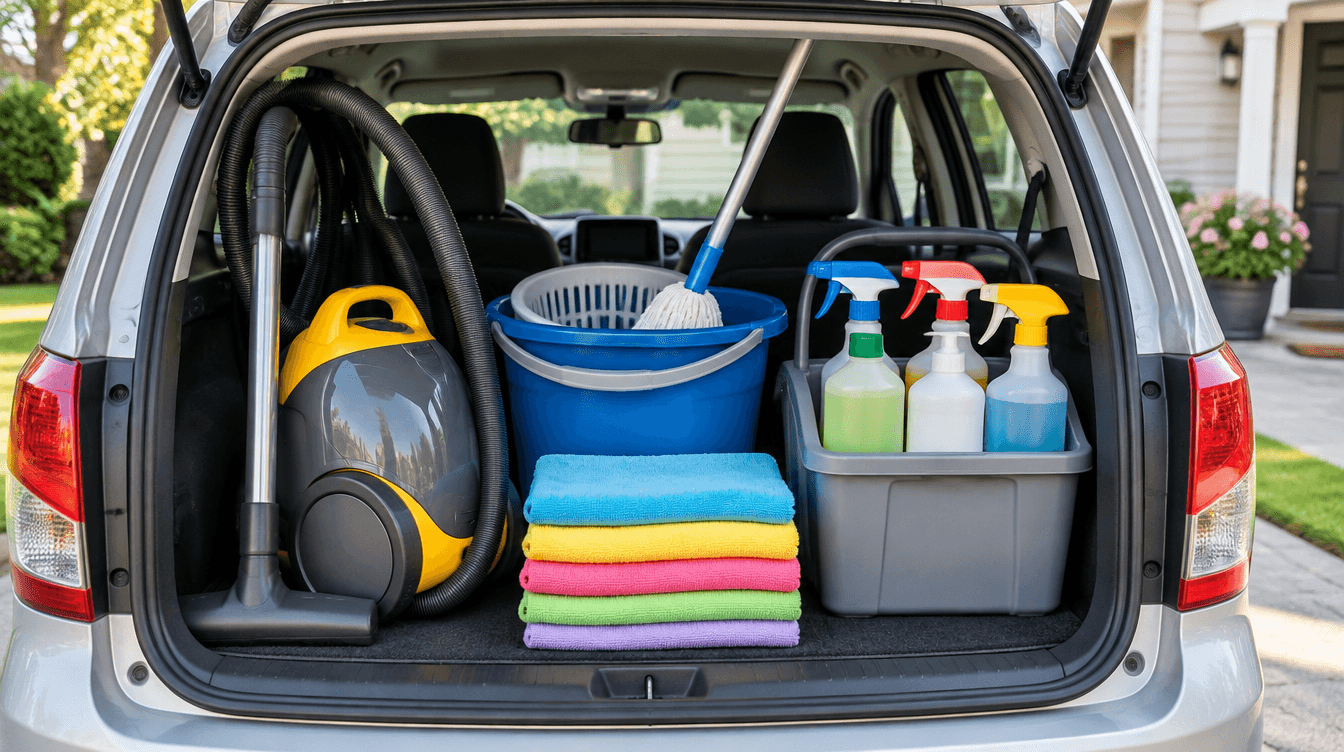
A hypothetical starter kit: a commercial vacuum and a backup, mops and buckets, microfiber in a few colors, a caddy, a step ladder and a first round of products. Call it $1,500, paid back over three years at $500 a year.
| Overhead line (hypothetical) | Per year |
|---|---|
| General liability insurance and bond | $1,400 |
| Car: fuel, maintenance, business share of insurance | $4,800 |
| Cleaning products and replacement supplies | $2,400 |
| Equipment payback ($1,500 over 3 years) | $500 |
| Phone and software | $1,200 |
| Marketing: website, cards, local ads | $1,200 |
| Accounting and tax prep | $500 |
| Registration and licenses | $200 |
| Total overhead | $12,200 |
Use your own quotes where you have them. The car line is the one people skip, and it's usually the biggest.
5. Set your price from your own numbers
Start from what one billable hour costs the business. Here's the math with hypothetical first-year numbers.
- Your pay. O*NET lists the national median for maids and housekeeping cleaners at $35,510 a year (2025). Use it as a floor: if the business pays you less, you'd earn more working for someone else. For janitors and building cleaners it's $36,840.
- Billable hours. 48 weeks × 40 hours = 1,920 hours. Driving between homes, quoting, supply runs and admin take a share, so at 70% billable that's 1,344 hours.
- Cost per billable hour. ($35,510 + $12,200) ÷ 1,344 = $35.50.
- Price with a margin. At a 25% margin: $35.50 ÷ (1 − 0.25) = $47.33 per billable hour.
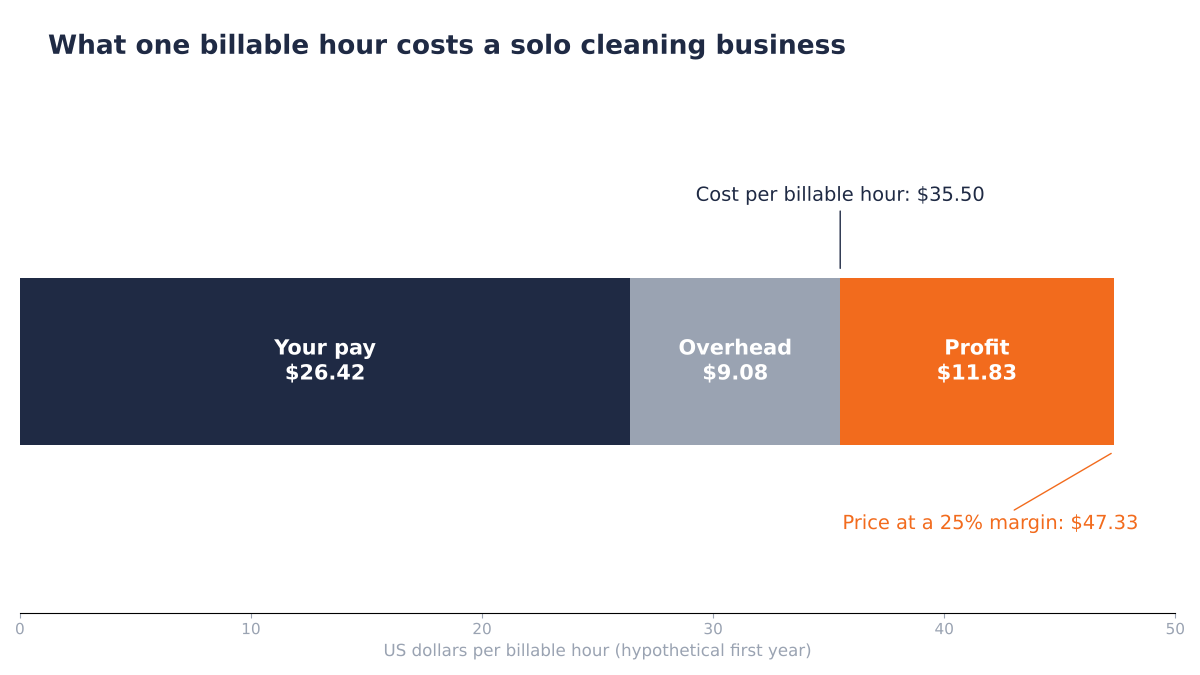
Turn it into a per-clean price. A standard clean that takes 3 hours on site plus 20 minutes of drive is 3 hours and 20 minutes, or 10/3 of an hour: $35.50 × 10 ÷ 3 = $118.33 of cost. At a 25% margin, $118.33 ÷ 0.75 = $157.77, so about $158 a visit.
That $158 comes from these hypothetical inputs. It's not a market rate. If your market won't pay it, you have three levers: less drive time (clients close together), more billable hours, or lower overhead. Run your own numbers in the hourly rate calculator, and check the margin on any price with the profit margin calculator.
Price deep cleans and move-outs as their own jobs, from the hours they really take. A first clean on a neglected house can run double a maintenance visit.
6. Set up quotes, invoices and payments
Decide how you'll quote, bill and get paid before the first client calls. Late invoices are how a cleaning business ends up with $2,000 owed to it in $150 pieces.
- Quotes: what's included room by room, what isn't (inside the oven, inside the fridge, windows), the price per visit and how often.
- Payment terms: payment due at each visit, or invoices on a set day each week or month. Say what happens on a lockout or a late cancellation. See payment terms.
- Getting paid: take cards so clients can pay without leaving a check on the counter. The fee trade-offs are in how to accept credit card payments.
WinPal is a mobile and web app for contractors and home-service pros that handles the paperwork around jobs: estimates, invoices, payments, jobs and schedules, customer info, expenses and reports. You can turn a photo and a voice note into a first-draft quote, then invoice from your phone and let clients pay online. Plan costs on the pricing page.
7. Land your first clients
Your first clients come from close by, and close by is how you make money.
- Tell friends, family and neighbors, and ask each one for one name.
- Set up a free Google Business Profile with your services and service area.
- Ask every happy client for a review after the second visit, and for a neighbor's name.
- Pick the area you want to work and say no to the client 40 minutes away, at least until your schedule is full.
A weekly client in the next street is worth more than a slightly higher price across town. The drive is unpaid time.
Common questions about starting a cleaning business
Do I need a license to start a cleaning business?
Requirements depend on where you work. Many cities and counties require a general business license, and you'll register a business name if it isn't your own. Check with your city or county and your state's business registration office before you advertise. Commercial clients will also ask for proof of insurance.
How much does it cost to start a cleaning business?
Less than most trades. This guide's hypothetical starter kit costs $1,500 for vacuums, mops, microfiber, a caddy, a ladder and first supplies, and the first-year overhead comes to $12,200 including insurance, the car and marketing. The EIN is free. Your own car and equipment you already own lower both numbers.
Do I need to be bonded and insured to clean houses?
Requirements come from your state, your city and your clients, so check locally. Even where nothing requires it, homeowners often ask, and commercial clients often want a certificate before you start. General liability covers damage and injuries. A janitorial bond protects clients against theft by someone working for you.
Should I start with residential or commercial cleaning?
Residential is quicker to start: you can book a client this week and get paid per visit. Commercial cleaning pays bigger monthly contracts but takes longer to win, often needs evening work, and clients ask for insurance certificates. Many cleaners start residential and add commercial once they can hire.
What to do this week
Get your EIN, call two insurance agents about liability and a bond, list your yearly overhead and work out your cost per billable hour. Then write your first per-visit price from it.
Already sent a quote? Upload it to the estimate checker and see if it's priced too low. Starting out in another trade? See how to start a handyman business or how to start a landscaping business. Pricing remodel work? Here's how to size a construction contingency.