How to Start a Landscaping Business: 8 Steps From License to First Invoice
Licenses, pesticide and irrigation rules, a free EIN, insurance, a first-year equipment and overhead budget, and a per-visit mowing price worked out from your own numbers.
To start a landscaping business, choose lawn care, landscaping or both, check your state's license and pesticide rules, register the business and get a free EIN, insure it, budget your equipment and overhead, and build your price from your own numbers. Then set up estimates, invoices and payments before spring hits.
Cost per billable hour = (your yearly pay + yearly overhead) ÷ billable season hours.
Hypothetical: ($39,150 + $19,900) ÷ 1,134 hours = $52.07. A 50-minute mowing stop then costs $43.39 and prices at about $58. Worked below.
The mower is the easy part. A landscaping business gets squeezed by the season: you earn most of the year's money in about eight months, and your truck payment doesn't take winter off.
Scope: US solo operators starting a lawn care or landscaping business. Budgets and rates below are hypothetical; license and tax rules point to the official source, so check your state. Already mowing for money? Go straight to the lawn care pricing chart.
1. Pick lawn care, landscaping, or both
Lawn care is recurring maintenance: mowing, edging, blowing, cleanups. Landscaping is project work: beds, mulch, planting, sod, hardscape. They need different equipment, different pricing and a different cash flow.
- Lawn care first: cheaper to start, steady weekly income, priced per visit. Your profit lives in route density, so stops close together matter more than any single price.
- Landscaping first: bigger tickets and deposits, priced per job from labor and materials, more license questions.
Most people start with mowing and add projects once customers ask. The landscaping services list sorts 35 services by how you price them, so you can pick a starter menu.
2. Check license, pesticide and irrigation rules
Mowing rarely needs a trade license. Spraying, irrigation and bigger projects often do. Check three things before you advertise them.
Contractor license. The limit moves by state. In California, unlicensed work is limited to jobs under $1,000 in total labor and materials that need no building permit (Cal. Bus. & Prof. Code § 7048). A patio or retaining wall can blow past that fast.
Pesticides and fertilizer with weed control. Federal rules put commercial applicators who use restricted use pesticides on ornamental plants and turf in their own certification category (40 CFR 171.101(c)). Your state's pesticide regulator sets the rules for everything else, so check before you spray anything for pay.
Irrigation. Some states license sprinkler work. In Texas, you need a license to sell, design, install, maintain, alter, repair or service an irrigation system (Tex. Occ. Code § 1903.251).
Then check your city or county for a general business license.
3. Register the business, get an EIN, and plan for taxes
If you work alone and don't form anything, you're a sole proprietor by default. An LLC is a state filing with fees and yearly paperwork; it can separate business and personal assets but doesn't replace insurance or a license. Ask a local accountant which fits.
Register a business name if it isn't your own, then get an EIN and open a separate bank account. The EIN is free: the IRS issues it online and says you never have to pay a fee for one (IRS, Get an EIN).
Self-employment tax is 15.3%, 12.4% for Social Security and 2.9% for Medicare, once your net earnings from self-employment reach $400 (IRS, Self-employment tax). That's on top of income tax. Put part of every payment in a tax account the day it clears, especially in July when the checks are big.
4. Insure the business and the equipment
Buy general liability before your first yard. A rock from the mower deck through a patio door is a normal Tuesday in this trade.
- General liability: damage to customer property and injuries to others. Commercial customers and HOAs often ask for a certificate.
- Commercial auto: a truck pulling a trailer for work may not be covered by a personal policy. Ask your agent.
- Equipment coverage: for a mower and trailer that can walk off overnight.
- Workers' comp: check your state's rules the day you hire.
5. Budget equipment and overhead for a full year
Start with equipment you can pay back, then list every yearly cost. The whole year has to come out of the season.
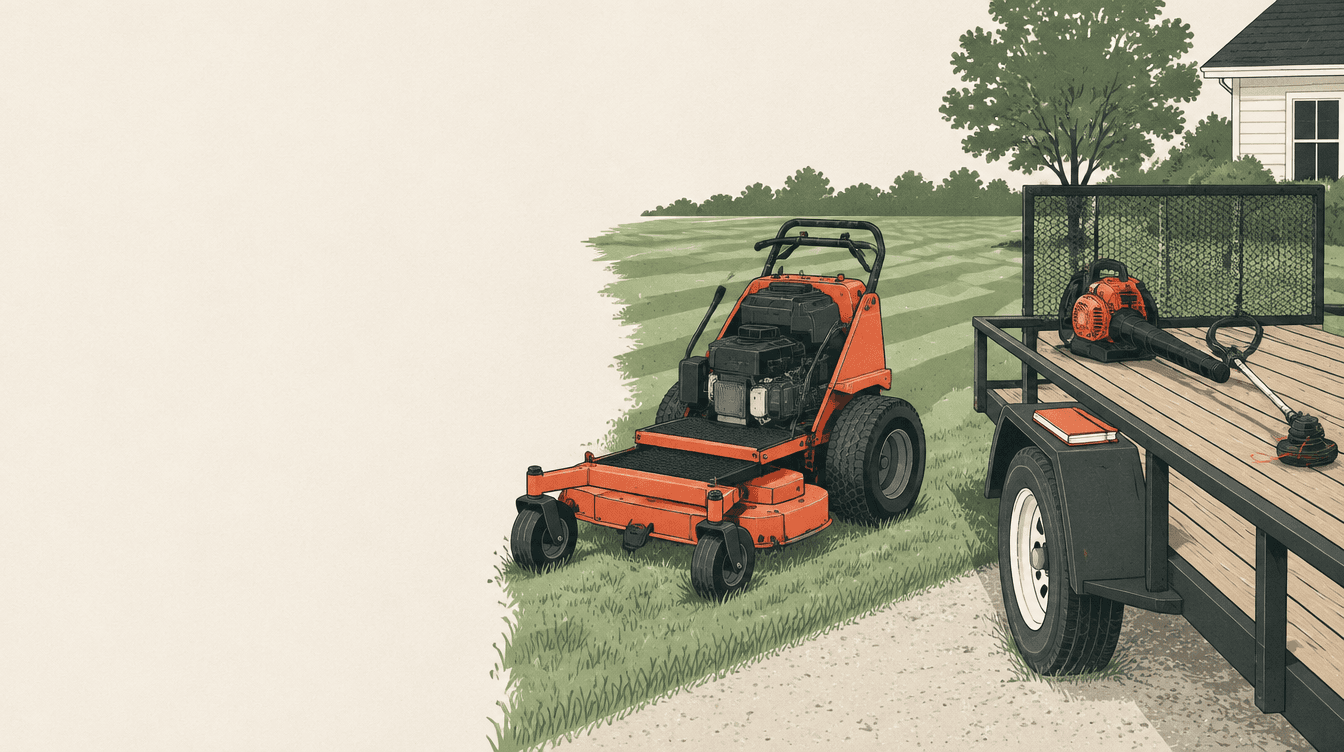
A hypothetical starter kit: commercial mower $9,000, trimmer, edger and blower $1,800, 6x12 trailer $3,000, spreader $500, hand tools and safety gear $700. That's $15,000, paid back over three years at $5,000 a year.
| Overhead line (hypothetical) | Per year |
|---|---|
| General liability and equipment insurance | $1,800 |
| Truck: fuel, maintenance, insurance | $7,000 |
| Equipment payback ($15,000 over 3 years) | $5,000 |
| Equipment fuel, blades and repairs | $2,400 |
| Phone and software | $1,200 |
| Marketing: website, signs, door hangers | $1,500 |
| Accounting and tax prep | $600 |
| Registration and licenses | $400 |
| Total overhead | $19,900 |
Use real quotes where you have them and round up where you don't. Buying used equipment lowers the payback line, and so does a longer payback period, as long as the gear lasts that long.
6. Set your price from your own numbers
Your price starts from what one billable hour costs the business. Here's the math with hypothetical first-year numbers.
- Your pay. O*NET lists the national median for landscaping and groundskeeping workers at $39,150 a year (2025). Treat it as a floor: if the business pays you less, you'd earn more working for someone else.
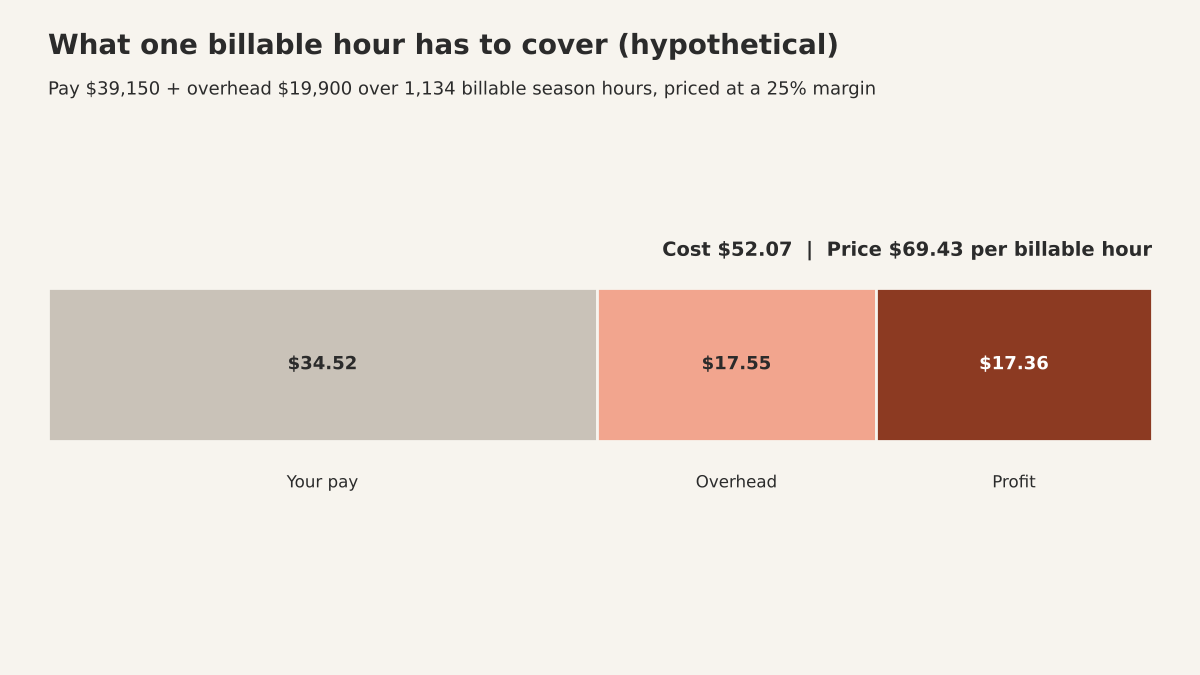
- Billable season hours. 36 weeks × 45 hours = 1,620 hours. Driving between yards, loading, quoting and supply runs take a share, so at 70% billable that's 1,134 hours.
- Cost per billable hour. ($39,150 + $19,900) ÷ 1,134 = $52.07.
- Price with a margin. At a 25% margin: $52.07 ÷ 0.75 = $69.43 per billable hour, plus materials on project work.
Turn it into a per-visit price. A weekly mow that takes 40 minutes on site plus 10 minutes of drive and loading is 50 minutes: $52.07 × 50 ÷ 60 = $43.39 of cost. At a 25% margin, $43.39 ÷ 0.75 = $57.85, so about $58 a visit.
That $58 comes from these hypothetical inputs. It's not a market rate. If your market won't pay it, you have three levers: tighter routes, more billable hours (fall cleanups, snow plowing in winter) or lower overhead. Run your own numbers in the hourly rate calculator and price single lawns with the lawn care pricing calculator. For beds, mulch and installs, use how to price landscaping jobs.
7. Set up estimates, invoices and payments
Decide how you'll quote, bill and get paid before the phone rings in March. Spring is when you're slowest to answer and customers are quickest to call someone else.
- Estimates: per-visit price for maintenance, line items for projects, and an expiration date when material prices move.
- Payment terms: a deposit on projects with materials, and a clear due date for maintenance. See contractor payment terms.
- Invoices: send them the same day, or batch maintenance invoices on a set day each month, and take cards so customers can pay without a check.
WinPal is a mobile and web app for contractors and home-service pros that handles the paperwork around jobs: estimates, invoices, payments, jobs and schedules, customer info, expenses and reports. You can turn a photo and a voice note into a first-draft estimate, then invoice from your phone and let clients pay online. See how it fits a landscaping business, and plan costs on the pricing page.
8. Land your first customers and plan the winter
Your first customers come from close by. Build a tight route before you build a big one.
- Tell friends, family and neighbors, and ask each one for a name on their street.
- Set up a free Google Business Profile with your services and service area.
- Door-hang the streets around every yard you already mow. A new stop next door costs you almost no drive time.
- Ask every happy customer for a review after the first month.
Then plan the off-season before you need it: fall cleanups, leaf removal, snow, or a winter job. The overhead keeps running from November to March, so the plan has to pay for it.
Common questions about starting a landscaping business
Do I need a license to start a lawn care business?
Mowing usually doesn't need a trade license, but your city may require a general business license. Applying pesticides for pay needs certification, and some states license irrigation work, like Texas. Bigger projects can need a contractor license: California's unlicensed limit is $1,000 per job with no building permit.
How much does it cost to start a landscaping business?
It depends on the equipment you already own. This guide's hypothetical starter kit costs $15,000 for a commercial mower, trimmer, edger, blower, trailer, spreader and hand tools, and the first-year overhead comes to $19,900 including equipment payback. The EIN is free. Buying used gear lowers both numbers.
Should I start with lawn care or landscaping?
Lawn care is cheaper to start and pays every week, so most solo operators begin there. Landscaping projects pay more per job but need more equipment, more pricing work and sometimes a license. Many businesses mow first and add beds, mulch and planting once their mowing customers ask.
Do I need an LLC for a landscaping business?
No. You can start as a sole proprietor, the default when you own an unincorporated business by yourself. An LLC is a state filing that can separate business and personal assets, with fees and yearly paperwork set by your state. It doesn't replace liability insurance or a license. Ask a local accountant which fits.
What to do this week
Check your state's license, pesticide and irrigation rules, get your EIN, call two insurance agents, and work out your cost per billable hour. Then write your first per-visit price from it.
Already sent a quote? Upload it to the estimate checker and see if it's priced too low. Starting out in another trade? See how to start a handyman business or, for commercial work, how to bid commercial plumbing jobs.