How to Price Snow Plowing Jobs: Per Push, Per Event or by the Season
Price one push from your hourly cost, then build per-event and seasonal prices from it. Includes a worked $190-a-push office lot and what a heavy winter does to a seasonal contract.

To price snow plowing jobs, work out what one push costs you: the hours on site plus the drive, times your hourly cost for the driver, the truck and plow, and overhead. Price salt as its own line. Divide by one minus your margin to get a per-push price, then build per-event and seasonal prices from that same number.
Price per push = (hours × hourly cost) ÷ (1 − margin).
A small office lot that takes 1.2 hours at $95 an hour costs you $114 a push. At a 40% margin: $114 ÷ (1 − 0.40) = $190 a push.
Snow has one problem the rest of your work doesn't: nobody knows how many times you'll show up. A seasonal contract is where that guess turns into profit, or into a long, cold winter of plowing for free.
This guide is for landscapers and contractors adding snow work, residential or small commercial. Amounts are in US dollars and the example is hypothetical: the rates and costs are placeholders to replace with your own, not market prices.
Mowing the same commercial lots in summer? The bid math for that side of the account is in how to price commercial lawn care.
1. Should you charge per push, per event, per hour or by the season?
Start with a per-push price, because every other model is built from it. Then pick the model for each customer based on who carries the risk of a heavy winter.
| Model | You get paid | Who carries a heavy winter | Fits |
|---|---|---|---|
| Per push | Each time you plow | Customer | Driveways, small lots, new customers |
| Per event | Each storm, by depth tier | Shared | Lots that need plowing and salt every storm |
| Hourly | Time on site | Customer | Loader work, stacking, hauling snow |
| Seasonal | A fixed amount, in installments | You | Steady accounts, predictable cash flow |
Per push and hourly are the safest for you. Seasonal is the steadiest money, and the one that can go sideways. Section 6 shows how far.
2. What does one push cost you?
Your hourly cost to run the truck and plow, times the hours a push takes, drive included. Get the hourly cost right and the rest is arithmetic.
- Labor: the driver's wage plus payroll taxes and workers' comp. If the driver is you, pay yourself a real rate.
- Truck and plow: fuel, cutting edges, hydraulic repairs, and a share of what the truck and plow cost to buy. Plowing is hard on a truck.
- Overhead: insurance, phone, software, the shop, and the nights you sit waiting for a storm that doesn't come. Get a real quote for snow liability coverage before you price. Don't guess it.
The example uses $40 an hour of loaded labor, $30 for the truck and plow, and $25 of overhead: $95 an hour. If you don't know your own numbers, the contractor hourly rate calculator works out labor and overhead per hour from your costs.
Then time the push: plowing, shoveling or blowing the walks, and the drive from the last stop. The truck is on the clock the whole time, even while you shovel.
Drive time is the line that kills snow margins. Ten stops on a tight route make money. Ten stops spread across town make traffic.
3. How do you price salt and ice melt?
Per application, as its own line. Salt is a material plus spreader time, and some storms need two salt runs and no plowing at all.
In the example, one application is 300 lb of bulk salt at $0.12 a pound ($36) plus 0.2 hours of spreading at $95 ($19). That's $55 of cost, or $91.67 at a 40% margin. Round to $92.
Calibrate your spreader and track pounds per application. Minnesota's Smart Salting program says participating organizations "have been able to cut their salt use by 30-70 percent, reducing costs for product" (Minnesota Pollution Control Agency). On a seasonal contract, salt you don't throw is margin you keep.
4. Worked example: pricing a small office lot per push
The job (hypothetical): a dental office with a 20-space lot and a front walk. 2-inch trigger, cleared before 7 a.m.
Hourly cost $95 (labor $40, truck and plow $30, overhead $25). Margin 40%.
| Line | Math | Cost |
|---|---|---|
| Plow the lot | 0.6 hr × $95 | $57 |
| Shovel and blow the walks | 0.3 hr × $95 | $28.50 |
| Drive share from the last stop | 0.3 hr × $95 | $28.50 |
| Cost per push | 1.2 hr × $95 | $114 |
| Price per push at 40% margin | $114 ÷ 0.60 | $190 |
| Cost per salt application | 300 lb × $0.12 + 0.2 hr × $95 | $55 |
| Price per salt application | $55 ÷ 0.60, rounded | $92 |
$190 leaves $76 of profit per push, which is 40% of the price.
Why 40% and not the 30% you might use on a paint job? Snow is night work on short notice, with equipment that breaks at 3 a.m. and a liability risk every time someone walks across that lot.
Margin is your call; the profit margin calculator shows the price at any margin.
5. How do you price snow removal per event?
Per-event pricing bundles the pushes and salt a storm usually needs into tiers by snowfall depth. Build each tier from your per-push and per-salt prices.
| Snowfall | Usually takes | Price per event |
|---|---|---|
| 2 to 6 in | 1 push + 1 salt | $282 |
| 6 to 10 in | 2 pushes + 1 salt | $472 |
| 10 to 14 in | 3 pushes + 1 salt | $662 |
| Over 14 in | Hourly, plus stacking or hauling | Quoted per storm |
Write down how depth is measured (on site, or at a named weather station) and what counts as one event, for example snowfall with less than a 12-hour break. That's the line customers argue about in March.
6. How do you price a seasonal snow contract?
Multiply your per-push and per-salt prices by the visits a normal season needs, then cap the visits the price covers. Without a cap, one heavy winter can take your whole margin.
Start with your own records: how many pushes and salt runs each account needed in past winters.
No records yet? NOAA's 1991 to 2020 climate normals include snowfall averages, and more than 5,700 stations report snowfall and snow depth normals (NOAA NCEI). Average inches are a starting point, not a visit count: you still have to turn inches into pushes at your trigger depth.
For the office lot, say a normal season is 14 pushes and 18 salt applications:
14 × $190 + 18 × $92 = $2,660 + $1,656 = $4,316 for the season.
Billed as five payments of $863.20, November through March.
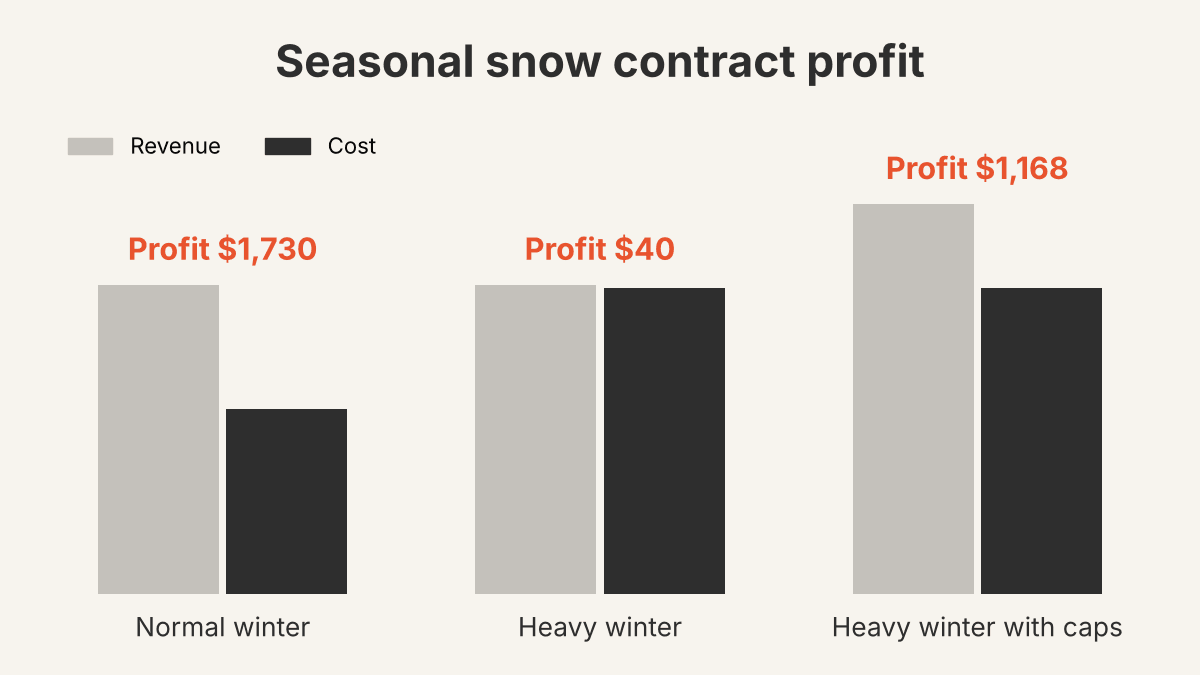
Here's what the weather does to that same price:
| Winter | Visits | Your cost | Revenue | Profit |
|---|---|---|---|---|
| Light | 6 pushes, 9 salt | $1,179 | $4,316 | $3,137 |
| Normal | 14 pushes, 18 salt | $2,586 | $4,316 | $1,730 |
| Heavy | 24 pushes, 28 salt | $4,276 | $4,316 | $40 |
| Heavy, with caps | 24 pushes, 28 salt | $4,276 | $5,444 | $1,168 |
The cap in the last row: the seasonal price covers up to 20 pushes and 24 salt applications, and anything beyond that is billed at $190 a push and $92 an application. In the heavy winter that's 4 extra pushes ($760) and 4 extra salt runs ($368), so revenue goes from $4,316 to $5,444.
A light winter is great for you and a sore point for the customer. You can offer a credit or a lower renewal after a light year to keep the account. That's a business call, not a math one.
7. How much should you charge to plow a residential driveway?
Same formula, smaller numbers, plus a minimum.
A double driveway that takes 15 minutes on site and 9 minutes of drive is 0.4 hours. At $95 an hour that's $38 of cost, or about $63 at a 40% margin. Round up to $65.
Driveways live or die on route density. Sign up neighbors on the same street and the drive per stop drops. A driveway across town with a 20-minute drive each way isn't a $65 job anymore.
Set a minimum per visit so a short driveway still covers the stop. Price walks, steps and the mailbox as extras, not favors.
8. What should a snow plowing contract say?
Everything the customer will argue about after the first storm. Put it in writing before the first flake:
- Trigger depth: plowing starts at, say, 2 inches. Zero-tolerance service (cleared at any snowfall) means more visits and should be priced that way.
- Service window: cleared by 7 a.m. for a business, or within a set number of hours after the snow stops.
- What's included: lot, walks, steps, how many salt applications, and where snow gets piled.
- Caps and overages: the pushes and salt runs a seasonal price covers, and the rates beyond them.
- Exclusions: stacking, hauling, roof clearing, damage to unmarked curbs or landscaping.
- Payment terms: an invoice after each storm for per-push and per-event work; fixed installment dates for seasonal.
Our guide to contractor payment terms covers deposits, due dates and payment schedules you can put in the same contract.
9. How do you bill snow work without losing track?
Invoice right after each storm, while the log is fresh: date, time, depth, pushes, salt applications. A customer who gets a $472 invoice the morning after a 9-inch storm pays it. One who gets a stack of invoices in April starts asking questions.
In WinPal you can make the estimate from a photo and a voice note in the lot, then invoice from your phone and let the customer pay online.
If you price spring and summer work too, our guide to pricing landscaping jobs uses the same formula. Doing remodel work over the winter instead? Here's how to estimate construction costs line by line.
Common questions about pricing snow plowing
How much should I charge for snow removal?
Work it out from your own costs. Time a typical visit including the drive, multiply by your hourly cost for labor, truck, plow and overhead, add salt per application, then divide by one minus your margin. In our hypothetical office lot, that's $190 a push and $92 per salt application at a 40% margin.
Is it better to charge per push or per season?
Per push protects you in a heavy winter, because every visit gets paid. A seasonal contract gives you steady income and the customer a fixed budget, but you carry the weather risk. If you sell seasonal, cap the pushes and salt applications it covers and bill extras at your per-push and per-application prices.
How do you bid a commercial snow removal job?
Walk the site and measure the lot, the walks and where snow can be piled. Time the plowing and salting, add the drive, and price one push and one salt application from your costs. Then offer per-push, per-event or seasonal pricing built from those numbers, with the trigger depth and service window in writing.
What is a trigger depth in snow plowing?
The snowfall depth at which plowing starts, written into the contract, for example 2 inches. Below the trigger you might only salt. A lower trigger, or zero tolerance, means more visits in the same winter, so it should cost more per season.
What to do before the first storm
Time each account, price one push and one salt run, then build the per-event or seasonal price with a cap. Get it signed before the forecast turns.
Already sent your snow quotes? Upload one to the estimate checker and see if it's priced too low.
Want to quote from the lot and invoice the morning after? Get started with WinPal.