How to Price Commercial Lawn Care Contracts That Pay for the Whole Season
Time a visit from your mower's real output, cost it per person-hour and bid the season. Includes a 2.5-acre office property priced at $8,503 a year.

To price commercial lawn care, time one visit from your mower's real output, cost it out with loaded labor, equipment and overhead, multiply by the number of visits in the season, add the extras in the scope, then divide by one minus your margin. Bid the season as a contract, not a per-cut price you made up in the parking lot.
Price = (cost per visit × visits + extras) ÷ (1 − margin).
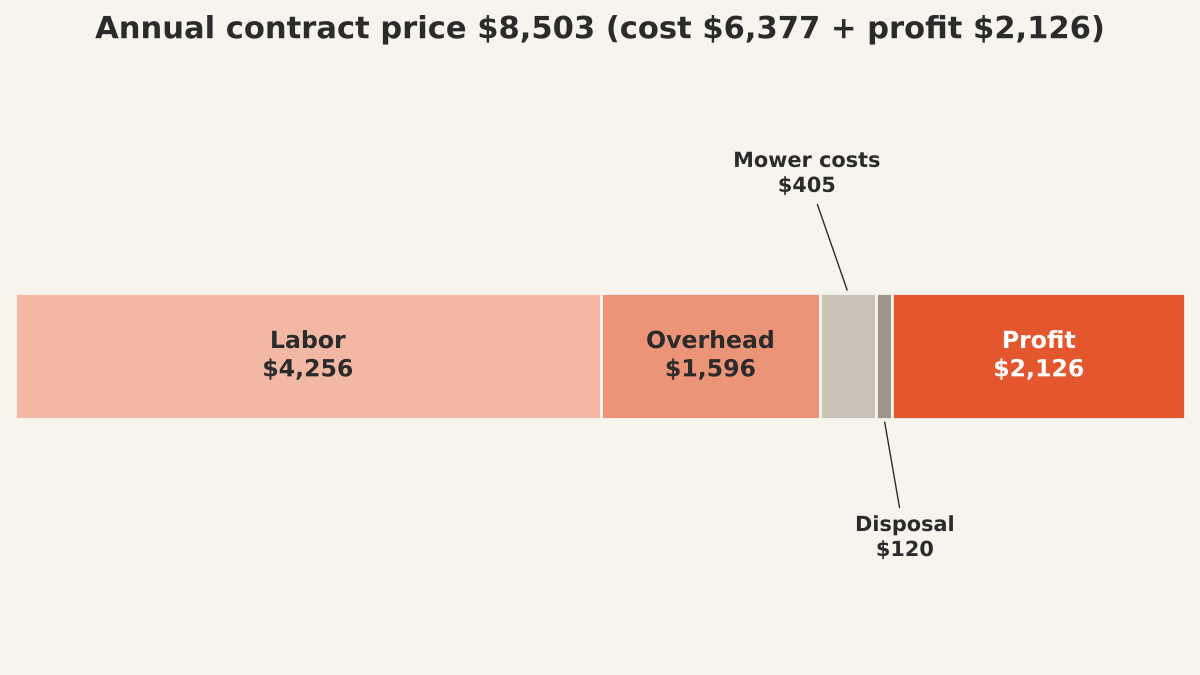
A 2.5-acre office property, 30 visits plus two cleanups: $6,377 in costs ÷ 0.75 = $8,503 a year at a 25% margin, or $708.58 a month over 12 months. Hypothetical, worked below.
Commercial accounts are where lawn businesses get steady, and where they quietly mow for free. One bad bid is a whole season of the wrong price, every week, with a property manager who's happy to renew it.
This guide covers office parks, retail lots, HOAs and small commercial properties. US dollars, a hypothetical example, and your own rates swapped in. For residential lawns, the lawn care pricing calculator does the per-visit math; it tells you to switch to a bid like this one above 5 acres.
1. Walk the property and write down the scope
Every commercial bid starts with a scope sheet: what gets done, how often, and what's not included. If the property manager sent a spec, price their spec. If not, write one, because the scope is what you'll point to in July when they ask for "just one more thing".
- Turf area in square feet or acres, split by what you'll mow it with: open areas for the rider, tight areas and slopes for the walk-behind or trimmer.
- Linear feet of edging along curbs and walks, and the beds and fence lines to trim.
- Frequency. Weekly in the growing season is common. Ask how they want it handled when growth slows or it rains.
- Extras. Spring and fall cleanup, leaf removal, mulch, shrub pruning, fertilization, irrigation checks. Each one gets its own line and its own price.
- Site rules. Hours you can work, noise limits, where the trailer parks, insurance certificates they need, who signs off on the work.
Measure the turf on a satellite map or the county parcel viewer before the walk, then check it on foot. The parcel size includes the building and the parking lot. You don't mow those.
2. Time one visit from your mower's real output
Mowing time comes from three numbers: ground speed, deck width and how much of the time you're actually cutting. The formula is acres per hour = speed (mph) × cutting width (ft) × efficiency ÷ 8.25.
The 8.25 isn't magic: one mile is 5,280 feet, one acre is 43,560 square feet, and 43,560 ÷ 5,280 = 8.25. Efficiency is the share of the time the blades are on uncut grass, after turns, overlap and obstacles. It's the same method farm machinery guides use to estimate field capacity (Iowa State University Extension, Estimating Field Capacity of Farm Machines).
A 61-inch zero-turn (5.08 ft) at 6 mph and 75% efficiency: 6 × 5.08 × 0.75 ÷ 8.25 = 2.77 acres per hour. The same 2.5 acres takes about 0.9 hours on that rider and nearly 2 hours with a 48-inch walk-behind at 3.5 mph. That gap is your bid.
Then add the parts that aren't mowing: string trimming, edging, blowing off walks and lots, and the drive. Time them on a similar property or use your own logs. A stopwatch on two of your current accounts is better data than any rule of thumb.
3. Cost per visit: labor, equipment and overhead
Cost each visit in person-hours, not crew-hours, and use your loaded labor rate. Loaded means wage plus payroll taxes, workers' comp and the rest of what an hour of a person costs; the hourly rate calculator builds it from your own numbers.
- Labor: mowing hours, plus trim, edge and blow hours, plus drive and setup for everyone in the truck.
- Mower costs: fuel, blades, oil and wear, as a cost per mower hour. Your fuel and repair receipts over a season divided by the hours on the meter gets you close.
- Overhead: truck, trailer, insurance, phone, software, the office hours. Spread it over the person-hours you bill in a year and add it per hour.
Disposal goes on its own line for cleanups. Clippings you mulch don't cost anything to dump; leaves in a trailer do.
4. Worked example: a 2.5-acre office property
Hypothetical bid. A two-building office property with 2.5 acres of open turf, curbs and walks to edge, beds to trim. Weekly mowing for 30 visits, plus a spring and a fall cleanup.
Crew of two. Rates are assumptions for a mid-cost US market; swap in yours.
| Per mowing visit | Qty | Rate | Cost |
|---|---|---|---|
| Mowing, 61-inch zero-turn (2.5 acres ÷ 2.77 acres/hr) | 0.9 hr | $32 | $28.80 |
| Trim, edge and blow | 2.0 hr | $32 | $64.00 |
| Drive and setup (2 people × 0.5 hr) | 1.0 hr | $32 | $32.00 |
| Mower fuel, blades and wear | 0.9 hr | $15 | $13.50 |
| Overhead | 3.9 hr | $12 | $46.80 |
| Cost per visit | $185.10 |
Now the season. Each cleanup is 2 people × 4 hours: $256 labor, $96 overhead, $60 disposal, $412 total.
| Season line | Qty | Each | Cost |
|---|---|---|---|
| Mowing visits | 30 | $185.10 | $5,553 |
| Spring and fall cleanups | 2 | $412 | $824 |
| Total cost | $6,377 | ||
| Price at 25% margin ($6,377 ÷ 0.75) | $8,503 |
That's $2,126 of profit for the year after everyone's wages, including yours. Per mowing visit the price works out to $246.80 ($185.10 ÷ 0.75), or about $98.72 per acre. Billed in 12 equal payments, it's $708.58 a month; over an 8-month season, $1,062.88.
The profit margin calculator shows the margin and markup side by side if you want to test 20% or 30% on the same costs.
5. Per visit, per month or per season
Many property managers want a fixed monthly number for budgeting. You want to be paid for the work you do. A season contract split into equal months does both, as long as the visit count in the contract matches the visit count in your math.
Write down the number of visits the price includes.
If the contract says "weekly mowing" with no number and the season runs to 34 visits, the last four are free. If you price per visit instead and a dry August cuts the season to 26, your $246.80 visit brings in $6,416.80 instead of $7,404. Either way, say how skipped visits are handled.
Plowing the same lots in winter? A year-round account smooths your cash flow, and the per-push math is in how to price snow plowing jobs.
6. What a commercial lawn bid should say
A commercial bid is a contract, so write it like one. Property managers compare bids side by side, and the one with a clear scope looks like the safer vendor even when it isn't the cheapest.
- Property address and a map or description of the areas you maintain.
- Services and frequency, with the number of mowing visits included.
- Extras with their own prices: cleanups, mulch, pruning, leaf removal.
- An hourly or unit rate for extra work, so add-ons aren't negotiated from scratch. In the example, $32 loaded labor plus $12 overhead at a 25% margin is $58.67 a person-hour.
- Term, renewal and how either side can end it.
- Payment terms: monthly amount, due date, accepted payment methods.
- What's excluded: irrigation repairs, storm cleanup, tree work, anything they'll otherwise assume.
On payment, some commercial accounts pay by card, some by bank transfer. A $708.58 monthly invoice by card costs about 2.9% to collect; the options are in how to accept credit card payments as a contractor. Deposit and due-date wording is in contractor payment terms.
7. How to get commercial landscaping contracts
Commercial work usually comes through property managers, HOA boards and facility managers, and much of it is put out to bid. Get on their vendor list, show up to the walk-through, and turn the bid around fast with a clean scope.
Start small: a single office building or a small retail strip near your residential routes. Route density is what makes commercial pay, because the drive is a line on every visit. A property ten minutes from three of your current lawns is worth more to you than a bigger one across town.
If you're already pricing residential installs and maintenance, the method in how to price landscaping jobs carries over. Commercial just adds the season, the contract and a buyer who reads every line.
In WinPal you can build the bid from photos and a voice note on the walk-through, send it from the truck, and invoice the account from the same job each month. See how it works for landscaping businesses.
Property managers who hire you for the grounds often need the building cleaned too. If you add that service, the production-rate math is in how to bid on janitorial contracts.
Common commercial lawn care pricing questions
How much should I charge for commercial mowing?
What your cost per visit divided by one minus your margin comes to. In the example, a 2.5-acre property with trimming and edging costs $185.10 a visit and prices at $246.80 at a 25% margin. Rates per acre vary with obstacles, mower size and drive time, so build each bid from timed hours, not a market average.
How do you price commercial lawn care per acre?
Divide your price per visit by the turf acres. The example comes to about $98.72 per acre per visit. Use per-acre numbers to sanity-check a bid or answer a phone question, not to build the price, because a wide-open acre and an acre of islands and slopes don't take the same hours.
Should commercial lawn contracts be monthly or per visit?
Monthly is what many property managers ask for, and it smooths your cash flow. Make it a season price divided into equal payments, state how many visits it includes, and say what happens when visits are skipped for weather or slow growth. Per visit is simpler when the frequency is uncertain.
What margin should I use on commercial lawn bids?
Pick the margin that covers your risk and still wins work; this guide uses 25% as an example. Price with margin, cost ÷ (1 − margin), not markup. A 25% markup only leaves 20% of the price as profit, and over 30 visits that difference is real money.
What to do before your next commercial walk-through
Measure the turf, time a visit from your mower's real output, cost it per person-hour, count the visits, add the extras, divide by one minus your margin. Then write the visit count into the bid.
Already sent a commercial bid? Upload it to the estimate checker and see if it's priced too low.