How to Start a Handyman Business: 8 Steps From License to First Invoice
Eight steps to start a handyman business, from state license limits and a free EIN to a hypothetical first-year budget and a rate built from your own costs.
To start a handyman business, pick the services you'll offer and check your state's license limits, register the business and get a free EIN, buy liability insurance, budget your first-year overhead, and set a price from your own costs. Then set up estimates, invoices and payments before the first call comes in.
Cost per billable hour = (your yearly pay + yearly overhead) ÷ billable hours.
Hypothetical: ($49,590 + $13,000) ÷ 1,300 hours = $48.15. Price above that, never below. Worked below.
Skip the business plan template with 30 pages. A handyman business lives or dies on three things: doing legal work, charging enough, and getting paid on time.
Scope: US solo handymen starting out. Budgets and rates below are hypothetical; tax and license rules point to the official source, so check your state. Already running? Jump to how to price handyman jobs.
1. Decide what you'll do, and what you legally can't
Start with a short list of services you can do well and quote fast. Then cross off anything your state says needs a contractor or trade license.
Your handyman services list is the place to start: 40 common services in eight groups, each with a pricing method.
The license line moves by state. In California, unlicensed work is limited to jobs under $1,000 in total labor and materials that need no building permit, and you can't advertise as a contractor (Cal. Bus. & Prof. Code § 7048). In Florida, the limit is an aggregate contract price under $2,500 for casual, minor work, and splitting a bigger job into small contracts doesn't count (Fla. Stat. § 489.103(9)).
Check your state's contractor board, and your city, before you print a single business card.
2. Pick a business structure: sole proprietor or LLC
You don't need an LLC to start a handyman business. If you work alone and don't form anything, you're a sole proprietor by default: the IRS defines one as someone who owns an unincorporated business by themselves (IRS, Sole proprietorships).
- Sole proprietor: nothing to file to exist, profit goes on Schedule C of your personal return. Your personal assets aren't separated from the business.
- LLC: a state filing with a fee and yearly paperwork set by your state. It can separate business and personal assets.
An LLC doesn't replace insurance or a license. Ask a local accountant which fits before you file.
3. Register the business, get an EIN, and plan for taxes
Register your business name with your state or county if you'll work under a name that isn't your own. Then get an EIN and open a separate bank account.
The EIN is free. The IRS issues it online in minutes and says you never have to pay a fee for one (IRS, Get an EIN). Sites that charge for it are middlemen.
Self-employment tax is 15.3%: 12.4% for Social Security and 2.9% for Medicare, and it applies once your net earnings from self-employment reach $400 (IRS, Self-employment tax). That's on top of income tax, and nobody withholds it for you. Sole proprietors pay through Schedule SE and estimated payments on Form 1040-ES.
Set aside part of every payment in a tax account the day it clears. April is a bad time to find out.
4. Get insured before the first job
Buy general liability insurance before you set foot in a customer's house. One cracked tile or flooded bathroom can cost more than a year of premiums.
- General liability: covers damage to the customer's property and injuries to others. Customers and property managers may ask for a certificate before you start.
- Commercial auto: your personal policy may not cover a truck used for work. Ask your agent.
- Workers' comp: the day you hire help, check your state's rules.
Get two or three quotes and put the yearly cost in your overhead budget.
5. Budget your first-year overhead
Overhead is everything the business pays for that isn't a specific job's materials. Write it down for a full year, because every hour you bill has to cover it.
| Overhead line (hypothetical) | Per year |
|---|---|
| General liability insurance | $1,800 |
| Vehicle: fuel, maintenance, insurance | $6,000 |
| Tool replacement and consumables | $1,500 |
| Phone and software | $1,200 |
| Marketing: website, signs, cards | $1,500 |
| Accounting and tax prep | $600 |
| Registration and licenses | $400 |
| Total overhead | $13,000 |
Your numbers will be different. Use real quotes where you have them and round up where you don't.
6. Set your price from your own numbers
Your price starts from what an hour of your time costs the business, not from what the guy down the road charges. Here's the math with hypothetical first-year numbers.
- Your pay. O*NET lists the national median for general maintenance and repair workers at $49,590 a year (2025). Use that as a starting target, or your old wage.
- Billable hours. 50 weeks × 40 hours = 2,000 hours, but driving, quoting, supply runs and paperwork eat a lot of it. At 65% billable, that's 1,300 hours.
- Cost per billable hour. ($49,590 + $13,000) ÷ 1,300 = $48.15.
- Price with a margin. At a 30% margin: $48.15 ÷ 0.70 = $68.78 per billable hour, plus materials.
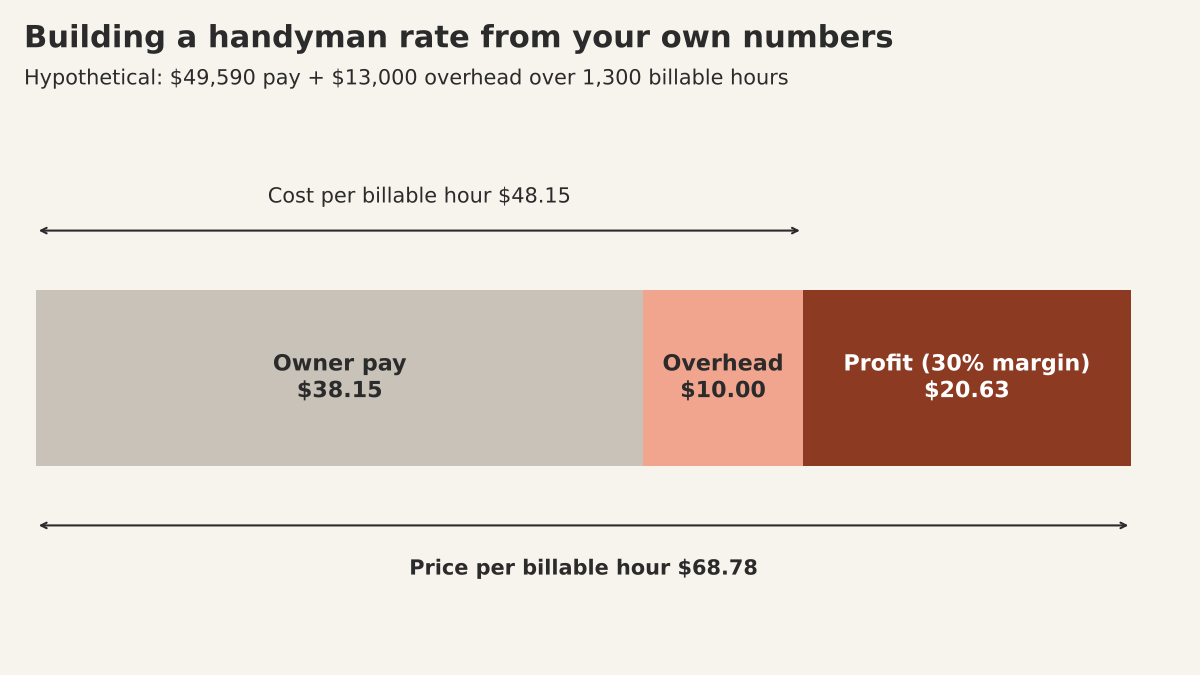
That $68.78 comes from these hypothetical inputs. It's not a market rate. Run your own with the hourly rate calculator, and set a visit minimum so short jobs pay for the drive: 1.5 hours (one on site, half an hour on the road) × $48.15 = $72.23, ÷ 0.70 = $103.19, so a $105 minimum.
7. Set up estimates, invoices and payments
Decide how you'll quote, bill and get paid before your phone rings. A fast, clear estimate wins jobs; a slow one loses them to whoever answered first.
- Estimates: one line per task and a separate trip line, written before you leave the driveway.
- Payment terms: due on completion for small jobs, a deposit when you buy materials. See contractor payment terms.
- Invoices and payments: invoice the same day and take cards, so customers can pay on the spot. See how to invoice as a contractor.
WinPal is a mobile and web app for contractors and home-service pros that handles the paperwork around jobs: estimates, invoices, payments, jobs and schedules, customer info, expenses and reports. You can turn a photo and a voice note into a first-draft estimate, then invoice from your phone and let clients pay online. Plan costs are on the pricing page.
8. Land your first customers
Your first customers usually come from people who already know you. Tell them you're open, and make it easy to say yes.
- Tell friends, family, neighbors and old coworkers, and ask each one for a name.
- Set up a free Google Business Profile with your services list and service area.
- Put your name and number on the truck.
- Ask every happy customer for a review the day the job's done.
Keep a simple list of every lead and every quote. Follow up on quotes after two days. A quote you chase beats one you forgot.
Common questions about starting a handyman business
Do I need an LLC for a handyman business?
No. You can start as a sole proprietor, which is the default when you own an unincorporated business by yourself. An LLC is a state filing that can separate business and personal assets, with fees and yearly paperwork set by your state. It doesn't replace insurance or a license. Ask a local accountant which fits.
Do I need a license to start a handyman business?
It depends on your state. California lets unlicensed handymen take jobs under $1,000 total that need no building permit, and Florida's limit is $2,500 for minor work. Electrical, plumbing, gas and structural work often need a licensed trade. Check your state's contractor board and your city's business license rules.
How much does it cost to start a handyman business?
It depends on the tools you already own. The EIN is free from the IRS. Budget for liability insurance, vehicle costs, tool replacement, phone and software, marketing and registration. This guide's hypothetical first-year overhead comes to $13,000, before any new tools or a truck.
Is a handyman business profitable?
It is when your price covers your pay, your overhead and a margin. Work out your cost per billable hour, divide by one minus your target margin, and add materials. Money leaks through unbilled time: drives, quotes and supply runs. A visit minimum and a separate trip line fix most of it.
What to do this week
Check your state's license limit, get your EIN, call two insurance agents, and work out your cost per billable hour. Then write your first estimate from it.
Already quoted a job? Upload it to the estimate checker and see if it's priced too low. Thinking about outdoor work too? See the landscaping services list.