Lawn Care Pricing Chart: Build Yours From Your Costs
Build a lawn care pricing chart from your cost per labor hour, your mowing times and a target margin. Includes a hypothetical chart by lot size and a full-season example.
A lawn care pricing chart lists a per-visit mowing price for each lot size band, plus fixed prices for the add-ons you sell (aeration, fertilizer, cleanups) and one hourly rate for everything else. Build every number from your cost per labor hour, the minutes each job really takes, and a target margin. Don't copy someone else's chart.
Price per visit = (minutes ÷ 60 × cost per labor hour) ÷ (1 − margin).
Hypothetical 5,001 to 10,000 sq ft lawn: (50 ÷ 60 × $43.41) ÷ 0.65 = $55.65, rounded up to $56 a visit.
Why build it yourself? Because a chart from a crew in another state bakes in their wages, their drive times and their mower. Your margin only shows up if the chart starts from your costs.
Scope: US lawn care and landscaping pros pricing residential maintenance. Every rate below is a hypothetical built from stated assumptions, not a market survey. Need to price one specific lawn right now? The lawn care pricing calculator does a single job. This page is about building the whole sheet.
1. Work out your cost per labor hour
Every line on the chart divides back to one number: what an hour of crew time costs you, with overhead in it.
Labor first. O*NET lists the national median wage for landscaping and groundskeeping workers at $18.82 an hour (2025). Add payroll taxes, workers' comp and other load. This guide assumes 35%, so $18.82 × 1.35 = $25.41 an hour.
Then overhead and equipment: mower and trimmer wear, trailer, fuel, insurance, phone, the hours you spend quoting. This guide assumes $18 per labor hour. Total: $43.41 per labor hour. Both the load and the overhead are assumptions. Swap in yours.
The hourly rate calculator works out your real number from last year's overhead and billable hours.
2. Time each lot size, including the drive
A chart is only as good as its minutes. Time your crew on a few lawns in each size band and include the drive from the last stop, unloading and blowing off the driveway.
This guide assumes mow, trim, edge and blow, with a 10-minute drive and setup inside every visit:
- Up to 5,000 sq ft: 35 labor minutes
- 5,001 to 10,000 sq ft: 50 labor minutes
- 10,001 to 15,000 sq ft: 65 labor minutes
- 15,001 to 21,780 sq ft (half an acre): 85 labor minutes
- 21,781 to 43,560 sq ft (one acre): 130 labor minutes
Labor minutes, not clock minutes. Two people on a lawn for 25 minutes is 50 labor minutes.
3. Pick a margin and use one formula
Use margin, not markup: price = cost ÷ (1 − margin). This guide uses a 35% margin, so every cost gets divided by 0.65.
Small recurring visits carry a lot of drive, setup and admin per dollar, which is why the margin here is fatter than on a big install. If 35% sounds high, run your own numbers through the profit margin calculator before you cut it.
A 35% markup would only give you a 25.9% margin. That gap is real money over a 30-visit season.
4. A hypothetical lawn care pricing chart
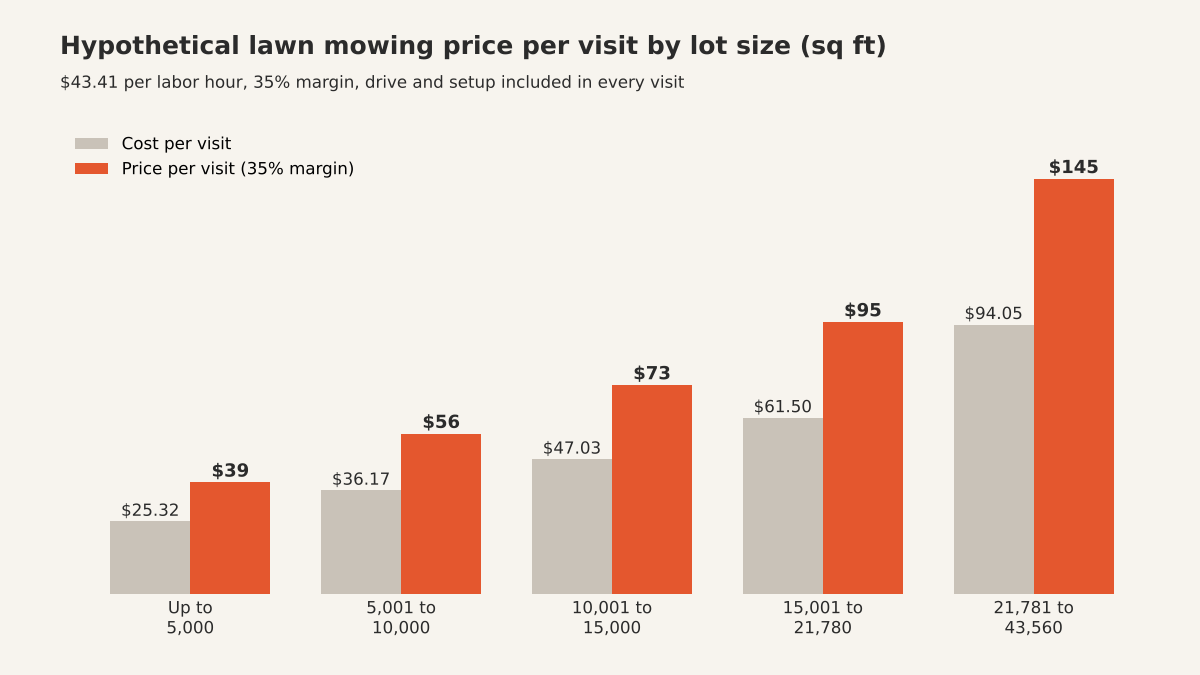
Here's the chart those assumptions produce: $43.41 per labor hour and a 35% margin, every price rounded up to the next dollar.
| Service | Unit | Assumptions | Price |
|---|---|---|---|
| Mowing, up to 5,000 sq ft | per visit | 35 labor minutes | $39 |
| Mowing, 5,001 to 10,000 sq ft | per visit | 50 labor minutes | $56 |
| Mowing, 10,001 to 15,000 sq ft | per visit | 65 labor minutes | $73 |
| Mowing, 15,001 to 21,780 sq ft | per visit | 85 labor minutes | $95 |
| Mowing, 21,781 to 43,560 sq ft | per visit | 130 labor minutes | $145 |
| Core aeration, up to 10,000 sq ft | per job | 45 labor minutes, $25 machine cost | $89 |
| Fertilizer application, up to 10,000 sq ft | per application | 20 labor minutes, $30 product | $69 |
| Cleanups, trimming, extra work | per labor hour | $43.41 cost | $67 |
| Disposal or dump fee | pass-through | your cost ÷ 0.65 | varies |
The math for the 10,001 to 15,000 band: 65 ÷ 60 × $43.41 = $47.03 of cost. Divide by 0.65 and you get $72.35, which rounds up to $73.
5. Worked example: one customer, one season
Hypothetical customer: an 8,000 sq ft lawn, weekly mowing for a 30-visit season, spring aeration, three fertilizer applications, and a fall leaf cleanup that takes 4 labor hours plus a $25 dump fee.
| Line | Math | Price |
|---|---|---|
| Weekly mowing | 30 visits × $56 | $1,680 |
| Core aeration | 1 × $89 | $89 |
| Fertilizer applications | 3 × $69 | $207 |
| Fall leaf cleanup | 4 labor hours × $67 | $268 |
| Dump fee | $25 ÷ 0.65, rounded up | $39 |
| Season total | $2,283 |
The cost side: 30 visits at $36.17 is $1,085.10, aeration $57.56, fertilizer 3 × $44.47 = $133.41, cleanup 4 × $43.41 = $173.64, plus the $25 dump fee. That's $1,474.71 in cost against $2,283 in price, so $808.29 of profit and a 35.4% margin.
Billing it evenly over a seven-month season comes to about $326 a month. Customers like a flat monthly number. You like knowing what's coming in.
6. When the chart doesn't fit the lawn
A chart covers the normal lawn. Quote these by the labor hour or add a line, instead of eating the time:
- Overgrown first cuts. Grass that hasn't been touched in a month can take twice the minutes. Charge the first visit by the hour.
- Slopes, ditches and lots of obstacles. Trampolines, beds and fence lines turn a 50-minute lawn into 70. Move it up a band.
- Bagging clippings. Extra minutes and a dump trip. Add a per-visit line.
- Commercial properties. Different math: acres, crews and contract terms. See how to price commercial lawn care.
Installs (beds, sod, plants) don't belong on a maintenance chart at all. Price those from materials and hours with the method in how to price landscaping jobs.
7. Keep the chart honest every season
Update the chart when your costs move, not when a customer complains. Re-time a few lawns each spring, check fuel and wages, and rerun the formula.
Put the chart where you quote. In WinPal for landscaping you can turn a walk-around into an estimate from a photo and a voice note, then invoice from your phone when the work's done. Check plan details on the pricing page.
Selling more than mowing? The landscaping services list groups 35 services by how to price each one and shows which earn the most per crew hour.
Common lawn care pricing chart questions
How much should I charge to mow a lawn per visit?
Divide your cost for the visit by one minus your margin. In this guide's hypothetical chart, $43.41 per labor hour and a 35% margin give $39 for a lawn up to 5,000 sq ft and $56 for 5,001 to 10,000 sq ft, with drive and setup counted in the minutes.
How do I make a lawn care price sheet?
List your lot size bands and add-on services, time each one with your own crew, and price every line with the same formula: cost ÷ (1 − margin). Round up, add a minimum per visit, and keep one hourly rate for anything that doesn't fit a line.
Should I price lawn care by square foot or by visit?
Measure by square foot, quote by visit. Lot size bands keep the chart short and the customer gets one number per mow. Inside each band, the time per visit matters more than the exact square footage, so check overgrown or obstacle-heavy lawns against the next band up.
How often should I update my lawn care pricing chart?
At least once a year, before spring renewals go out. Re-time a few lawns, update wages, fuel and insurance, and rerun the formula. If your cost per labor hour goes up $3, every price on a 35% margin chart goes up about $4.62 per labor hour.
What to do before you send next season's prices
Time your crew on one lawn in each band, plug your cost per labor hour into the formula, and send prices that start from your numbers.
Already quoted a customer? Upload the estimate to the estimate checker and see if it's priced too low. Bidding bigger commercial work too? The same cost-first math runs through how to bid commercial electrical jobs.