How to Bid Commercial Electrical Jobs: Takeoff to Price
Bid commercial electrical work from the plans: take off devices and footage, turn counts into hours, price labor, materials and job costs, then add margin. Worked example: a hypothetical $28,430 office build-out.
To bid a commercial electrical job, read the whole bid package, take off every device and foot of conduit from the plans, turn the counts into labor hours with your own labor units, then add materials, job costs and overhead, and price the total with a target margin. Write a proposal that lists exactly what you included and excluded.
Bid price = (labor + materials + job costs + overhead) ÷ (1 − margin).
Hypothetical 4,000 sq ft office build-out: $25,017.87 of cost ÷ 0.88 = $28,429.40, rounded to a $28,430 bid at a 12% margin.
Commercial work is a different game from service calls. The general contractor compares your number to three others line by line, the specs decide what you install, and a missed fixture schedule comes out of your margin, not theirs.
Scope: US electrical contractors bidding commercial work (tenant improvements, small retail and office) as a subcontractor or direct to an owner. Rates and labor units below are hypothetical assumptions. For residential and service pricing, see how to price electrical jobs.
1. Read the whole bid package before you count anything
Start with the documents, not the plans. The specs and the bid form decide what the GC expects in your number.
- Drawings: the electrical sheets, plus architectural sheets for ceiling heights and reflected ceiling plans.
- Specs: the electrical section (Division 26 in the MasterFormat numbering many specs use) sets wire type, conduit type, approved manufacturers and testing.
- Fixture and panel schedules: the fixture types and quantities you'll price.
- Addenda: changes issued after the plans went out. Note each one on the bid form.
- Bid form and instructions: due date, bond requirements, alternates, unit prices and how long your price has to stay valid.
Write down every question as you read. A request for information sent before the deadline is cheaper than a change order fight later.
2. Take off devices, fixtures and footage
A takeoff is a count of everything you'll install: each fixture type, each device, every panel and the linear feet of conduit and wire per circuit type.
Count by symbol, sheet by sheet, and mark each one as you go so nothing gets counted twice. Measure home runs and feeders from the panel location, and add vertical drops from the ceiling height on the architectural sheets.
Keep the takeoff in the same line items you'll price. That makes the next step one multiplication per line, and makes your bid easy to check when the GC calls.
3. Turn counts into hours with labor units
A labor unit is the hours one electrician needs to install one item, like 0.5 hours per duplex receptacle. Multiply each count by its unit and add them up.
Your best labor units are your own. Track actual hours on a few jobs by task and compare them with what you estimated. Published labor-unit manuals exist, but they assume conditions that may not match your crew or your jobs.
Adjust for conditions the plans tell you about: high ceilings that need a lift, work in an occupied building, night shifts, or a tight schedule that stacks trades on top of each other.
4. Price labor, materials and the job costs people forget
Labor gets a loaded hourly cost, materials get supplier quotes, and job costs get their own lines.
Labor. O*NET lists the national median wage for electricians at $30.38 an hour (2025). This guide adds a 40% load for payroll taxes, workers' comp and benefits, so $42.53 an hour. Commercial work often pays more, and prevailing-wage jobs set the rate for you (section 6).
Materials. Get quotes on fixtures and gear, then add waste and small parts. Copper prices move, so put an expiration date on the bid. Electrical contractor profit margin covers copper price risk on bids.
Job costs. Permits, lift rental, dumpsters, temporary power, testing and close-out documents.
Overhead. Your office, trucks, insurance, estimating time. This guide charges $15 per labor hour. The hourly rate calculator works out your real number.
5. Worked example: a 4,000 sq ft office build-out
Hypothetical bid: a 4,000 sq ft office tenant improvement with a new 225 A panel. Labor units, material costs and job costs are assumptions.
| Line item | Qty | Hours each | Labor hours | Material each | Material |
|---|---|---|---|---|---|
| 2x4 LED troffers | 60 | 0.75 | 45.0 | $95 | $5,700 |
| Duplex receptacles | 48 | 0.5 | 24.0 | $18 | $864 |
| Switches and occupancy sensors | 12 | 0.6 | 7.2 | $45 | $540 |
| EMT and branch wiring | 1,800 ft | 0.04 | 72.0 | $1.60 | $2,880 |
| 225 A panel, set and terminate | 1 | 16 | 16.0 | $2,400 | $2,400 |
| Exit and emergency lights | 8 | 1.0 | 8.0 | $120 | $960 |
| Totals | 172.2 | $13,344 |
Now price it:
| Cost line | Math | Amount |
|---|---|---|
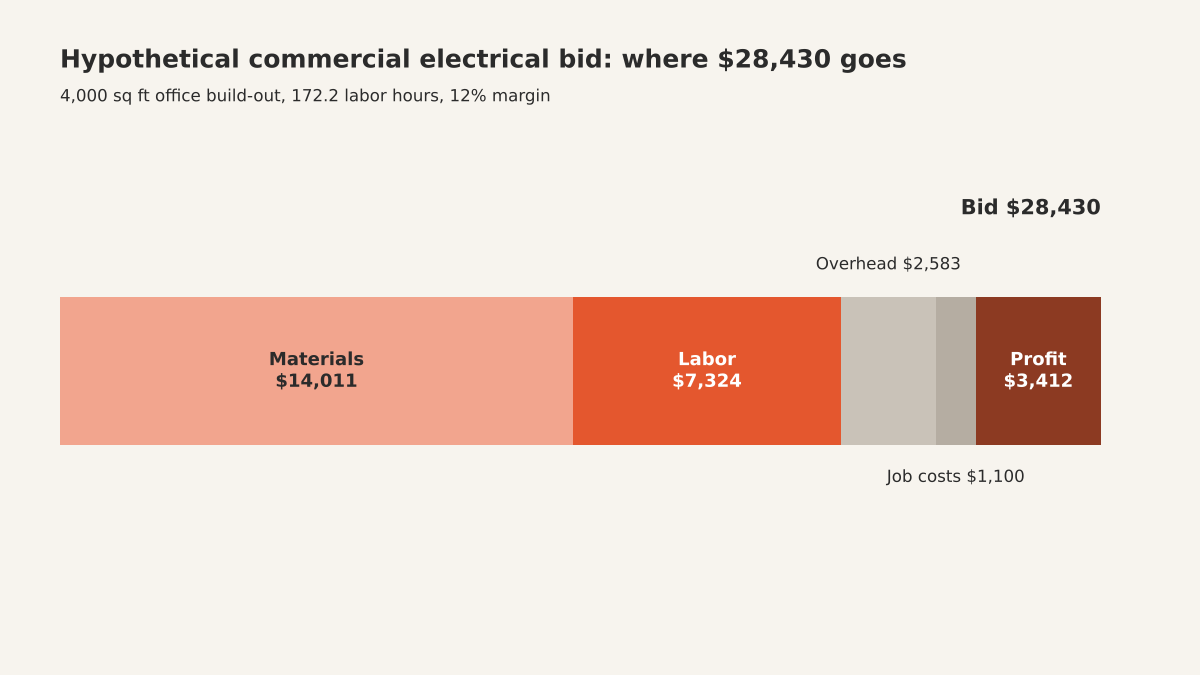
| Labor | 172.2 hours × $42.53 | $7,323.67 |
| Materials | $13,344 + 5% waste and small parts ($667.20) | $14,011.20 |
| Job costs | $450 permit + $650 lift rental | $1,100.00 |
| Overhead | 172.2 hours × $15 | $2,583.00 |
| Total cost | $25,017.87 | |
| Price at 12% margin | $25,017.87 ÷ 0.88 | $28,429.40 |
| Bid | rounded up to the next $10 | $28,430 |
That leaves $3,412.13 of profit, a 12.0% margin, or about $7.11 per square foot. The margin is thinner than on service work because you're competing on a line-by-line bid. That's exactly why the takeoff and the labor units have to be right.
6. The commercial rules that change your number
Commercial and public bids come with terms that cost money. Read them before you price, not after you win.
Bonds. On federal construction, the bonds statute (formerly the Miller Act) requires performance and payment bonds on any construction contract over $150,000 (FAR 28.102-1). When a bid guarantee is required, it must be at least 20% of the bid price, capped at $3 million (FAR 28.101-2). Private owners and GCs can ask for bonds too. The premium is a job cost; ask your surety and put it in before the margin.
Prevailing wage. Federal construction contracts over $2,000 that employ laborers and mechanics must state minimum wages based on prevailing rates set by the Secretary of Labor (40 U.S.C. § 3142). Many states have their own rules. If it applies, the wage determination replaces your labor rate.
Retainage and payment terms. Many contracts hold back part of each payment until the job is done. That's cash you carry, so price it. See retainage.
Changes. Commercial plans change. Know the change order process in the contract before you sign, and use construction change orders to get paid for them.
7. Write a bid proposal the GC can compare
Your proposal is the price plus the rules it's based on. Keep it to one or two pages and use the GC's bid form when there is one.
- Project, drawings and addenda you bid from, by sheet and date.
- Base bid as one number, with alternates and unit prices listed separately.
- Inclusions: what you're installing, in plain words.
- Exclusions: low voltage, fire alarm, trenching, patching and painting, utility fees, overtime, bonds. Whatever you didn't price.
- Clarifications: assumptions you made where the plans were unclear.
- Validity and terms: how many days the price holds, payment terms and retainage.
Exclusions are where bids get compared unfairly. If one bidder includes fire alarm and you don't, say so clearly or the GC will think you're cheap and then expect it for free. A clear construction scope of work helps here too.
Common commercial electrical bidding questions
How do you bid a commercial electrical job?
Read the full bid package, take off every fixture, device and foot of conduit, multiply counts by your labor units to get hours, then add loaded labor, materials with waste, job costs and overhead. Divide the total by one minus your margin and submit a proposal listing inclusions and exclusions.
What profit margin should I use on commercial electrical bids?
There's no single number; it depends on your overhead, the competition and the risk in the contract. The hypothetical example here uses 12% on top of a $15 per labor hour overhead charge. Price bonds, retainage and schedule risk as costs first, then pick the margin.
What should an electrical bid proposal include?
The drawings and addenda you bid from, a base bid number, alternates and unit prices, a plain list of inclusions and exclusions, clarifications of any assumptions, how long the price is valid, and your payment terms. Use the GC's bid form when one is provided.
How is a commercial electrical bid different from a residential one?
Commercial bids are built from plans and specs instead of a walk-through, priced by takeoff and labor units, and compared line by line against other bidders. They often add bonds, prevailing wage, retainage and strict change order rules that residential jobs rarely have.
What to do on your next commercial bid
Track actual hours on your next two jobs so your labor units are yours, then build the bid line by line with the formula above. The general method for any trade is in how to bid construction jobs.
Already have a number? Upload the estimate to the estimate checker and see if it's priced too low. The same cost-first formula also builds a recurring service price sheet, like this lawn care pricing chart.