Construction Contingency: How Much to Add and How to Price It
How much contingency to put in an estimate: the 5 to 10% rule of thumb, a risk-list method that sizes it job by job, and a worked bathroom remodel.

A construction contingency is money you put in your estimate for problems you can't see yet: rot behind the tile, an old pipe that won't take a new fitting, a price that jumps before you order. It's a cost, not profit. Most jobs carry 5 to 10%, but the better number comes from a short list of the risks on this job.
Contingency = the sum of (chance it happens × cost if it does) for each risk you can name.
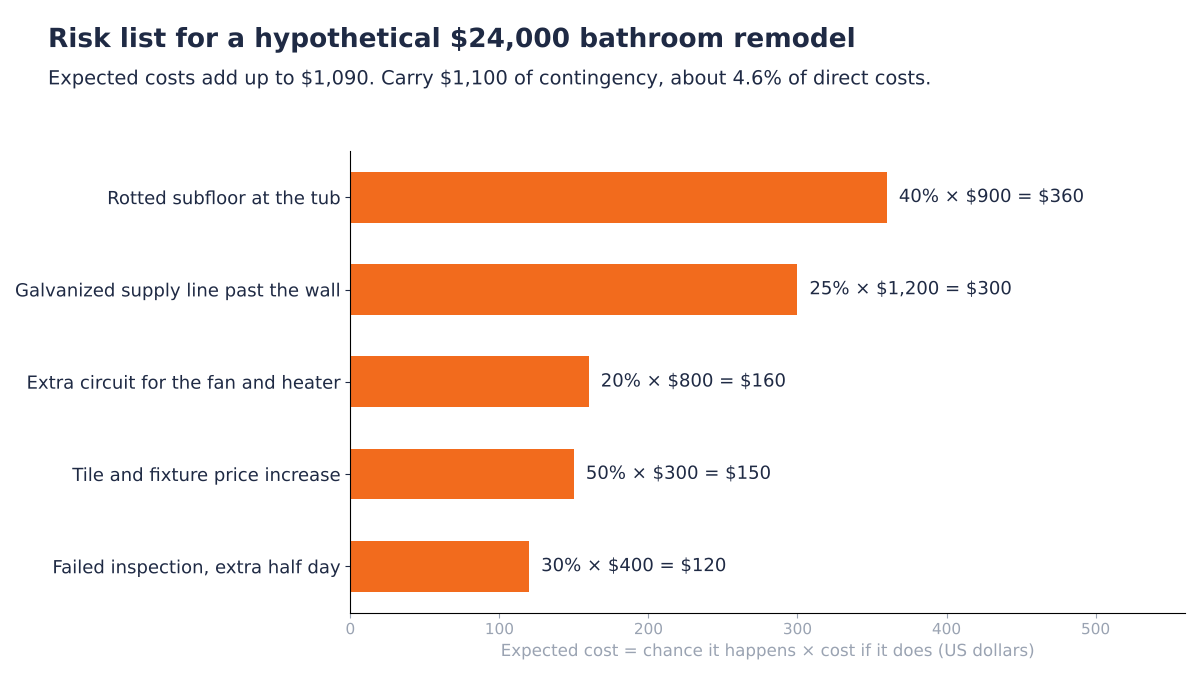
Five risks on a $24,000 bathroom remodel add up to $1,090, so carry $1,100, about 4.6%. Hypothetical, worked below.
Leave it out and the first soft spot in the subfloor comes straight out of your margin. Pad it to 15% on every job and you lose bids to the guy who did his homework.
Scope: small contractors and remodelers pricing residential and light commercial work in the US. US dollars, hypothetical numbers. The full estimate, from takeoff to margin, is in how to estimate construction costs.
1. What is contingency in construction?
It's a reserve inside the budget that isn't tied to any line of work. Procore describes it as money set aside for unforeseen costs, risks, events or scope changes, and says the money "is not allocated to any specific area of work" (Procore).
There are two kinds, and they belong to different people:
- Contractor contingency: in your price, for your risks: quantities you missed, labor that runs long, conditions you couldn't see on the walk-through. Procore says contractors treat it as money already spent.
- Owner contingency: the customer's own reserve for changes they decide to make. It's not in your price. When they use it, it comes to you as a change order.
This guide is about the first one: the number you put in your own estimate.
2. Contingency vs allowance vs markup
Three lines that get mixed up on estimates, and they do different jobs.
| Line | What it covers | Who keeps what's left |
|---|---|---|
| Contingency | Unknowns on your side of the scope | Depends on the contract (section 5) |
| Allowance | Items the customer hasn't picked yet, like a vanity or tile, at a stated amount | The customer pays more if they pick pricier, less if cheaper |
| Markup or margin | Overhead and profit | You, if the job runs to plan |
The common mistake: using contingency as hidden profit, or using profit as a hidden contingency. Do the first and you can't explain your number when the customer asks. Do the second and every surprise eats your pay. Keep them on separate lines in your own estimate, even if the customer only sees one total.
3. How much contingency should you add?
The rule of thumb: "Most projects will use a rate of around 5-10% of the total budget for contingencies" (Procore). The Ohio Valley chapter of Associated Builders and Contractors puts low-risk, well-defined commercial work at 5 to 8% of hard cost, and says the lower end fits residential and small commercial work with mature designs (Ohio Valley ABC).
A range is a sanity check, not an answer. The same source says a flat 5% on every job ignores what's actually different about each one, and suggests starting from the risks you can identify, putting a number on each, and adding them up.
What pushes your number up:
- Old houses, wet rooms and anything behind walls you haven't opened.
- Thin plans, or a customer still deciding.
- Materials you won't order for weeks, at prices that move.
- Work you haven't done before, or a sub you haven't used before.
What pulls it down: new construction, a scope you've built twenty times, firm sub quotes and materials bought up front.
4. Worked example: a risk list for a bathroom remodel
The job (hypothetical): gut and rebuild a bathroom in a 1960s house. Direct costs are $24,000: your crew, materials, subs, permit and dumpster. You walk it and write down what could go wrong, how likely it looks, and what it would cost you.
| Risk | Chance | Cost if it happens | Expected cost |
|---|---|---|---|
| Rotted subfloor at the tub | 40% | $900 | $360 |
| Galvanized supply line past the wall | 25% | $1,200 | $300 |
| Extra circuit for the fan and heater | 20% | $800 | $160 |
| Tile and fixture price increase | 50% | $300 | $150 |
| Failed inspection, extra half day | 30% | $400 | $120 |
| Total | $4,600 | $1,090 |
The chances are your judgment from the walk-through and past jobs. Nobody hands you those numbers. That's fine: a rough guess per risk beats a percentage picked for every job.
Now price it. Overhead is 10% of direct costs, and you want a 25% margin.
- Total cost: $24,000 + $1,100 contingency + $2,400 overhead = $27,500.
- Price: $27,500 ÷ (1 − 0.25) = $36,666.67, so $36,670.
- Profit if nothing goes wrong beyond the plan: $36,670 − $27,500 = $9,170, which is 25%.
Here's what the contingency does when the walls open up. Say the subfloor and the supply line both go bad: $2,100 of extra cost.
| Scenario | Price | Profit | Margin |
|---|---|---|---|
| No contingency, both risks hit | $35,200 | $6,700 | 19.0% |
| $1,100 contingency, both risks hit | $36,670 | $8,170 | 22.3% |
| $1,100 contingency, nothing hits | $36,670 | $10,270 | 28.0% |
The no-contingency price is $26,400 ÷ 0.75 = $35,200. Both risks hitting took $2,100 straight off the $8,800 profit. The contingency didn't cover everything, but it turned a bad job into an OK one.
A flat 10% would have been $2,400 of contingency and a price of $38,400, $1,730 higher than the risk list. On a job you're bidding against two other contractors, that gap matters.
5. Show it on the estimate, or not?
It depends on how the job is priced.
- Fixed price (lump sum): the contingency is part of your cost and sits inside your price. The customer sees one number. If you don't use it, it's yours; if you need more, that's yours too.
- Cost plus or guaranteed maximum price: the customer sees your costs, so contingency is usually a visible line with rules for how it's used and who gets what's left. Procore notes an unused contingency can be distributed to the project participants. Write those rules into the contract.
Which contract you're on changes this a lot. The trade-offs are in types of construction contracts.
Either way, write exclusions for the big unknowns you can't price, like asbestos, structural damage or anything mold-related. Contingency is for the likely small stuff. The big stuff goes on the estimate as "excluded, priced as a change order if found."
6. Track what you used and fix the next number
When the job closes, write down three numbers: contingency carried, contingency used, and what it went on. After ten bathrooms you'll know your real rot rate in 1960s houses, which is worth more than any rule of thumb.
- Used all of it and more on most jobs? Your chances are too low, or the risk belongs in the base estimate as a line.
- Used almost none on most jobs? You may be pricing yourself out of bids.
- Same risk hits every time? It's not a risk anymore. Put it in the scope at its real cost.
Labor overruns count too. If your hours keep coming in long, the fix is a better labor rate and better hour counts, not a bigger contingency. Labor burden covers what a loaded hour really costs.
Contingency is one line in a bigger plan. To see where it sits next to your cost codes, and how buyout and change orders adjust it, read construction budget.
Common construction contingency questions
What is a typical contingency percentage in construction?
Procore says most projects use around 5 to 10% of the total budget. The Ohio Valley chapter of Associated Builders and Contractors puts low-risk, well-defined work at 5 to 8% of hard cost. Treat those as a check on your own number. Build the number from a list of this job's risks, then compare it with the range.
Is contingency the same as profit?
No. Contingency is a cost you expect to spend on problems you can't see yet. Profit is what's left after every cost, including the contingency you used. On a fixed-price job, unused contingency ends up as extra profit, but you shouldn't plan on it. Price your margin as if the contingency gets spent.
What is the difference between contingency and allowance?
An allowance is a set amount for something the customer hasn't picked yet, like fixtures or tile. If they pick something pricier, they pay the difference. A contingency covers unknowns in your own scope, like hidden rot. The customer chooses what an allowance buys; nobody chooses what a contingency covers.
Should contingency be included in the markup?
Yes, if you price with the formula price = cost ÷ (1 − margin). Contingency is part of your cost, so your margin applies on top of it. In the example, the $1,100 contingency adds $1,466.67 to the price, because the margin covers the overhead and profit on that money too.
What to do on your next estimate
Walk the job, list the four or five things most likely to go wrong, put a chance and a cost on each, add them up and compare the total with 5 to 10%. Write exclusions for anything too big to price. After the job, note what you used.
Already sent one without a contingency line? Upload it to the estimate checker and see if it's priced too low. To turn cost into price at the margin you want, use the profit margin calculator.
Pricing a different kind of work, like recurring cleaning jobs? The cost-per-hour method is in how to start a cleaning business.