Roofing Business Profit Margin: Averages and the Math
Roofing companies keep about 5% to 8% net. Here's the IRS benchmark, why commissions belong in the price formula, and a worked $1.2M roofing year.
A typical roofing business profit margin is about 5% to 8% net, with the owner's pay counted as an expense. Roofing has no IRS row of its own, so the closest benchmark is the specialty trade group roofers file under. In tax year 2022, those corporations kept 5.5% of their receipts as net income, and the ones that made money kept 8.3%.
Gross margin is a different number. It depends on your mix of repairs, retail reroofs and builder work, and on whether your sales commissions are in the price.
Gross margin = (revenue − job costs) ÷ revenue. Net margin = (gross profit − overhead) ÷ revenue.
On a hypothetical $1,200,000 roofing year: $412,500 gross profit (34.4%), $345,000 overhead including the owner's pay, $67,500 net (5.6%).
That 5.6% has to cover the warranty callback, the storm season that never came, and the next trailer. Price one reroof wrong a week and it's gone.
Scope: US residential roofing companies doing repairs, replacements and some new construction. Benchmarks dated below, worked example hypothetical. For what the general contractor above you keeps, see general contractor profit margin.
1. What is a good profit margin for a roofing company?
Treat 5% to 8% net as normal and 10% or more as strong, with owner pay already taken out. Under 5%, one bad warranty year or a stretch of rain can erase it.
| Benchmark, tax year 2022 | Figure | What it measures |
|---|---|---|
| Other specialty trade contractor corporations (366,576 returns) | 5.5% net | Net income less deficit ÷ total receipts |
| The 263,930 of them that reported net income | 8.3% net | Net income ÷ total receipts |
| Corporations with no net income for the year | 28.0% | Share of returns |
| Cost of goods sold | 65.2% of business receipts | Leaves about 35% before overhead |
| Officers' pay | 3.0% of total receipts | Owner and officer salaries, deducted before net income |
Source: IRS Statistics of Income, Corporation Complete Report, Tables 5.1 and 5.2, tax year 2022 (Publication 16, September 2025), row "Other specialty trade contractors". Figures are IRS sample estimates.
Why that row? The Form 1120 instructions put roofing under business code 238100, "Foundation, Structure, & Building Exterior Contractors", next to framing, masonry, glass and siding. The corporation tables only break out electrical and plumbing/HVAC, so roofing lands in the "other specialty trade" total with painters, drywallers and flooring installers.
So read it as a neighborhood average, not a roofing average. These corporations also average about $2.2 million in business receipts, bigger than a two-crew shop.
2. Why roofing gross margins look lower than you'd expect
About 35% gross sounds low next to the 40% or 50% you hear quoted on job sites. Two things pull it down.
Labor sits in cost of goods sold. Corporate returns report the cost of labor inside cost of goods sold (IRS Form 1125-A), so crew pay is in that 65.2% next to the shingles and the dumpster.
Materials are a big slice of every reroof. In the reroof example below, the material order is about a third of the price. Percentages drop even when the dollars per job look great.
Net travels better than gross. Your gross margin depends on how you book crew pay, subs and commissions. Net is net. If you file a Schedule C instead, your wage and your profit are mixed in one number; the HVAC profit margin guide walks through that trap with IRS data.
3. Price the commission before you price the margin
If a salesperson gets a percentage of the contract, that percentage comes off the price, not the cost. So it goes in the formula next to your margin: price = cost ÷ (1 − margin − commission rate).
Hypothetical 30-square asphalt tear-off and reroof:
| Job cost line | Cost |
|---|---|
| Materials: shingles, underlayment, ice and water, drip edge, vents, nails (assumed supplier quote) | $4,800 |
| Dumpster and disposal (assumption) | $650 |
| Permit (assumption) | $250 |
| Labor: 4 roofers × 16 hours at $38 loaded | $2,432 |
| Job cost | $8,132 |
The $38 is the O*NET median wage for roofers, $26.65 an hour (2025), plus an assumed 43% for payroll taxes, workers' comp and benefits, rounded.
Target a 35% gross margin after a 10% sales commission (both assumptions): price = $8,132 ÷ (1 − 0.35 − 0.10) = $8,132 ÷ 0.55 = $14,785. That's about $493 a square.
Now the common mistake. Price it at 35% and forget the commission: $8,132 ÷ 0.65 = $12,511. The rep takes $1,251, and you keep $3,128, which is 25.0%. Ten points of margin gone, and the job still looked "priced at 35%".
The same thing happens with financing fees and card fees. Any cost that's a percentage of the price belongs in the denominator.
4. Shingle prices move between quote and install
Material price swings land straight on your margin, because the price is already signed. Watch the time between the quote and the material order.
The producer price index for asphalt shingle and coating materials was 370.4 in September 2026, up 3.7% from a year earlier. It also climbed 8.4% between March and August 2026, from 348.1 to 377.3 (BLS via FRED, series PCU324122324122, not seasonally adjusted; recent months are preliminary).
An 8.4% jump on the $4,800 material order above is $403. On a $14,785 job, that's 2.7 points of margin you didn't plan to give away.
Put an expiration date on every quote, for example 30 days, and reprice anything that sits longer. If a customer signs in March for a July install, say in writing what happens if the supplier's price changes.
5. Worked example: a $1,200,000 roofing year
Take a hypothetical residential roofer: $150,000 in repairs and maintenance at a 60% gross margin, $750,000 in retail reroofs at 35% after commissions, and $300,000 of new construction for builders at 20%. Overhead, including a fair salary for the owner, is $345,000.
| Work type | Revenue | Gross margin | Gross profit | Share of revenue | Share of gross profit |
|---|---|---|---|---|---|
| Repairs and maintenance | $150,000 | 60% | $90,000 | 12.5% | 21.8% |
| Retail reroofs | $750,000 | 35% | $262,500 | 62.5% | 63.6% |
| New construction for builders | $300,000 | 20% | $60,000 | 25.0% | 14.5% |
| Total | $1,200,000 | 34.4% | $412,500 | 100% | 100% |
Subtract $345,000 of overhead and the year nets $67,500, or 5.6%. Right at the IRS group average.
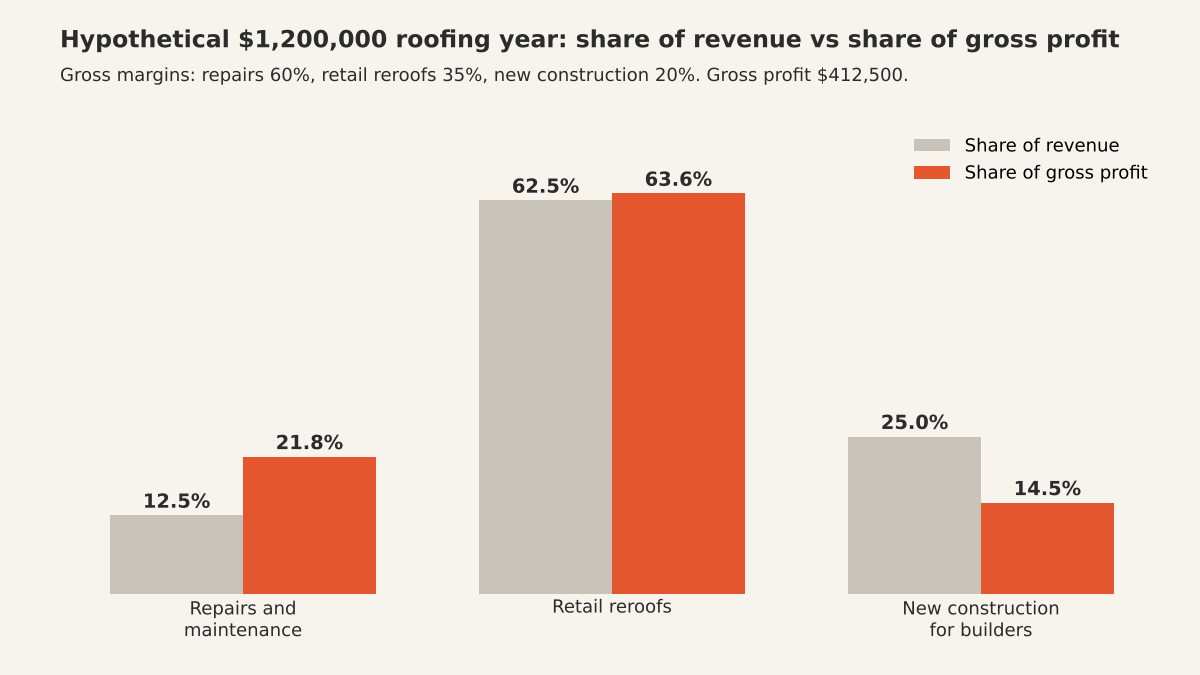
Builder work still helps here: $60,000 toward overhead and steady crew hours between storms. It just pays the least per dollar, and the builder sets the schedule.
6. What moves your net margin
Hold overhead at $345,000 and change one thing at a time. Reroofs are most of the revenue, so their margin swings the year.
| Scenario | Gross profit | Net profit | Net margin | Change vs base |
|---|---|---|---|---|
| Base | $412,500 | $67,500 | 5.6% | |
| Reroof margin slips from 35% to 30% | $375,000 | $30,000 | 2.5% | −55.6% |
| Reroof margin rises from 35% to 40% | $450,000 | $105,000 | 8.8% | +55.6% |
| $50,000 moves from builder work to repairs, same total revenue | $432,500 | $87,500 | 7.3% | +29.6% |
Five reroof points. An unpriced commission, a material increase you ate, an extra layer of decking you didn't charge for. Any one of them can cost five points. In this example, five points is more than half the year's profit.
The other direction. Charge for decking by the sheet, price commission in the denominator, and add the extras the job needs. Five points back is $37,500.
Mix. Shifting $50,000 of capacity from builder work to repairs adds $20,000 of profit without a dollar of new revenue. Only if the repair calls are really there.
Doing insurance work? The paperwork side changes, but the margin math doesn't. See how to invoice for an insurance claim.
7. How to check your own roofing margins
- Split last year's revenue into repairs, retail reroofs, insurance work and builder or new construction work.
- Add up job costs for each: materials, disposal, permits, crew labor at a loaded rate, subs and sales commissions.
- Gross margin for each bucket = (revenue − job costs) ÷ revenue.
- Add up overhead: office, trucks and trailers, insurance, marketing, estimating time, software and your salary.
- Net margin = (total gross profit − overhead) ÷ total revenue.
- Compare each bucket's real margin with the margin you priced in. The gap is the leak: extra labor days, decking, ventilation, flashing, or a commission that never made the price.
The profit margin calculator checks a single job, and the hourly rate calculator builds overhead into your crew rate. Doing siding too? How to bid a siding job runs the same math on walls. Other trades on the same houses run their own numbers, like electrical contractor profit margins.
After the roof is on, the builder brings in a cleaning crew. If that's a sideline for you or a sub you hire, here's how they build a post-construction cleaning price list.
Common roofing profit margin questions
What is the average profit margin for roofing companies?
About 5% to 6% net. Roofing has no IRS row of its own; the specialty trade group it files under reported 5.5% net for tax year 2022, and 8.3% for corporations that made a profit. That's after officers' pay. Repair-heavy shops can beat it; builder-heavy shops often fall short.
What gross margin should a roofer target on a reroof?
There's no official standard, so set it from your overhead and your commission plan. Whatever target you pick, check what's left after commissions. In the hypothetical shop above, 35% after commission on reroofs, 60% on repairs and 20% on builder work produced 5.6% net.
Is a roofing business profitable?
It can be, but not by default. In IRS data for tax year 2022, 28.0% of corporations in the specialty trade group that includes roofing reported no net income. The profitable ones price commissions and material risk into the job and charge for every extra the roof turns up.
How do you calculate profit margin on a roofing job?
Subtract the job's costs, including commission, from the price, then divide by the price. A $14,785 reroof with $8,132 in costs and a $1,479 commission keeps $5,174, a 35% margin. To set a price from a target margin, use price = cost ÷ (1 − margin − commission rate).
What to do on your next roofing estimate
Put commission in the formula, give the quote an expiration date, and list decking and extras as their own lines.
Already sent one? Upload it to the estimate checker and see if it's priced too low.