Good Better Best Pricing for Contractors: How to Build 3 Options
Three options, one margin: how to build, price and present good better best options on your estimates, with a worked water heater job.
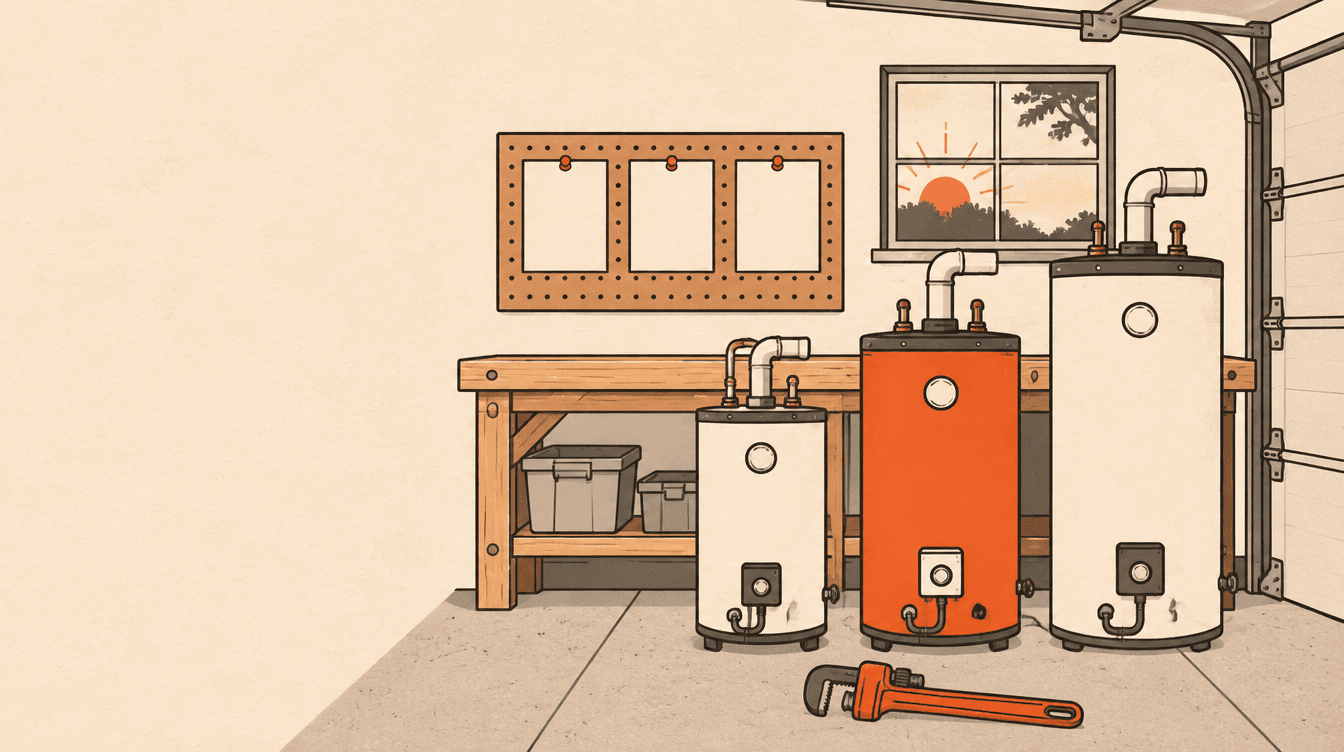
Good better best pricing means giving the customer three versions of the same job at three prices: a basic option, a middle option and a premium one. Instead of a yes or no on your number, they pick which yes. For contractors it works best on replacements and installs where the materials or equipment can change and the labor mostly doesn't.
Price every option from its own cost: price = cost ÷ (1 − margin).
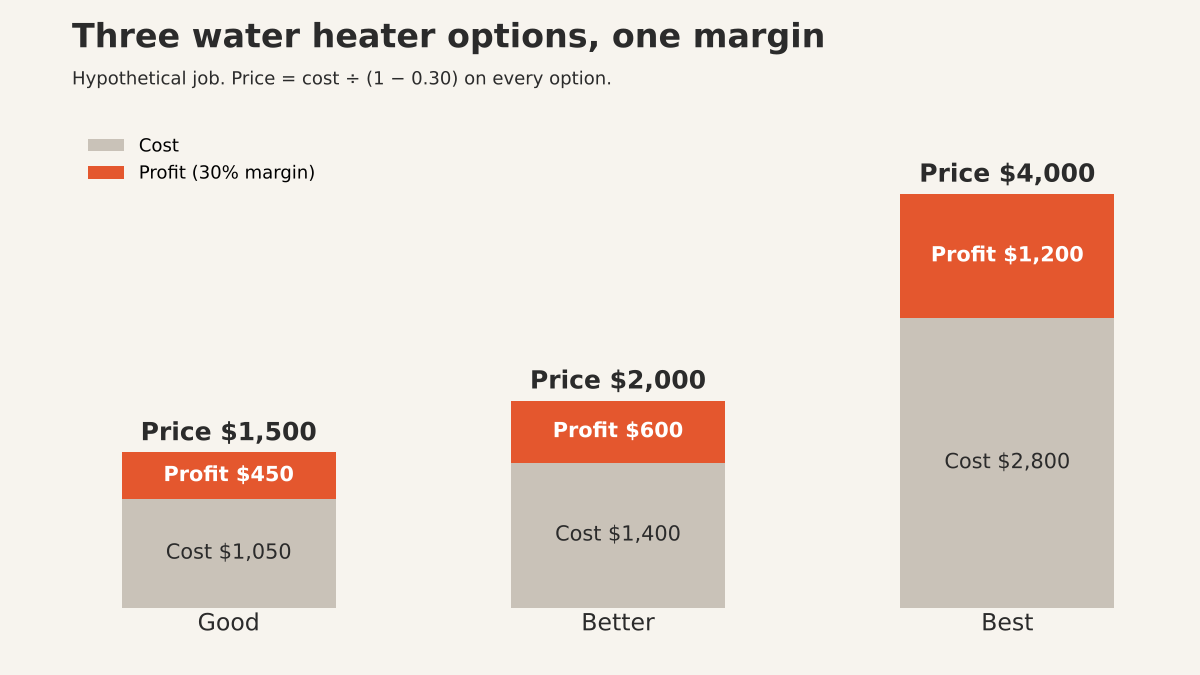
Hypothetical water heater job at a 30% margin: Good $1,500, Better $2,000, Best $4,000. Worked below.
Why it matters: one price gets you a yes or a no. Three prices give the customer who wanted the better unit a way to buy it, and the tight-budget customer a way to stay with you instead of shopping around.
Scope: US contractors and home-service pros pricing residential work. All dollar figures are hypothetical. Trade-specific notes are in how to price HVAC jobs and the plumbing flat rate pricing guide.
1. What good better best pricing is
It's a tiered pricing method, and it isn't new. Wikipedia describes it as a tiered pricing strategy, also known as Goldilocks pricing, that offers variations of a product or service at multiple price levels, typically three: basic, mid-range and premium.
Harvard Business Review covered it in 2018 under the line "Why every company should consider a tiered model." The summary of that piece names the problem it fixes: "Companies often crimp profits by using discounts to attract price-sensitive customers and by failing to give high-end customers reasons to spend more." (HBR, Rafi Mohammed, Sept./Oct. 2018 issue.)
On a job site that sounds like this: the budget customer gets a real option instead of a discount, and the customer who wanted the nicer unit doesn't have to ask for it.
2. Which jobs it works on
Tiers fit when the customer can choose the part, the material or the extras, and the job itself stays about the same:
- Plumbing: water heaters, faucets, toilets, water treatment.
- HVAC: system replacements, thermostats, filtration add-ons, maintenance visits.
- Roofing: shingle line, underlayment and warranty level.
- Painting: paint grade, prep level, how many rooms or coats.
- Landscaping: plant size, mulch versus stone, irrigation or not, maintenance packages.
- Handyman and remodeling: fixture grade, door and hardware packages.
It fits badly on diagnostic work you can't scope yet and on small fixed tasks. Nobody needs three ways to hang a TV.
3. Worked example: three water heater options
Hypothetical plumbing shop replacing a gas water heater. Labor is priced at a $40 loaded hourly cost: the O*NET 2025 median plumber wage of $30.67 an hour (O*NET 47-2152) plus about 30% for payroll costs, an assumption, rounded. Permit $75 on every option. Target margin 30% on all three.
| Line | Good | Better | Best |
|---|---|---|---|
| What it is | 40-gal tank, 6-yr warranty | 50-gal tank, 9-yr warranty, expansion tank, new shutoff | Tankless gas, venting and gas line upgrade |
| Equipment | $690 | $890 | $1,750 |
| Materials | $125 | $235 | $575 |
| Permit | $75 | $75 | $75 |
| Labor at $40/h | 4 h = $160 | 5 h = $200 | 10 h = $400 |
| Cost | $1,050 | $1,400 | $2,800 |
| Price at 30% margin | $1,500 | $2,000 | $4,000 |
| Profit | $450 | $600 | $1,200 |
The math on each: $1,050 ÷ (1 − 0.30) = $1,500. $1,400 ÷ 0.70 = $2,000. $2,800 ÷ 0.70 = $4,000. Same margin, same formula. The only things that change are what's installed and how long it takes.
4. What three options do to the money
Say 10 customers a month would hire you for a water heater. With one price, the Good option only, that's 10 × $450 = $4,500 of profit.
Now offer all three. Suppose 3 pick Good, 5 pick Better and 2 pick Best. That mix is hypothetical, not a benchmark; yours will depend on your customers and how you present it.
- Good: 3 × $450 = $1,350
- Better: 5 × $600 = $3,000
- Best: 2 × $1,200 = $2,400
Total: $6,750, which is $2,250 more than the one-price month, from the same 10 customers. No discount, no hard sell. Some of them simply wanted more than the basic unit.
5. Options beat discounts
The customer says $2,000 is more than they wanted to spend. You can knock 10% off the Better option, or point them to Good.
- 10% off Better: $1,800 price, $1,400 cost, $400 profit. You gave away a third of your profit and installed the same unit.
- Good instead: $1,500 price, $450 profit, still at a 30% margin. The customer saved $500 and you kept your margin.
That's the HBR point in one driveway: the price-sensitive customer gets a cheaper option, not a cheaper version of your margin.
6. How to build good better best options
- Start with Better. Build the option you'd recommend if it were your house. That's the anchor.
- Build Good by taking things out, not by cutting your rate. A smaller unit, a shorter warranty, fewer extras. It must be a job you'd stand behind. No decoys.
- Build Best by adding real value: better equipment, longer warranty, the upgrade that fixes the next problem.
- Price each one from its own cost with the same formula. Check the numbers in the profit margin calculator.
- Keep the scope identical except for the named differences. Same cleanup, same haul-away, same permit, on all three.
- Write the difference in plain words. "9-year warranty instead of 6" beats "premium protection package."
- Add an expiry date. Equipment prices move. Thirty days is plenty.
7. How to present three options
- Show all three on one estimate, side by side, so nobody has to ask for the other two.
- Say which one you'd pick and why. You're the expert in their basement. Recommending isn't pushing.
- Talk about the job, not the tier names. "This one lasts longer and you won't need the expansion tank next year" lands better than "this is our Gold package."
- Stop at three. Four or five options and the customer goes home to think about it. Two works fine for small jobs.
- Get the choice in writing. The signed estimate should say which option they picked, so the invoice matches. See quote vs estimate for when an option becomes a firm price.
8. Mistakes that kill good better best
- A Good option you'd hate to install. If it causes a callback, it costs more than it made.
- A lower margin on Good. Then every budget customer is a discount in disguise.
- Hidden scope differences. If Best includes haul-away and Good doesn't, say so on the estimate. Surprises turn into disputes.
- Labor that doesn't match the option. The tankless job takes 10 hours, not 5. Price the hours each option really takes.
- Forgetting the extras on all three. Permit, disposal, cleanup. Leaving one off is underbidding on whichever tier gets picked.
Common good better best pricing questions
What is good better best pricing?
It's a tiered pricing method where you offer three versions of the same job at three prices: a basic option, a recommended middle option and a premium one. The customer picks the version that fits their budget. For contractors, the tiers usually differ in equipment, materials, warranty or extras, while the core job stays the same.
Does good better best pricing work for small contractors?
Yes, on jobs where the customer can choose the part or material: water heaters, HVAC systems, roofing, paint, fixtures, landscaping packages. You don't need software or a price book to start. Build your recommended option, then make a simpler and a premium version and price each from its cost with the same margin.
Should every option have the same profit margin?
Same margin is the safe default, because then no option is a hidden discount and profit dollars rise with price. Some shops carry a slightly higher margin on the premium option for the extra risk and callbacks. Avoid going lower on the basic option, or every budget customer costs you margin.
How many options should I give on an estimate?
Three for bigger replacements and installs, two for smaller jobs. More than three and customers stall instead of choosing. Put all of them on one estimate, side by side, with the differences in plain words and your recommendation marked.
Is good better best the same as upselling?
Not quite. Upselling adds to a price the customer already accepted. Good better best shows the choices up front, before they decide, so the customer sets the size of the job. Every option should be a job you'd stand behind, including the basic one.
What to do on your next estimate
Pick your most common replacement job. Build the option you'd recommend, then a simpler and a premium version, price each with cost ÷ (1 − margin), and send all three on one estimate with your pick marked.
Wondering whether you should charge for the estimate visit itself? See do contractors charge for estimates.
Already sent one? Upload it to the estimate checker and see if it's priced too low.