How Much to Charge for Christmas Light Installation (With the Math)
Per foot, per hour or per job? Build your holiday lighting price from labor, lights, truck and overhead, with a worked 150 ft roofline example.
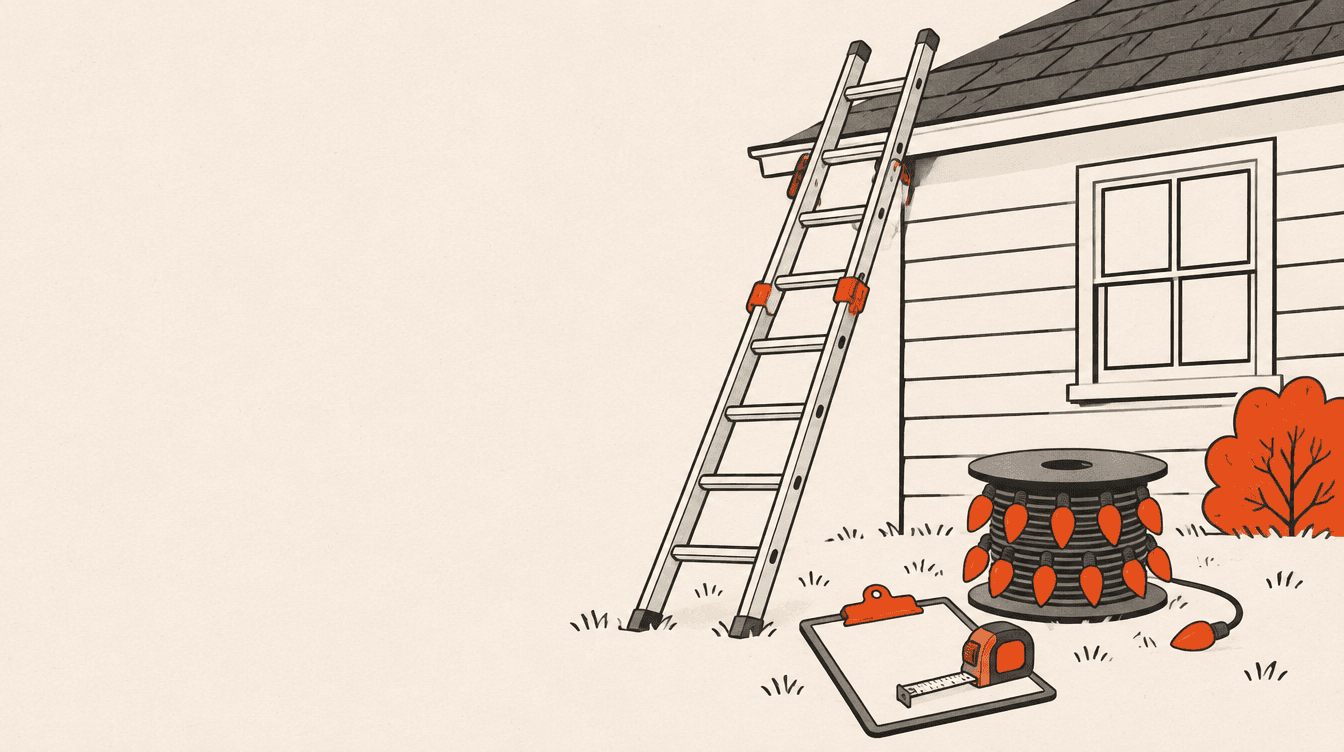
Charge for Christmas light installation from your costs, not from a number you saw on a neighbor's flyer. Add the labor to hang and take down, the lights and clips if you supply them, the truck and a slice of overhead, then divide by one minus your margin. On a hypothetical 150 ft roofline that works out to about $4.72 per foot with the customer's lights and $7.44 per foot with yours.
Price = (labor + lights and clips + truck + overhead) ÷ (1 − margin)
Hypothetical: $460 of cost to hang and remove the customer's lights, at a 35% margin, is $460 ÷ 0.65 = $707.69. Worked below.
Holiday lighting is a good add-on for landscapers, handymen, gutter and window cleaners. It fills the slow weeks and the same customers book you every year. It also puts your crew on a roof in November, so price it like the risky job it is.
Scope: US residential installs, dollar figures hypothetical. Related: landscaping services list, handyman services list, how much to charge for gutter cleaning.
1. Per foot, per hour or per job?
The usual way to quote is per linear foot of roofline, with line items for trees, bushes, wreaths and ground lights. Customers understand feet. You can measure it from the driveway.
Nextdoor's pricing guide for light installers puts it this way: "Pricing for holiday light installation services is usually determined by footage of lighting used, the difficulty of the installation process, labor, and expenses." (Nextdoor). The same 2022 guide cites a HomeGuide average of $2 to $5 per foot for installation.
Use that range to sanity-check, not to set your price. A per-foot rate is just your job cost divided by the feet. If your rate doesn't come from your own hours, you're guessing.
- Per foot: easy to quote and compare. Build a separate rate for one-story and two-story.
- Per hour: fair for custom work and trees, but customers hate open-ended bills.
- Per job: best for repeat customers once you know the house. Last year's hours are your estimate.
2. What goes into the cost
- Install labor. Every hour on site, including setup, ladder moves and testing every strand.
- Takedown labor. In the example below it takes half the install time. It's a second trip, so it gets its own line.
- Lights, clips, timers and cords if you supply them. If you own the lights and reuse them, charge a share each season for wear and replacement.
- Equipment. Ladders, a lift rental for tall trees or three-story eaves, ladder stabilizers.
- Truck and drive time. Two trips per house minimum. The drive counts.
- Storage if you keep the customer's lights between seasons.
- Overhead. Insurance, phone, marketing, your time quoting. Check with your insurer that roof work is covered before you sell this.
For labor, O*NET lists a 2025 median wage of $18.82 an hour for landscaping and groundskeeping workers (O*NET 37-3011). The example below uses a $30 loaded labor cost per hour as an assumption, to cover payroll taxes, workers' comp and unbillable time. More on that in labor burden.
3. Install only or full service?
| Offer | What the customer gets | How you price it |
|---|---|---|
| Install only | You hang and remove their lights | Labor, truck and overhead per foot, plus a charge for any strands you have to replace |
| Full service, lights sold | You supply, hang and remove; they keep the lights | Install-only price plus lights and clips at cost, inside your margin |
| Full service, lights leased | You supply, hang, remove and store; you keep the lights | Install-only price plus a yearly share of the lights and storage |
Leasing is how a lot of installers build repeat business: the lights sit in your shop, so the customer calls you next year. It also means you carry the inventory. Pick the offer that fits your storage and cash, then show the options side by side, the same idea as good better best pricing.
4. Worked example: a 150 ft roofline
Hypothetical two-story house, 150 ft of roofline, C9 LED strands on clips. Two-person crew: 4 hours to install, 2 hours to take down, so 12 labor hours at a $30 loaded cost. Target margin 35%.
| Cost line | Install only | Full service, lights sold |
|---|---|---|
| Labor: 12 h × $30 | $360 | $360 |
| Truck and fuel, two trips | $40 | $40 |
| Overhead share | $60 | $60 |
| Lights: 150 ft × $1.50 | none | $225 |
| Clips, timer, extension cords | none | $40 |
| Total cost | $460 | $725 |
| Price at 35% margin (cost ÷ 0.65) | $707.69 | $1,115.38 |
| Profit | $247.69 | $390.38 |
| Per foot (price ÷ 150) | $4.72 | $7.44 |
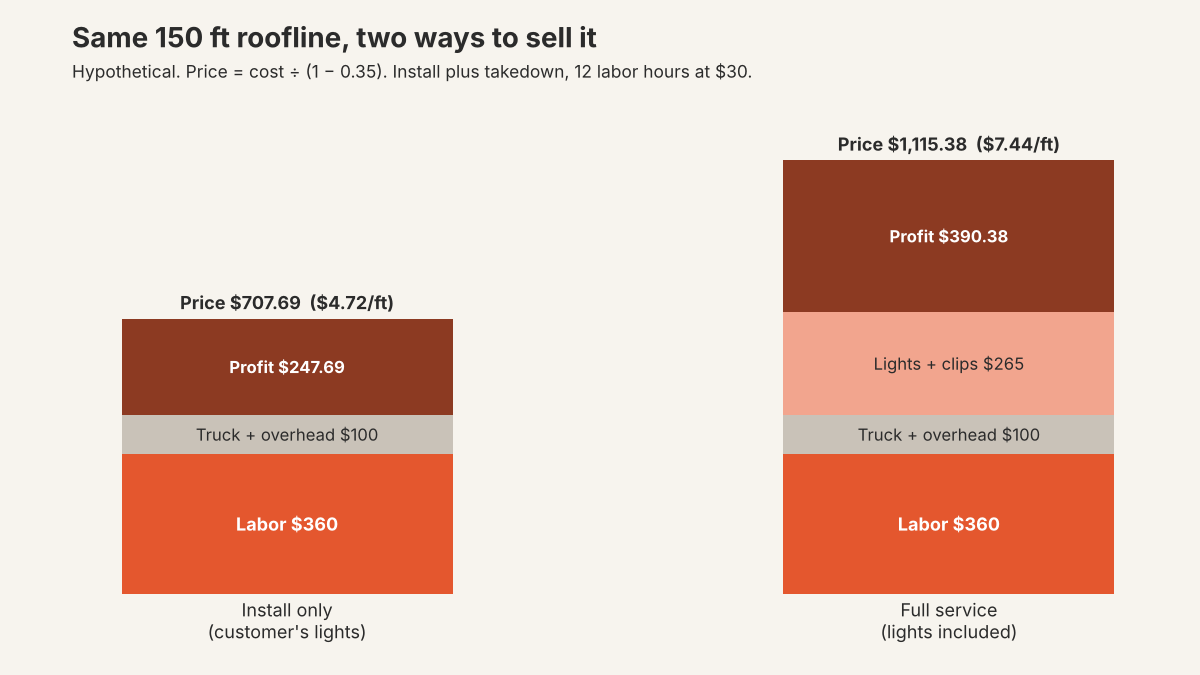
That's why per-foot prices online are all over the place. Some include lights, some don't, some include takedown. Say which one your number is. You'd quote these as $710 and $1,120 and move on.
Notice the install-only price sits near the top of the $2 to $5 range on a two-story house. A one-story ranch with the same footage might take half the ladder time. Run the numbers per house, not per brochure.
5. What makes a house cost more
- Height and pitch. Two stories, steep roofs and three-story peaks mean more ladder moves, a harness, or a lift.
- Trees. Wrapping trunks and branches eats hours. Price trees by height or by the hour, never by roofline feet.
- Bushes, wreaths, ground stakes, window frames. Each gets its own line.
- Power. Not enough outdoor outlets means long cord runs and more timers. Never promise electrical work you aren't licensed for.
- Gutters and surfaces. Clipping to shingles, gutters and brick takes different clips and different time.
- Timing. Customers who want it up the week before a party pay a rush price, or wait.
Measure on site and photograph the house. That photo saves an argument in January when someone swears the garage was included.
6. Charge for takedown, storage and service calls
Takedown is half the job and the half people forget to price. Put it on the quote with a target window, like "removal between January 2 and January 15."
Service calls happen: a strand goes dark, a squirrel eats a cord, wind pulls a run loose. Decide now whether repairs are included for the season or billed as a trip charge. One simple rule: include a set number of service visits and charge after that. Write it down.
Storing customer-owned lights? Charge for the space and the labelling, or tell them to keep the bins in their garage.
7. Early-bird discounts and repeat customers
Discounts fill your October calendar. They also come straight out of profit. On the install-only job above, 10% off drops the price to $636.92. Your costs stay at $460, so profit falls from $247.69 to $176.92. That's 29% of your profit gone for a 10% discount.
Better options: book next year's install at this year's price when they sign for takedown, or add a free extra (a wreath, a bush) instead of cutting the rate. If you do discount, price it in on purpose. The same math is in underbidding.
8. What to put on the quote
- Footage and areas: roofline, trees, bushes, wreaths, with the photo.
- Whose lights, which type and color, and who keeps them.
- Install date or window, and the takedown window.
- What's included for service calls during the season, and the charge after that.
- Deposit and payment terms. See contractor payment terms.
- Price validity and what happens with weather delays. A checklist is in estimate terms and conditions.
In WinPal you can build detailed estimates from a photo and a voice note: snap the house, say the footage and extras out loud, then check the lines before you send.
Common Christmas light pricing questions
How much should I charge per foot for Christmas light installation?
Work it out from your own costs: labor to hang and remove, truck, overhead and lights if you supply them, divided by one minus your margin, then divided by the feet. In our hypothetical, that's $4.72 per foot with the customer's lights and $7.44 with yours. Nextdoor's guide cites a HomeGuide average of $2 to $5 per foot.
Should I charge separately for taking the lights down?
Price it in every quote, either as its own line or bundled into the install price, and say which. Takedown is a second trip; in our example it's half the install hours. Leaving it out is the fastest way to work January for free.
Should I include the lights in my price?
Offer both. Install-only uses the customer's lights and costs them less. Full service with your commercial-grade lights costs more and earns more per job. If you lease the lights and store them, the customer is likely to call you again next year.
How much deposit should I take?
Enough to cover anything you buy for that house, plus your scheduling risk. One simple setup: part up front at booking, the rest after install. Check your state's rules on deposits for home improvement work before you set a percentage; contractor payment terms covers the basics.
How do I price wrapping trees?
Separately from the roofline. Estimate the hours from the height and how tight the wrap is, add the lights, and apply your margin. A tall tree that needs a lift should carry the lift rental too. Per-foot roofline rates don't fit trees.
What to do on your next estimate
Measure the roofline, list every tree, bush and wreath, and count the hours for install and takedown. Add lights if you supply them, then divide by one minus your margin. Check your loaded labor rate with the hourly rate calculator and the final number with the profit margin calculator. Landscaper adding lights for winter? See WinPal for landscaping. Planning a bigger job this winter? See how to create a construction schedule.
Already sent one? Upload it to the estimate checker and see if it's priced too low.