Construction Allowance: What It Covers and How to Bill the Overage
An allowance holds a price for things the customer hasn't picked yet. Here's how to set one, write it on the estimate and bill the difference, with a worked $1,600 bathroom example.
A construction allowance is a dollar amount you put in the estimate for an item the customer hasn't picked yet, like a vanity, tile or light fixtures. The customer picks, you buy, and the price moves up or down by the difference through a change order. Write down what the allowance covers and how you'll bill the difference, or the overage comes out of your pocket.
Allowance adjustment = actual cost of the selection − allowance amount, billed or credited by change order.
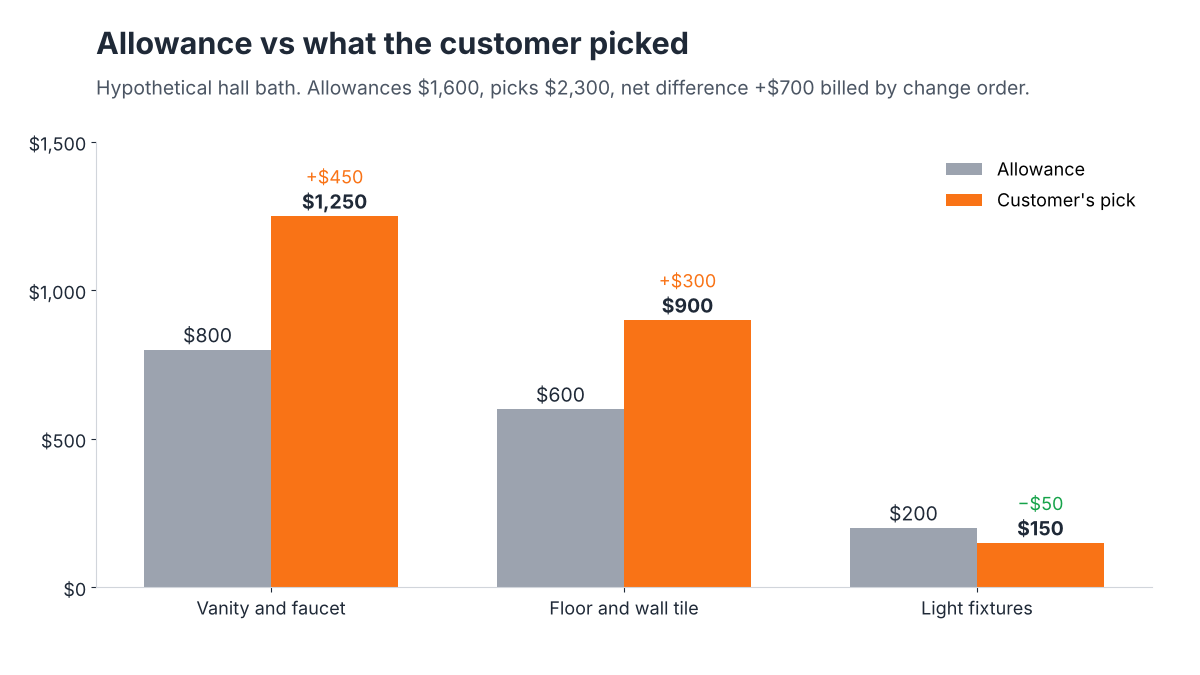
Hypothetical hall bath: $1,600 in allowances, the customer picks $2,300 worth. Bill the $700 and your profit holds at $4,000. Don't, and it drops to $3,300. Worked below.
Allowances let you sign the job before every selection is made. They also start more arguments than almost anything else on a remodel, because the customer remembers the total and forgets the word "allowance."
Scope: US residential remodeling and trade work. Dollar figures are hypothetical. Related: construction contingency, construction change orders, construction scope of work.
1. What is an allowance in construction?
AIA Contract Documents defines it as "a specific dollar amount included in the contract sum as a placeholder for items whose exact cost cannot be determined at bid time" (AIA Contract Documents). When the item is picked and bought, the actual cost replaces the placeholder.
The usual suspects: plumbing fixtures, tile and flooring, light fixtures, cabinets, countertops, appliances, hardware. Anything where the customer says "we'll pick that later."
The item is definitely going in. Only the price is unknown. That's the difference from contingency, which covers things that may never happen.
2. Allowance vs contingency vs exclusion
| Line | What it covers | Example | If it changes |
|---|---|---|---|
| Allowance | A known item with an unknown final price | Vanity and faucet: $800 | Change order for the difference, up or down |
| Contingency | Risk that may or may not happen | Rot behind the tub wall | Depends on your contract; see construction contingency |
| Exclusion | Work that isn't in your price at all | Moving the drain | New scope, new price |
Mix these up and you'll either eat a fancy vanity or bill the customer for rot you promised to cover. Name each one on the estimate.
3. Material allowance or installed allowance?
Estimating author Michael Stone splits allowances into two types: material allowance amounts and installed allowance amounts (Markup and Profit).
- Material allowance: the cost of the item only, plus tax and delivery. Your labor to install it is already in your price. Good for carpet, tile, fixtures, appliances.
- Installed allowance: material and labor together. Use it when the pick changes the install time too, like countertops or cabinets.
Under AIA's A201 general conditions, allowances "cover the cost of materials and equipment delivered to the site, including taxes, minus any trade discounts", with your handling, labor, installation, overhead and profit carried elsewhere in the contract sum. That's the commercial default. On residential work you set the rule, so write it down.
4. How to set an allowance amount
- Ask what they're thinking. Brand, style, a photo from their phone. "Something nice" isn't a number.
- Price a real product in that range at your supplier, with tax and delivery.
- Write the assumption, not just the dollars. "Tile allowance $600: 120 sq ft at $5.00 per sq ft, material only."
- Stay realistic. A low allowance makes your total look cheap and sets up a fight. Stone's rule of thumb: ask enough questions to get within about 5% of the final pick.
- Use as few as you can. Every allowance is a price you haven't locked. Push for selections before signing.
Low-balling allowances to win the bid is the same trap as underbidding, just with a delay. The customer pays the real number eventually. They just don't like hearing it in week three.
5. Worked example: a hall bath with three allowances
Hypothetical remodel. Everything you control (labor, other materials, permit, disposal) costs $12,000. At a 25% margin that's $12,000 ÷ (1 − 0.25) = $16,000. Three material allowances go in at cost, $1,600 total, so the contract is $17,600 and your profit is $4,000.
Then the customer goes shopping:
| Item | Allowance | Customer's pick | Difference |
|---|---|---|---|
| Vanity and faucet | $800 | $1,250 | +$450 |
| Floor and wall tile (120 sq ft) | $600 ($5.00/sq ft) | $900 ($7.50/sq ft) | +$300 |
| Light fixtures | $200 | $150 | −$50 |
| Total | $1,600 | $2,300 | +$700 |
Three ways it can end:
- You don't bill it (no clause, customer pushes back): contract stays $17,600, profit falls to $3,300. That's 18.8% instead of 22.7%.
- You bill the difference at cost: change order +$700, contract $18,300, profit stays $4,000.
- You bill it with a stated 20% markup: $700 × 1.20 = $840, contract $18,440, profit $4,140.
If the pick also changes your labor, that goes on the change order too. Say the $7.50 tile is a small mosaic that adds 4 hours at a $50 loaded labor cost (an assumption): $200 ÷ (1 − 0.25) = $266.67. AIA makes the same point: the change order should account for changes in handling, labor or installation, not just the material.
6. Write the overage and credit rule into the estimate
Stone's advice: if you mark up overages, put the markup percent in the contract, and credit markup on underages too. Pick one rule and print it:
- At cost: "Allowance differences are billed or credited at our cost, plus any change in labor."
- With markup: "Allowance differences are billed or credited at our cost plus 20%, plus any change in labor."
Markup isn't margin. A 20% markup on the overage earns about a 16.7% margin on it. If you want your full 25% margin on extra cost, the markup is 33.3% ($700 ÷ 0.75 = $933.33). More on the difference in contractor markup.
Also say when the difference gets billed: on the next progress payment or the final invoice. Then write the change order the day they pick, with the receipt attached. Not at the end of the job when nobody remembers the vanity.
7. How allowances show up on the estimate and the invoices
- Their own lines. "Allowance: vanity and faucet, $800, material only." Never buried in a task line. Same idea as an itemized quote.
- A selection deadline. "Selections due by [date] to hold the schedule." Late picks cost you crew days.
- On the schedule of values for bigger jobs, so each allowance can be closed out as a line. See schedule of values.
- A running tally on each invoice: allowance, actual, difference, change order number.
The fine print around allowances (validity, exclusions, change orders, payment) belongs in your estimate terms. A checklist is in estimate terms and conditions.
In WinPal you can build detailed estimates from a photo and a voice note, then add your allowance lines before you send.
Common construction allowance questions
What is an allowance in construction?
It's a set dollar amount in the estimate or contract for an item the customer hasn't selected yet, such as fixtures, tile or appliances. Once they pick and the real cost is known, the contract price goes up or down by the difference, usually through a change order that both sides sign.
Does a construction allowance include labor?
It depends on the type. A material allowance covers the item, tax and delivery, and your labor sits elsewhere in the price. An installed allowance covers material and labor together. AIA's A201 treats allowances as material and equipment cost by default. Say which one you mean on every allowance line.
What happens if the customer goes over the allowance?
They pay the difference, plus any markup and extra labor your contract states. Write a change order when they make the pick, show the allowance, the actual cost and the difference, and bill it on the next progress payment or the final invoice. Without a written rule, expect an argument.
Do you credit the customer if they come in under the allowance?
Yes, the contract price goes down by the difference. If you add markup to overages, credit markup on underages too, so the rule is fair both ways. Net the items together on one change order when several allowances close at the same time.
What's the difference between an allowance and a contingency?
An allowance is for a specific item that will definitely be bought, at a price not yet known. A contingency is a reserve for problems that may or may not show up, like hidden rot. Allowances are customer choices; contingency is risk. They get separate lines and separate rules.
What to do on your next estimate
List every item the customer hasn't picked. Price a real product for each, write the assumption on its own allowance line, and print your overage and credit rule. Then push for selections before you sign. Starting from scratch? Use the construction estimate template and check the job with the profit margin calculator.
Already sent one? Upload it to the estimate checker and see if it's priced too low.