Itemized Quote: What to Show the Customer (and What to Keep)
Itemize the scope, not your costs. What to put on each line, a worked $2,500 handyman quote, and why cutting a line beats a discount.

An itemized quote breaks the price into lines the customer can read: each task or area of the job, with its own price, plus permits, disposal and anything optional. Itemize the scope, not your costs. Every line should carry the same margin, so the customer sees what they're buying without getting a map of your markup.
Price every line the same way: line price = line cost ÷ (1 − margin).
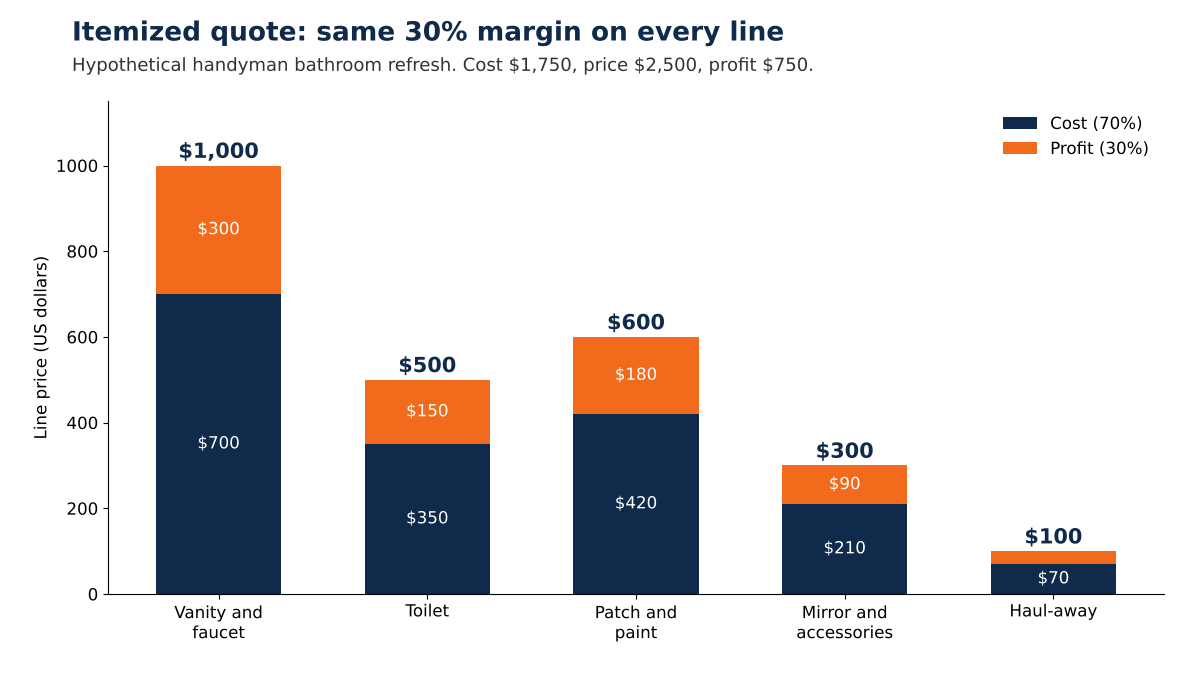
Hypothetical handyman bathroom refresh: $1,750 of cost at a 30% margin is $2,500, split into five lines. If the customer drops a line, your margin stays at 30%. Worked below.
Why it matters: more customers ask "can you break that down?" before they sign. Say no and some walk. Say yes the wrong way and you've handed them a list of things to argue about.
Scope: US residential trade and handyman jobs. Dollar figures are hypothetical. Related: quote vs estimate, how to price handyman jobs, good better best pricing.
1. What is an itemized quote?
Housecall Pro defines it as "a line-by-line breakdown of the requested service cost" (Housecall Pro). The opposite is a lump sum quote: one scope description and one number.
"Itemized estimate" and "itemized quote" get used for the same thing. The difference between a quote and an estimate (fixed price or best guess) is a separate question, covered in quote vs estimate. Either one can be itemized.
2. Should you give itemized quotes at all?
Contractors disagree, loudly. Housecall Pro argues customers want transparency and that itemized pricing is becoming a standard. Estimating author Michael Stone argues the opposite: "providing an itemization gives customers a reason to argue with your price" (Markup and Profit). He also says your overhead and profit are your business, not the customer's, and suggests charging for itemization when a customer insists.
Both are right about something. The fix is to choose what you itemize:
- Itemize the scope: tasks, rooms, areas, quantities, the product or model you're installing, permits, disposal, options.
- Don't itemize your costs: no hourly rate times hours, no material cost plus a markup line, no separate "overhead" or "profit" line.
The customer can see what's in the job and what each part costs them. They can't see what you paid for the vanity.
3. What to include in an itemized quote
| Part | What to write | Why |
|---|---|---|
| Job description | What the customer asked for, in one or two lines | Anchors the scope |
| Line items by task or area | "Remove and replace vanity, faucet and supply lines," with its price | Shows what they're paying for |
| Products and quantities | Model or spec, size, count, color if chosen | Stops "that's not what I picked" later |
| Permits and disposal | Their own lines | Easy to forget, easy to question if hidden |
| Options | Upgrades priced separately, clearly marked optional | Lets them add without renegotiating |
| Exclusions | What's not included (hidden rot, wiring behind walls) | Sets up the change order if you find it |
| Terms | Total, deposit, payment schedule, how long the price is good for | Turns a quote into a deal |
Listing every screw isn't the goal. Major tasks and major products are enough for most service and remodel work.
4. Worked example: a handyman bathroom refresh
Hypothetical job. Labor cost assumption: O*NET lists a 2025 national median of $23.84 an hour for general maintenance and repair workers (O*NET 49-9071). Add a 30% load for taxes and insurance and call it $31. Add $15 an hour for overhead (truck, tools, phone, insurance), an assumption. Cost per labor hour: $46. Target margin: 30%.
| Line | Labor | Materials and fees | Cost | Price (cost ÷ 0.70) |
|---|---|---|---|---|
| Replace vanity and faucet | 5 h × $46 = $230 | $470 | $700 | $1,000 |
| Replace toilet | 2 h × $46 = $92 | $258 | $350 | $500 |
| Patch and paint walls and ceiling | 6 h × $46 = $276 | $144 | $420 | $600 |
| Mirror, towel bars, accessories | 1.5 h × $46 = $69 | $141 | $210 | $300 |
| Haul-away and disposal | $70 | $70 | $100 | |
| Total | 14.5 h | $1,750 | $2,500 |
The customer sees the first and last columns only: five lines and a $2,500 total. Profit is $750, a 30% margin, and it's spread across every line in the same proportion.
5. When the customer cuts a line (instead of your price)
Here's where itemizing pays you back. Say the customer keeps the old toilet:
- Drop the toilet line: price $2,000, cost $1,400, profit $600. Still a 30% margin.
- Give 10% off instead: price $2,250, cost $1,750, profit $500. Margin falls to 22.2%, and a third of your profit is gone.
Same customer, similar total, very different job for you. When someone pushes on price, point at the lines: "Which one do you want to take out?" It moves the talk from your number to their scope.
Customer wants to buy the vanity themselves? Fine. Re-price that line from its labor: $230 ÷ 0.70 is about $329. Don't just subtract the vanity's retail price, or you'll install it for less than cost.
6. How to write the line items
- Name the result, not the steps. "Replace toilet, new wax ring and supply line" beats "remove toilet, set toilet, caulk."
- Group small stuff. Caulk, fasteners and patch compound live inside the line they belong to.
- Keep labor inside each line. A separate "labor: 14.5 h" line invites hourly math you don't want.
- Price options as their own lines. "Optional: exhaust fan upgrade" with its price, so yes or no is easy. More in good better best pricing.
- Write exclusions under the lines. If you open the wall and find rot, that's a change order, and the quote already said so.
- Round line prices to clean numbers. $1,000 reads better than $1,000.43, and nobody believes the cents anyway.
7. When a lump sum is still better
A single number is fine for small, simple jobs where the scope is one thing (hang a door, fix a leak). It also makes sense when a line breakdown would mostly invite haggling and the customer didn't ask for one.
A middle path: itemize by area or phase (demo, rough-in, finish) and give one price per phase. You can also offer more detail on request, as some contractors do, for a fee. Whether to charge for that time is the same call as charging for estimates; see do contractors charge for estimates.
In WinPal you can build detailed estimates from a photo and a voice note, and the app suggests upgrades you can offer your client, which drop in as their own lines.
Common itemized quote questions
What is an itemized quote?
It's a quote that splits the total price into separate lines for each task, area or product, plus permits, disposal and options. The customer sees what each part of the job costs them. It doesn't have to show your hourly rate, your material costs or your markup.
Do contractors have to give itemized estimates?
There's no single answer for every job. A contract, a customer's lender, an insurance claim or your state's contractor rules can require a breakdown, so check what applies where you work. Where nothing requires it, many contractors itemize the scope and keep their costs private.
Should an itemized quote show labor and materials separately?
Usually no. Splitting labor and materials invites the customer to price-shop your materials and do hourly math on your labor. Put labor and materials together inside each task line. Insurance claims and some commercial contracts are the exception when they ask for a labor and materials breakdown.
Is an itemized quote the same as an itemized invoice?
No. The quote comes before the job and shows the planned scope and price. The invoice comes after and shows what was done, any change orders, payments received and the balance due. Keeping the same line names on both makes the invoice easy to approve.
How detailed should an itemized estimate be?
Detailed enough that the customer could say which lines they want, not so detailed that they can reverse-engineer your costs. For most residential jobs that's three to ten lines: major tasks or areas, major products, permits, disposal and options.
What to do on your next estimate
Split the job into tasks, cost each one, divide by one minus your margin, and show the customer the lines and the total. Keep labor and markup inside the lines. When they push on price, offer to cut a line, not your margin. Starting from scratch? Try the handyman estimate template or check your numbers with the profit margin calculator.
Billing a bigger job in stages? See construction billing.
Already sent one? Upload it to the estimate checker and see if it's priced too low.